
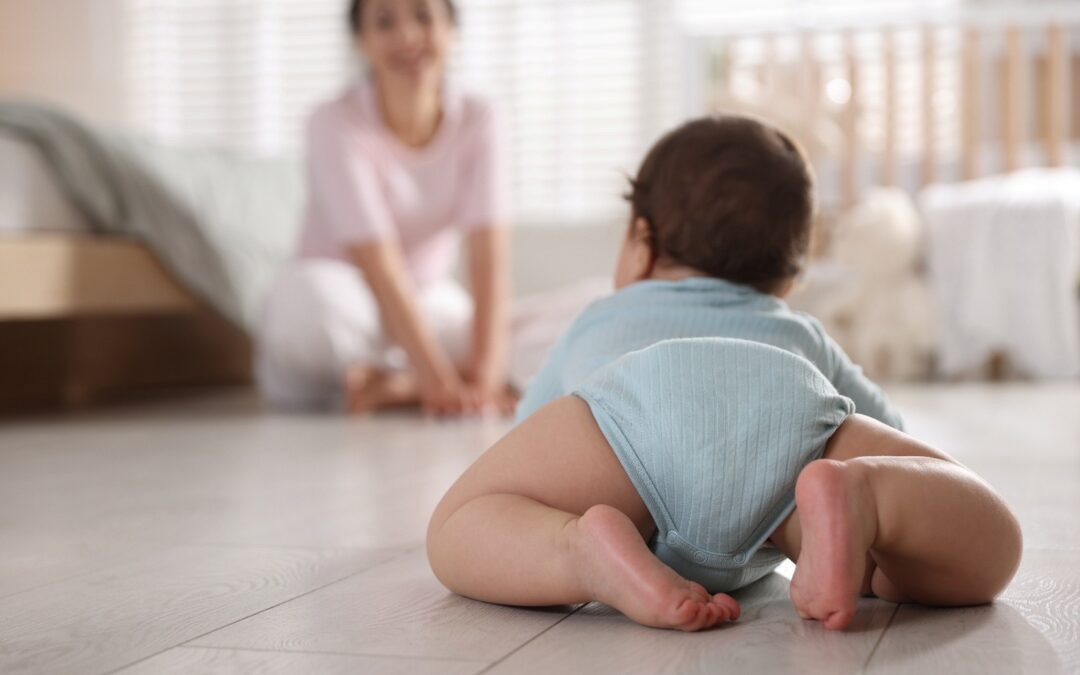
A baby in your playgroup is already crawling. Yours is the same age and seems perfectly happy sitting in one spot, reaching for whatever happens to be nearby.
At 7 months, that difference can feel bigger than it really is.
If you’re wondering when do babies start crawling, many babies master traditional crawling somewhere between 7 and 10 months. That means 7 months is near the beginning of a broad window, not a date by which every baby should already be crossing the room.
Seven Months Can Be the Beginning of Crawling
Some babies do crawl at 7 months. Plenty of others don’t.
The American Academy of Pediatrics describes the period from 4 to 7 months as a time when babies are developing skills such as grasping, rolling, sitting, and possibly even crawling. That “possibly” is worth noticing. Crawling can emerge during this stage, but it isn’t expected from every 7-month-old.
Your baby may simply be busy working on other ways of controlling their body.
What Might Your Baby Be Doing Instead?
Before crawling becomes the big attraction, other movement changes may be much easier to spot.
Your baby might be rolling in both directions, sitting more steadily, reaching for objects with one hand or transferring a toy from one hand to the other. AAP includes those among the movement skills that commonly develop during this period.
You may also notice your baby leaning farther from sitting, turning to get a better view of something, pushing up during tummy time, or trying to reposition on the floor.
None of those actions serves as a countdown to crawling. They simply show that your baby is gaining new ways to move and interact with the space around them.
The Lead-Up Can Be Easy to Miss
Crawling rarely arrives because a baby completes a neat series of required steps. The changes beforehand may look ordinary.
Your baby reaches toward a toy and nearly tips onto their belly. They turn themselves around while playing on the floor. They push with their arms and somehow end up several inches away from where they started.
Some babies rock on their hands and knees before moving forward. Others belly-crawl, scoot, or take another route altogether. AAP recognizes several crawling styles and notes that not every baby crawls traditionally.
For parents, watching how movement is changing can be more useful than waiting for a textbook crawl.
Yes, Another 7-Month-Old May Already Be Crawling
Seeing a baby the same age crawl can make comparison almost automatic.
But a child who crawls at 7 months is showing what can happen at that age, not what every 7-month-old is required to do.
Your own baby may be making noticeable progress in sitting, rolling, reaching, or another skill. Their crawl may appear later within the common range, or their first form of mobility may look different from another baby’s.
Age gives parents a useful frame of reference. It does not make babies interchangeable.
Give Your Baby Opportunities to Move
You don’t need to accelerate the crawling timeline.
Floor time gives babies a chance to use their bodies without being restricted by a seat, stroller, or other container. CDC recommends daily floor or play-mat time because it helps babies move, learn, and explore.
Keep it simple.
Place a few interesting toys nearby. Sit on the floor with your baby. Give them enough space to roll, reach, turn, or try to move toward something that catches their attention.
If the toy remains untouched because your baby decides chewing on their own sock is more interesting that day, that’s fine too.
Movement develops through repeated opportunities, not a crawling drill.
When Should You Bring Up a Concern?
Not crawling at 7 months by itself is not a reason to assume something is wrong.
Still, you know how your baby normally moves. If something about their development concerns you, you do not need to wait until a certain crawling age before talking with the pediatrician.
Bring up observations such as a loss of a skill your baby previously had, unusual stiffness or floppiness, persistent one-sided movement, or broader concerns about how your baby is moving.
AAP advises parents to discuss concerns when a child doesn’t seem to be moving normally. It also notes that alternative mobility styles are generally less concerning when babies coordinate both sides of the body and use both arms and legs.
Share what you are seeing rather than trying to decide what it means medically. Your pediatrician can consider the full picture of your baby’s development.
Watching Early Movement at Celebree School of Glen Burnie
Babies in the same classroom can be at very different points physically.
At Celebree School of Glen Burnie, the infant program includes separate classrooms for babies 6 weeks to 9 months and 9 to 18 months, along with individualized care plans that adapt as children develop. Physical-development experiences include tummy time, reaching and grasping, and teachers document milestones as they emerge.
That may mean one 7-month-old is beginning to crawl while another spends floor time rolling and reaching. Someone else may be gaining much better balance while sitting.
Teachers can share those everyday changes with families through regular communication and reports, giving parents another view of what their baby has been practicing during the day.
Give Seven Months Room to Be Seven Months
A baby who isn’t crawling at 7 months isn’t automatically late. This is an age when physical abilities can change quickly, and traditional crawling is only one of the skills that may be beginning to emerge.
Watch what your baby is doing now. Give them safe room to move, enjoy the new abilities that appear along the way, and bring questions to your pediatrician whenever something concerns you.
Families looking for daycare in Glen Burnie, MD can visit Celebree School of Glen Burnie to see how our infant classrooms support movement, exploration, and individualized care. Contact our team to find a time to tour the school and meet the educators who spend each day with our youngest learners.