
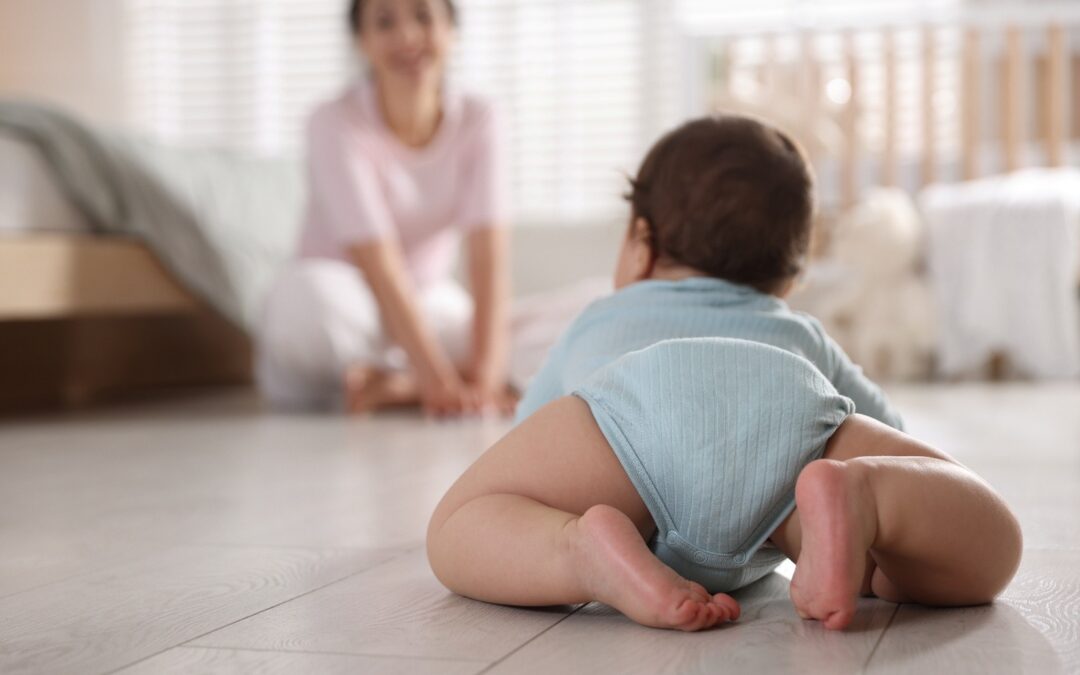
Once your baby starts becoming more mobile, you may find yourself watching closely for what happens next. Will they rock on their hands and knees first? Scoot across the floor? Start crawling all at once?
If you are wondering when babies start crawling, many babies begin traditional hands-and-knees crawling around 7 to 10 months. The path to getting there can look quite different from one baby to another, though. Some crawl earlier or later, while others rely on scooting, rolling, or another way of moving.
That makes the idea of fixed “crawling stages” a little more complicated than it may sound.
Are There Really Seven Stages of Crawling?
You may come across articles describing seven stages of crawling, but there is no single seven-step sequence that every baby needs to complete.
Babies develop movement skills in different ways. One may spend weeks rocking on hands and knees before moving forward. Another may belly-crawl first. A third may figure out how to scoot across the floor and show little interest in a traditional crawl.
Rather than looking for seven boxes to check, it is more useful to notice how your baby is gaining control over their body and finding new ways to explore.
Think Progression, Not a Checklist
There are several changes you might notice as your baby becomes more mobile. They may begin sitting more steadily, reaching farther without losing balance, shifting their weight, or figuring out how to move between positions.
You may also see them:
- Pivot around while lying on their belly
- Push up more strongly through their arms
- Rock on their hands and knees
- Scoot or pull themselves toward something interesting
- Move farther without your help
- Become quicker and more coordinated once they find a method that works
These movements can be part of the journey toward crawling, but none is a required “stage.” Your baby’s development may include some of them, all of them, or a completely different combination.
Your Baby May Take a Different Route
Traditional crawling is only one way babies become independently mobile.
Some babies move on their bellies using their arms to pull forward. Others scoot while sitting, crawl backward before going forward, or roll and pivot to reach what they want.
A small number of babies never spend much time crawling on hands and knees at all.
The way your baby gets around may change, too. A belly crawl that works perfectly for a few weeks may eventually give way to hands-and-knees crawling. Or your baby may become more interested in pulling up and standing.
Crawling Can Overlap With Other Skills
Early movement does not always develop in neatly separated phases.
While your baby is learning to crawl, they may also be becoming more confident sitting, moving into new positions, or trying to pull themselves upright.
That can make development feel surprisingly fast. You may spend several weeks waiting for crawling to begin, only to see a few new abilities appear close together.
This overlap is another reason a rigid crawling-stage chart can be misleading. Your baby’s skills may be developing side by side rather than one at a time.
How Can You Tell Your Baby Is Making Progress?
Instead of focusing on whether your baby has reached a specific crawling stage, pay attention to changes over time.
Are they gaining better control while sitting or reaching? Trying new ways to change position? Using movement to get closer to you or a favorite object? Becoming stronger or more coordinated?
Those observations give you a broader view of physical development.
You can support that exploration by giving your baby supervised floor time and safe space to move. There is no need to guide them through a prescribed crawling sequence. Give them opportunities to practice using their body and see what they figure out.
When Should You Ask Your Pediatrician?
Crawling develops across a broad range, so one particular crawling style or timeline does not tell the whole story.
Still, you know your baby well. If something about their movement or development concerns you, talk with their pediatrician rather than waiting for a particular crawling deadline.
It is also important to mention if your baby loses a skill they previously had or if you consistently notice one side of their body being used differently from the other.
Your pediatrician can look at your child’s overall development and help you decide whether anything needs closer attention.
What Teachers May Notice at Daycare
Babies spend much of their day experimenting with movement, often in small ways that are easy to overlook.
At Celebree School of Spring Ridge, infant teachers observe physical development as children play and explore. They may notice a baby becoming steadier in a new position, finding a new way to move across the floor, or trying something they have not seen before.
Sharing those observations with families can help you see how your baby’s development is unfolding throughout the day.
Teachers are there to observe, provide safe opportunities for movement, and keep you informed. When questions about development need a closer look, your pediatrician remains the right resource.
Let Your Baby Find Their Own Path
There is no universal seven-stage route from staying put to crawling across the room.
Your baby may rock, scoot, roll, belly-crawl, move on hands and knees, or surprise you with another approach entirely. What matters is the larger pattern of growth and the new things they are learning to do with their body.
If you are looking for daycare in Frederick, MD, Celebree School of Spring Ridge provides infants with safe opportunities to move, explore, and develop at their own pace. Schedule a Visit to meet our team and learn more about infant care at Celebree.