
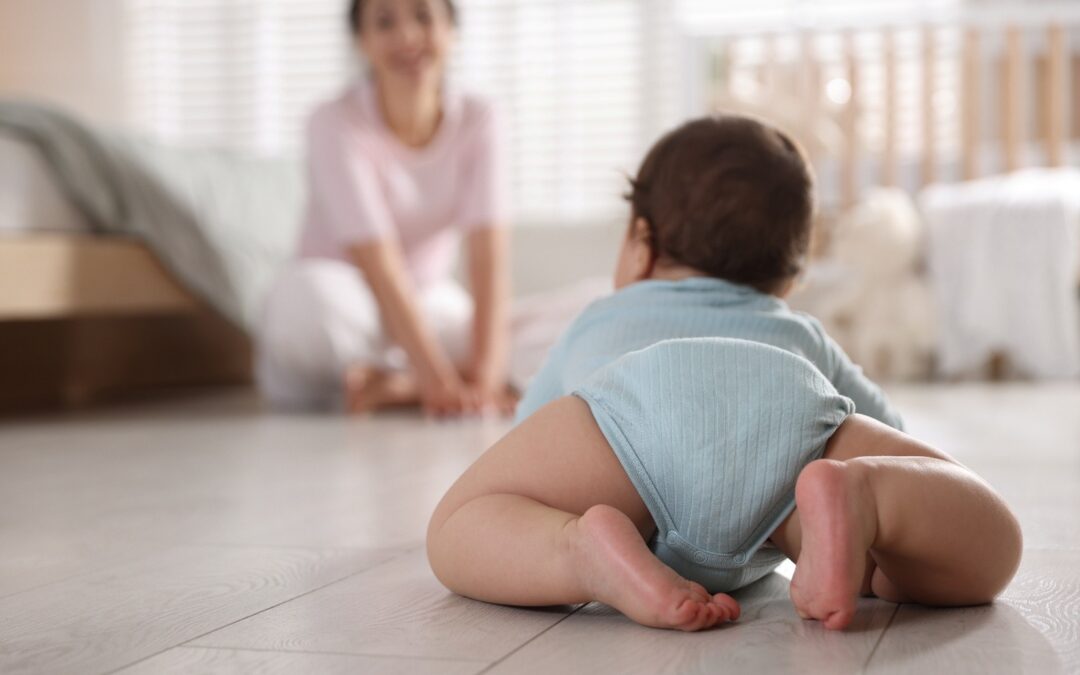
At 10 months, babies can surprise you with how quickly their movement changes. Your child may be sitting more confidently, reaching farther, pulling toward something interesting, or finding clever ways to get around the floor.
If crawling has not started yet, you may be wondering when do babies start crawling and whether 10 months is getting late. Many babies begin crawling somewhere around 7 to 10 months, but there is still plenty of variation in both timing and movement style.
Is 10 Months Too Late to Start Crawling?
Not necessarily.
Some babies are already fast crawlers by 10 months. Others are still working out how they want to move. Your baby may spend more time sitting, rolling, scooting, moving on their belly, or experimenting with standing before traditional crawling appears.
A common age range can be helpful for context, but it is not a deadline.
Look at More Than Crawling
When one skill has not appeared yet, it is easy to focus on that skill alone.
Try widening the view. You may notice that your baby can reach much farther than before, move between positions more easily, shift their weight with better control, or find a new way to reach a favorite toy.
Those everyday changes can tell you a lot about how your child’s movement is developing.
What Might Your Baby Be Doing Instead?
Babies do not all travel across the floor in the same way.
At 10 months, your baby might:
- scoot while sitting
- roll toward something they want
- move forward on their belly
- pivot or turn to change direction
- pull up with support
- combine several movement styles
Some babies eventually move onto hands and knees. Others may use another method for a while or spend relatively little time crawling in the traditional way.
Give Your Baby Room to Figure It Out
You do not need to turn crawling into something your baby has to practice on command.
Supervised floor time gives them space to experiment naturally. Try placing an interesting toy nearby and allowing your baby to decide how to reach it.
They may crawl. They may scoot. They may stretch as far as possible and then decide something else is more interesting. The goal is simply to give your baby safe opportunities to move, explore, and try new positions.
When Should You Talk With Your Pediatrician?
Ten months is a reasonable time to bring up movement questions if something is concerning you.
Talk with your child’s pediatrician if your baby loses a skill they previously had, consistently uses one side of the body differently, seems unusually stiff or floppy, or you have concerns about their overall movement or development.
You do not need to decide for yourself whether something is significant before asking. Your pediatrician can consider what you are noticing as part of the bigger developmental picture.
Small Changes Matter at Day Care
Progress is not always a dramatic first crawl across the room. Sometimes it is reaching a little farther, getting into a new position, or figuring out how to move closer to something interesting.
At Celebree School of Franklin-Cool Springs, infants have opportunities for age-appropriate physical development, gross and fine motor experiences, and everyday exploration. Teachers can also share the new movements and changes they notice with families.
For a 10-month-old who is not crawling yet, those small changes still matter. Each new reach, turn, scoot, or shift can be part of learning how their body works.
If you are looking for day care in Franklin, TN, Celebree School of Franklin-Cool Springs provides responsive infant care where babies have space to move, explore, and grow at their own pace.