
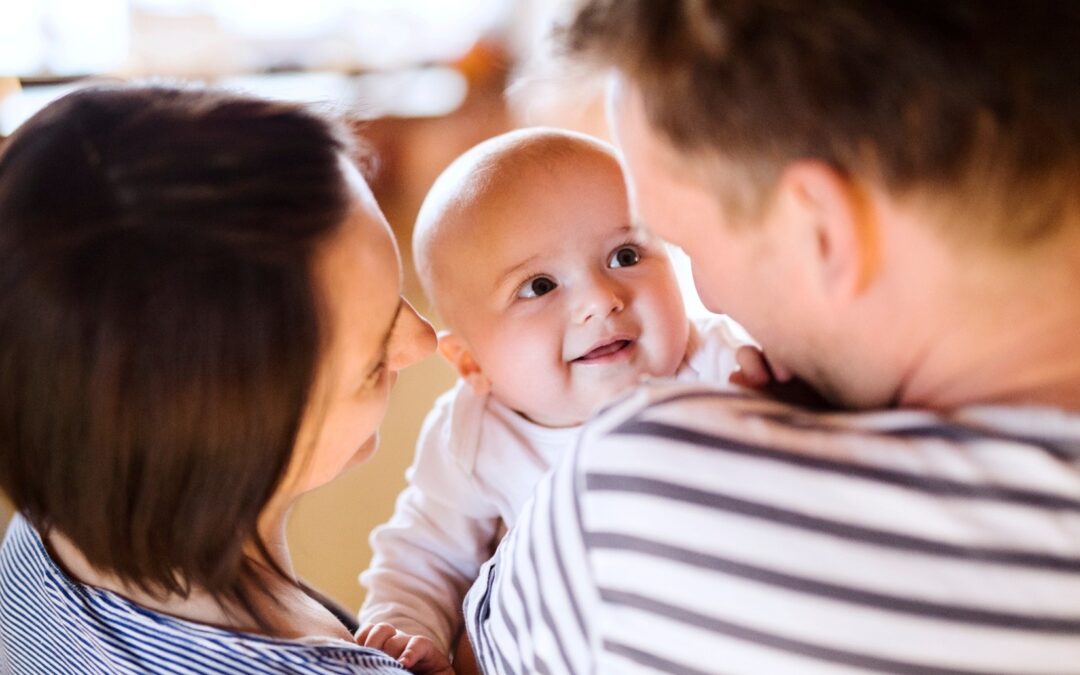
A soft toy may sit beside your baby for months, but the way they interact with it will change dramatically. At first, they may simply look at it. Later, they may swipe toward it, grab it, bring it to their mouth, shake it, pass it between their hands, or drop it just to see what happens.
Play offers an interesting window into baby milestones because it changes as movement, coordination, communication, and curiosity develop. What looks like simple fun is often your baby experimenting with a new ability.
Watching and Listening Count as Play
During the earliest months, play may not look very active.
Newborns spend much of their time sleeping, feeding, and adjusting to the world around them. During alert periods, however, they begin paying attention to faces, voices, light, movement, and sounds.
By about 2 months, many babies smile in response to another person, make sounds besides crying, watch people move, and briefly hold their head up during tummy time.
A face moving closer, a song, or a gently moving toy may hold your baby’s attention for a few moments. Those quiet interactions matter even before your baby is ready to reach out and grab something.
Reaching Changes the Game
As control of the head, arms, and hands improves, play becomes more active.
A baby who once watched a toy may begin swiping toward it. With time, those early attempts become more accurate. Your baby may reach, grasp, bring objects closer, or explore them with their mouth.
Rolling and stronger body control also change what is possible. A baby who can shift position or sit with support has a different view of the room and more freedom to interact with nearby objects.
When Do Babies Start Playing With Toys?
There is not one exact age when babies suddenly begin “playing.”
Early play may involve watching, listening, or touching. More active interaction with toys often becomes noticeable during the early-to-middle months as reaching and grasping improve.
By around 4 to 6 months, many babies are more interested in holding, mouthing, shaking, or exploring objects within reach.
The toy itself is only part of the experience. Your baby is also practicing how to coordinate vision, movement, and attention.
Repetition Becomes Part of the Fun
Later in the first year, babies often repeat the same action over and over.
Shake the toy. Bang it. Drop it. Pick it up. Do it again.
To an adult, the repetition may seem simple. To a baby, each round offers another chance to notice what happens.
By around 6 to 9 months, you may see your baby transfer an object from one hand to the other, bang objects together, sit more steadily while playing, or deliberately drop something and look toward where it went.
Babbling may become more repetitive too, adding sounds to the experimentation happening during play.
Play Starts Including a Little Detective Work
As babies become more curious, they often start searching for things that are no longer fully visible.
A toy that slips behind a cushion may suddenly be worth looking for. If you partly cover an object with a cloth, your baby may reach toward it or try to uncover it.
What Is Object Permanence?
Object permanence is the growing understanding that something still exists even when it cannot currently be seen.
This understanding develops gradually during infancy. You may notice signs of it when your baby searches for a dropped toy, looks toward where something disappeared, or becomes more interested in simple hiding games.
That growing awareness adds a new layer to play. Your baby is no longer responding only to what is directly in front of them.
Other People Become Part of the Play
Play also becomes increasingly social.
A baby may copy a simple action, laugh during a familiar routine, take turns making sounds, or begin participating in games such as peekaboo.
Later, gestures such as waving and clapping may join the mix.
These moments draw on more than one type of development. Clapping takes coordination. Peekaboo involves attention and memory. Turn-taking with sounds combines communication and social interaction.
Play starts to feel less like something happening around your baby and more like something they are actively joining.
Near the First Birthday, Play Has More Purpose
By about 10 to 12 months, many babies interact with objects in more deliberate ways.
Instead of simply holding a cup, your baby may put something into it. Instead of watching a toy fall, they may drop it repeatedly and look for it. They may move toward a favorite object, pull up near it, or cruise along furniture to get closer.
Around the first birthday, babies may also:
- Wave goodbye
- Play simple interactive games
- Understand “no”
- Look for hidden objects
- Put objects into containers
- Pull to stand
- Cruise while holding furniture
- Pick up small objects with increasing precision
Independent walking is not required by the first birthday. Some babies walk earlier, while others continue crawling, cruising, or using another way to move.
You Do Not Need Special Toys to Support Development
Babies do not need complicated toys for meaningful play.
A board book offers pages to touch and pictures to study. A stacking cup may be held, banged, dropped, or filled. A soft ball invites reaching and movement. Even a safe household object may become fascinating when your baby is learning what it feels like, sounds like, or does when moved.
Follow your baby’s interest rather than trying to turn play into a lesson.
A younger infant may be perfectly content watching and listening. An older baby may want to touch everything within reach. Both are using play in ways that fit where they are developmentally.
Play in Daycare Looks Different at Every Age
The same variation applies when babies spend part of their week in daycare.
At Celebree School of Fort Mill-Patricia Lane, infant care includes familiar routines along with opportunities for movement, interaction, and exploration. In daycare in Fort Mill, SC, play naturally changes as babies gain new abilities.
For one infant, that may mean watching a caregiver sing or reaching toward a nearby toy. Another baby may sit independently, pass objects between their hands, move toward something interesting, or take part in a simple back-and-forth game.
There is no need to hurry from one kind of play to the next. Each stage gives babies a different way to explore what their bodies, voices, and surroundings can do.
When to Ask About Development
Babies develop on different timelines, but questions are worth discussing with your child’s pediatrician.
Reach out if your baby is not meeting expected milestones, loses a skill they previously had, or if you have concerns about how they move, play, communicate, interact, or develop overall.
From quietly watching a face to deliberately searching for a hidden toy, play changes right along with your baby during the first year.