
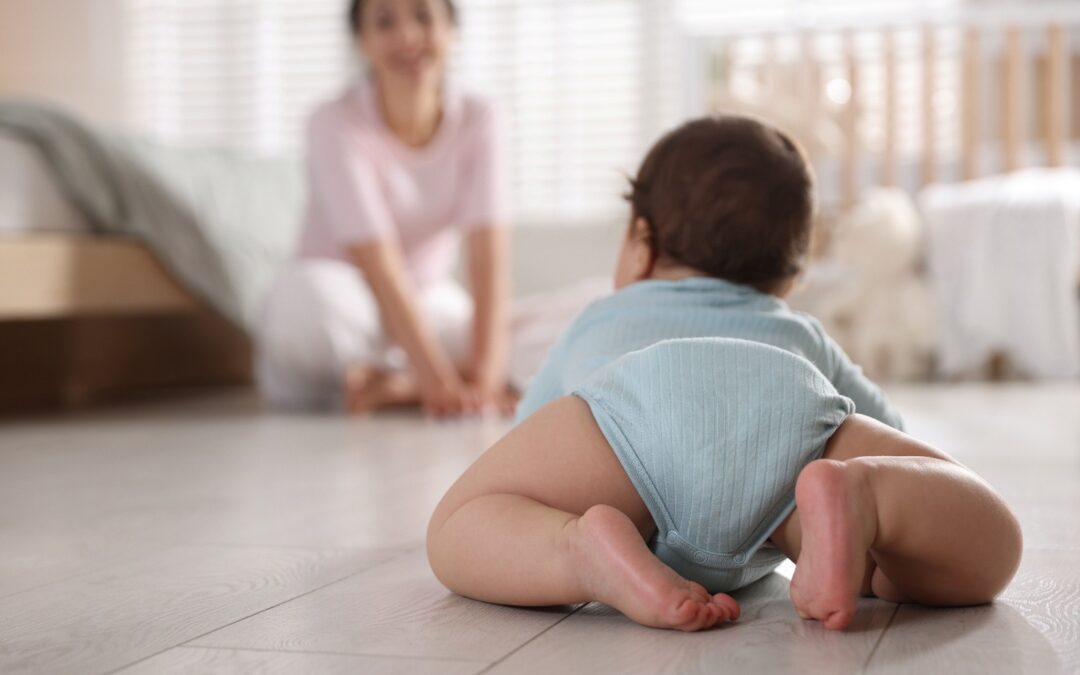
When a baby looks close to crawling, the instinct to help can be strong. You may want to tuck a knee underneath them, straighten a leg, or move a favorite toy just a little farther away.
If you are wondering when do babies start crawling, many babies begin traditional hands-and-knees crawling around 7 to 10 months. Some start earlier or later, and others scoot, belly-crawl, roll, or find another way to move.
Parents can support this stage without directing every attempt. Often, the most useful help is creating a safe opportunity and then giving your baby some room to figure things out.
Start With Room to Move
Babies need time outside of seats, swings, and other contained spaces where they can use their bodies freely.
A safe floor area gives your baby room to reach, roll, turn, shift positions, scoot, or begin crawling. You do not need elaborate equipment or a special course set up in the living room.
A few interesting objects nearby can be enough.
As your baby becomes more capable, that same stretch of floor may go from being a place to sit and play to a space they can travel across on their own.
Give Them a Reason to Try
Babies often have their own motivation for moving.
A favorite toy might catch their attention. They may want to reach you, follow a familiar voice, or investigate an object that suddenly looks much more interesting from across the mat.
Place something appealing within a reasonable distance and see what happens.
Your baby may crawl toward it. They may roll, scoot, pivot, or stretch as far as possible before deciding the effort is not worth it.
That is fine, too.
There is no need to repeatedly move the object farther away or turn playtime into a test.
Know When to Let Them Work It Out
Early movement rarely looks efficient.
Your baby might push backward when they meant to go forward, get halfway to a toy and sit back down, or end up facing the opposite direction.
It can be tempting to fix their position every time.
But those attempts give babies a chance to experience what happens when they shift their weight, push against the floor, or move one part of their body differently.
If the space is safe and your baby is still engaged, give them a little time before stepping in.
The solution they discover may not be the one you expected.
When Does a Baby Actually Need Your Help?
There is a difference between allowing some trial and error and leaving a baby in a situation where they need assistance.
Step in if your baby has moved into an unsafe position, is clearly finished with the activity, or becomes genuinely distressed.
You can also help by changing the environment rather than moving your baby’s body for them. Bring the toy closer. Clear more floor space. Sit nearby so they can move toward you.
That keeps the opportunity available without taking over the movement itself.
The Crawl Does Not Have to Look Perfect
Even after mobility begins, your baby’s technique may not resemble the familiar hands-and-knees crawl.
Some babies move on their bellies. Others scoot while sitting, roll toward their destination, or combine different movements.
Your baby may also switch methods as their abilities change.
There is usually no reason to repeatedly reposition their arms or legs simply to make the crawl look more traditional. Pay more attention to how they are using their body and becoming increasingly able to move and explore.
More Practice Does Not Create a Deadline
It is easy to think that if a little floor time is good, more practice must make crawling happen sooner. Infant development is not that predictable.
Providing safe opportunities to move can support physical development, but it cannot determine the date your baby will crawl. Some babies practice similar movements for weeks before becoming reliably mobile. Others seem to figure things out very quickly.
A few babies never spend much time using a traditional crawl at all. That is why the goal should be opportunity rather than acceleration.
Bring Concerns to Your Pediatrician
Giving babies time to figure out movement does not mean parents should ignore something that concerns them.
If you notice a loss of a skill your baby previously had, a persistent difference in how they use the two sides of their body, or another movement pattern that worries you, talk with your pediatrician.
You also do not need to wait for a specific crawling deadline before asking a question.
Describe what you have been seeing. Your child’s doctor can consider that information alongside the larger picture of development and let you know whether anything deserves closer attention.
Making Room for Movement at Celebree School of Fort Mill-Patricia Lane
At Celebree School of Fort Mill-Patricia Lane, infant teachers provide age-appropriate opportunities for babies to move and explore throughout the day.
That may look different for every child.
One baby may spend floor time reaching and rolling. Another may be scooting toward a toy, while a newly mobile child is beginning to cross the play area.
Teachers can observe what each baby is trying, make room for safe exploration, and share those changes with families. The purpose is not to rush a child toward crawling. It is to respond to the developmental stage they are in today.
Help by Making Exploration Possible
Supporting a baby who is learning to move does not require becoming their crawling coach.
Give them safe floor space, something interesting to explore, and enough time to try things their own way. Step in when they need you, but do not feel responsible for solving every awkward attempt.
If you are looking for daycare in Fort Mill, SC, Celebree School of Fort Mill-Patricia Lane offers individualized infant care with plenty of opportunities for movement and exploration. Want to see what the infant program looks like in person? Contact our team to arrange a tour.