
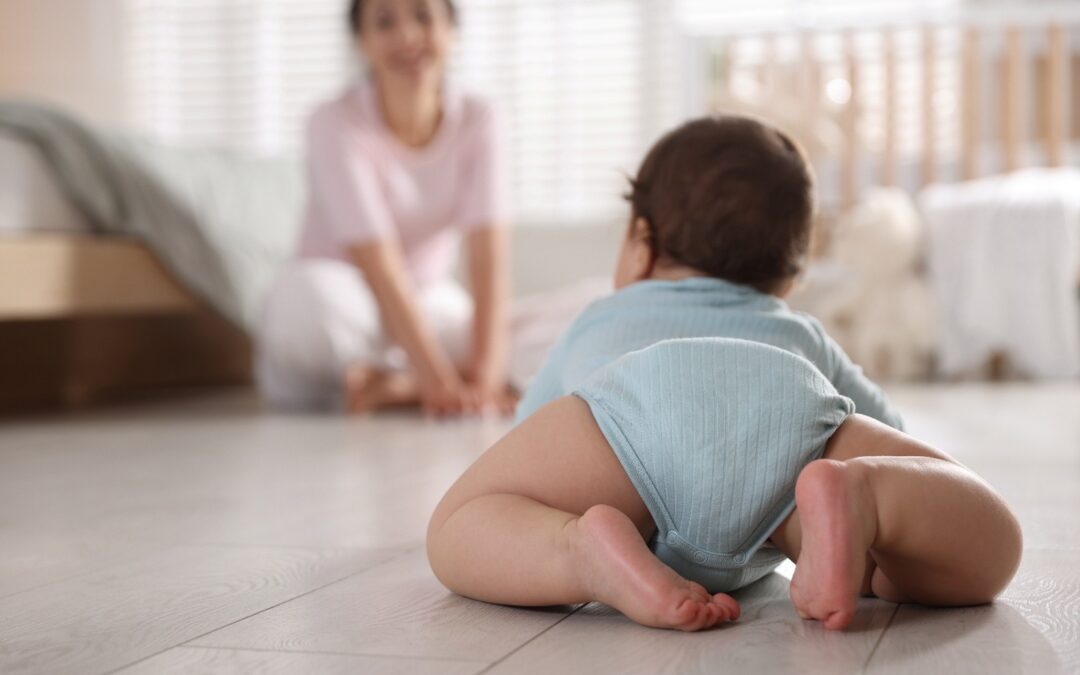
Your baby is on their tummy, kicking both legs and pushing against the floor with surprising determination. They may even manage to shift a few inches before getting stuck. It certainly looks like they are trying to go somewhere.
So, are they already trying to crawl at 4 or 5 months?
Maybe. Babies this age can begin experimenting with movements that will later contribute to crawling, even though a coordinated crawl may still be months away. The American Academy of Pediatrics notes that around 5 months, babies may rock on their stomachs, kick their legs, and make swimming motions with their arms as they build skills needed for rolling and crawling.
What Does “Trying to Crawl” Look Like?
Early attempts at movement don’t always resemble the crawling you picture.
Your baby might push their chest high off the floor and kick behind them. They may reach toward something interesting, wiggle their whole body, or seem to push without actually moving forward.
Sometimes all that effort sends them sideways or backward instead.
At this stage, babies are gaining more control of their head, neck, trunk, arms, and legs. AAP describes the 4-to-7-month period as an important time for pushing up, rolling, balancing, reaching, and preparing for later skills such as sitting and crawling.
Those movements don’t need to happen in a particular order. Your baby may spend weeks practicing one of them before something new appears.
Can a Baby Really Crawl at 5 Months?
It is possible, but 5 months is at the early end of the range for a traditional hands-and-knees crawl.
The World Health Organization’s Motor Development Study found a broad window for hands-and-knees crawling among healthy children, ranging from approximately 5.2 to 13.5 months. The midpoint was about 8.3 months.
So, a baby crawling at 5 months can fall within the observed range, but it shouldn’t become a new expectation for every baby that age.
AAP guidance also describes traditional crawling as a skill usually mastered between about 7 and 10 months. Your 5-month-old may be genuinely beginning to crawl, or they may simply be becoming much more active on the floor.
What About Crawling at 4 Months?
At 4 months, crawling-like movements are more likely to be part of the lead-up to mobility.
Your baby may push through their arms, lift their chest, kick vigorously, or try to reach something just beyond their grasp. Those attempts can look surprisingly close to crawling from a parent’s point of view.
But there is plenty happening before babies need to travel across the room.
Current CDC 6-month movement milestones include rolling from tummy to back, pushing up with straight arms while on the tummy, and leaning on the hands for support while sitting. Crawling is not listed as a 6-month milestone.
That gives parents useful perspective when a 4-month-old seems eager to get moving.
There Are Other Skills Worth Watching
Once you start wondering when your baby will crawl, every tummy-time session can feel like a preview of the milestone. Try widening your view.
You may notice that your baby can hold their head steadier than they did a month ago. They might reach more accurately for toys, roll more easily, or push their upper body farther off the floor.
Perhaps they are beginning to balance while sitting with support.
These aren’t boxes your baby needs to check before crawling. They are simply examples of the many physical skills developing during the same period.
Sometimes the most noticeable change isn’t that your baby traveled farther. It’s that they have more control over what their body does.
Give Early Movement Time to Develop
A baby who looks determined to crawl doesn’t need a training program.
Supervised floor time gives your baby opportunities to push, reach, roll, kick, and experiment with movement while awake. You can place an interesting toy nearby, get down on the floor with them, or simply give them room to see what they figure out.
There is no need to repeatedly arrange their arms and legs into a crawling position.
Your baby may work very hard and still stay in exactly the same spot. That effort is part of discovering how movement works.
Crawling Early Isn’t a Competition
It can be exciting when a baby reaches a milestone earlier than expected, especially when friends and relatives are eager to compare notes.
But an early crawl isn’t a scorecard.
The wide window observed in WHO research is a reminder that healthy babies can reach the same gross-motor milestone at very different ages.
If another 5-month-old is moving across the floor while yours is still perfecting the roll from belly to back, that comparison doesn’t tell you where either child will be developmentally a year from now.
What matters more is continuing to notice your own baby’s progress.
Know When to Ask About a Movement Concern
Most crawling questions at 4 or 5 months are simply questions about a rapidly changing baby.
Still, parents should bring concerns to their pediatrician if a baby loses a skill they previously had, seems to consistently use one side differently from the other, appears unusually stiff or floppy, or something about their movement continues to worry them.
CDC encourages parents to act early if a child loses skills, isn’t meeting milestones, or a parent has another developmental concern.
You don’t need to decide whether something is significant before mentioning it. Describe what you’ve noticed and let your child’s doctor help put it into context.
Watching Early Movement at Celebree School of Eldersburg
The infant program at Celebree School of Eldersburg includes individualized care plans that address physical development, gross- and fine-motor activities, and the recognition and documentation of infant milestones. The school also separates infant classrooms into 6-weeks-to-9-month and 9-to-18-month groups to respond to changing developmental needs.
That means an infant teacher may notice that a baby is suddenly pushing much higher during floor play, rolling more purposefully, or kicking and shifting their body when a toy catches their attention.
Daily morning and evening check-ins help families and teachers share those everyday changes.
Teachers aren’t there to predict when a baby will crawl. They can provide age-appropriate opportunities to move, observe what each child is practicing, and keep families connected to the progress happening during the day.
Enjoy the Attempts Before They Become Crawling
At 4 or 5 months, your baby’s determination can be just as interesting as the distance they cover.
Today’s enthusiastic kicks and pushes may eventually become rolling, sitting, crawling, or another way of getting around. There is no need to turn those early attempts into a race toward the next milestone.
Families exploring daycare in Sykesville, MD, can visit Celebree School of Eldersburg to see how infant teachers support physical development while following each baby’s individual pace. Explore day care at Celebree School of Eldersburg
Contact the school to arrange a visit and see the infant program in person.