
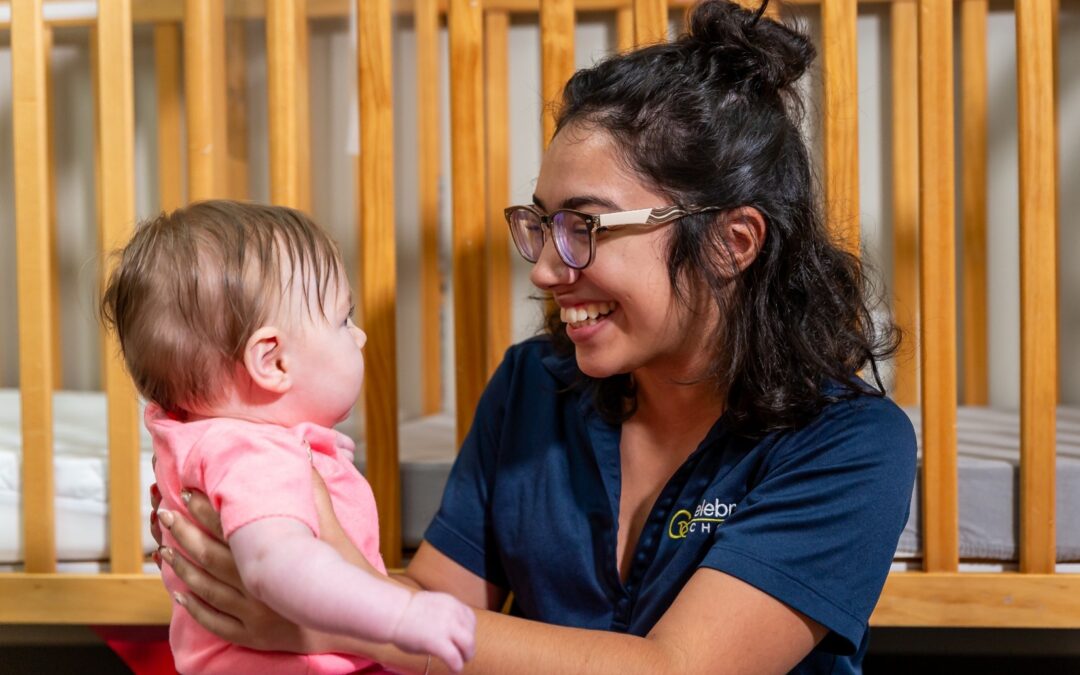
An infant classroom works differently from a classroom for older children.
Babies are still settling into feeding and sleep patterns, learning how to communicate their needs, and spending much of the day in close care with teachers. Their routines also change quickly, which makes a one-size-fits-all schedule impractical.
At Celebree School of East Cobb, infant care begins as early as 6 weeks. Feeding, rest, diapering, comfort, interaction, and early learning all have a place in the day, but the timing will vary from child to child.
Babies Do Not Follow One Classroom Schedule
In a preschool classroom, children may eat, rest, and participate in activities at similar times. Infant care is more individual.
One baby might be ready for a bottle while another is sleeping and a third is awake and taking in the room.
Celebree School of East Cobb uses morning check-ins to learn when a baby last ate, slept, and was changed. Teachers can use those details alongside the child’s usual routine to understand what they may need after arrival.
There is structure to the day, but feeding, sleep, and comfort do not happen on the same clock for every infant.
Close Care Takes Up More of the Day
Much of infant care is hands-on.
At Celebree School of East Cobb, babies are held during feedings and rocked to sleep. Diaper changes, settling, feeding, and comfort also take time, especially during the earliest months.
These routines naturally create one-on-one interaction.
A caregiver might talk during a feeding, respond to sounds and expressions, or offer reassurance while helping a baby settle.
For infants, those ordinary care moments are part of the classroom experience.
A Primary Caregiver Adds Familiarity
Each infant at Celebree School of East Cobb is assigned a primary caregiver, and families work with the school to develop an individual care plan.
That gives the classroom team important information about feeding, sleep, comfort, and other routines from home.
As the primary caregiver spends time with the child, they can also become familiar with smaller details: how tiredness tends to show up, what usually helps with settling, or which kinds of interaction hold the baby’s attention.
Those observations become useful as routines begin to shift.
What Does Learning Look Like in an Infant Classroom?
Infant learning looks very different from what parents may picture for preschool.
Celebree School of East Cobb includes personal and social development, language, physical development, gross and fine motor experiences, developmental observation, and simple sign language within infant care plans.
In practice, learning might happen while a baby listens to a caregiver talk, moves on the floor, handles a safe object, looks at a book, or responds to music and simple signs.
Teachers can watch how the child engages and use those observations when deciding what experiences to offer next.
Awake Time Can Have Different Paces
Some awake periods are active. Others are quieter.
A baby might spend one stretch of time reaching, moving, or interacting and another simply watching the room or listening to a familiar voice.
There is no need to fill every alert moment with a new activity. Infants also learn by observing, repeating movements, and spending time focused on something that interests them.
The Classroom Changes as Babies Grow
Celebree School of East Cobb has separate infant classrooms for babies from 6 weeks to 9 months and from 9 to 18 months.
The balance of the day changes considerably across those stages.
Feeding, sleep, comfort, and close interaction often occupy more time early in infancy. With longer awake periods and more ways to move and communicate, children have greater opportunities for exploration and interaction.
The shift happens gradually, and each child moves through it at their own pace.
Parents Need a Clear Picture of the Day
Because infant routines are so individual, the details families share and receive matter.
Morning check-ins give teachers context about how the day began. At pickup, Celebree School of East Cobb provides reports on meals, diaper changes, naps, and play.
Parents can see when their baby ate and slept while also getting a better sense of how they spent their awake time.
If feeding, sleep, or comfort needs begin changing at home or school, those conversations help both sides keep the child’s routine current.
What Should Parents Expect From an Infant Classroom?
An infant classroom should not feel like a smaller version of preschool.
The day gives more attention to individual feeding, sleep, comfort, and close care, while early learning happens through movement, language, interaction, observation, and exploration.
As babies grow, the balance between those parts of the day changes along with them.
Explore Infant Daycare at Celebree School of East Cobb
If you are exploring infant daycare at Celebree School of East Cobb, visit the infant classrooms and ask how teachers handle individual feeding, sleep, comfort, and awake-time routines.
You can also ask how the experience changes between the younger and older infant classrooms.