
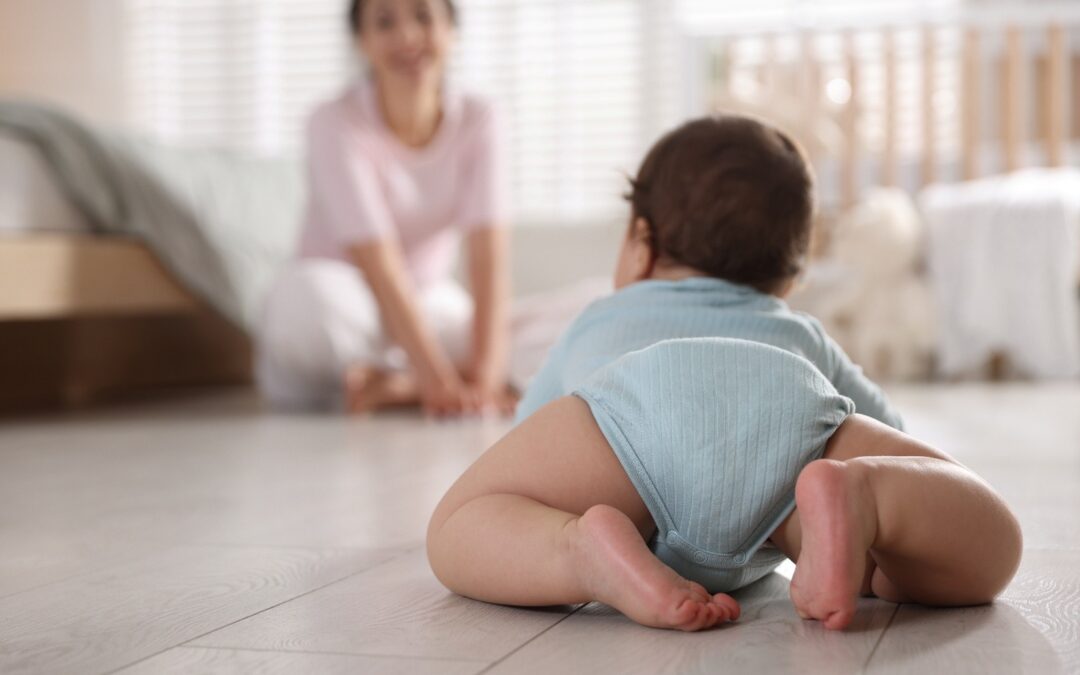
Your baby is only 6 months old, and somehow they are already on the move. Maybe it is a wobbly hands-and-knees crawl, a belly pull, or a determined scoot toward whatever caught their attention.
That can make you wonder whether your baby is crawling unusually early. Many babies begin crawling closer to 7 to 10 months, so 6 months is on the early side. But babies can become mobile on a wide range of timelines, and early movement by itself is not something you need to correct.
What Can Crawling Look Like at 6 Months?
At this age, mobility may still look experimental.
Your baby might get onto hands and knees, move forward on their belly, push backward, pivot around the floor, or switch between several approaches. One day they may cover a surprising amount of ground. The next, they may seem more interested in sitting and reaching.
That inconsistency is part of learning how to move.
When parents ask when do babies start crawling?, it helps to remember that there is no single version of crawling that has to appear first.
Does Crawling Early Mean Other Milestones Will Happen Early Too?
Not necessarily.
It can be tempting to assume that an early crawler will also pull up, cruise, and walk ahead of schedule. Development does not usually move at one steady speed like that.
Your baby may become mobile early and spend plenty of time exploring that skill before something new appears. Another child may crawl later and move quickly into standing.
One early skill does not predict the timing of everything that follows.
Your Babyproofing Timeline May Have Changed
A mobile 6-month-old can make your home look very different.
Things that once seemed safely out of reach may suddenly be accessible. Take another look at stairs, cords, outlets, low shelves, small objects, and furniture your baby could pull or bump into.
It also helps to get down to floor level and look around from your baby’s point of view. The items you barely notice may be the most interesting things in the room.
As your baby gets faster, you may find yourself updating that safety check more than once.
Give Your Baby Room to Use Their New Skill
Once your child discovers a way to move, give them safe opportunities to practice it.
Floor time lets your baby reach, change direction, shift their weight, and explore what happens when they move toward something interesting. A favorite toy nearby can give them a reason to keep going without turning movement into a formal exercise.
You do not need to encourage your baby to move faster simply because they started early. Let them use the skill at their own pace and follow their curiosity.
When Should You Ask Your Pediatrician About Movement?
Crawling at 6 months by itself is not a reason for concern.
Still, you know your baby best. If you notice that your child consistently uses one side of the body differently, seems unusually stiff or floppy, loses a skill they previously had, or something about their movement concerns you, bring it up with your pediatrician.
You do not need to wait until a particular milestone date to ask a question. Your child’s doctor can consider what you are seeing alongside the rest of their development.
A Mobile Baby Experiences Daycare Differently Too
Once babies can get somewhere on their own, everyday play changes. A toy across the room becomes a destination. A familiar play space gives them new things to investigate.
At Celebree School of Dulles at Arcola, infant care includes opportunities for physical development, gross and fine motor experiences, and age-appropriate exploration throughout the day. Teachers also communicate with families about what they observe as babies grow and change.
For an early crawler, that might mean having room to safely move toward something interesting, explore from a new position, or practice navigating a familiar space in a new way.
If you are looking for daycare in Sterling, VA, Celebree School of Dulles at Arcola provides responsive infant care where babies can explore new abilities at their own pace while families stay connected to the changes happening throughout the day.