
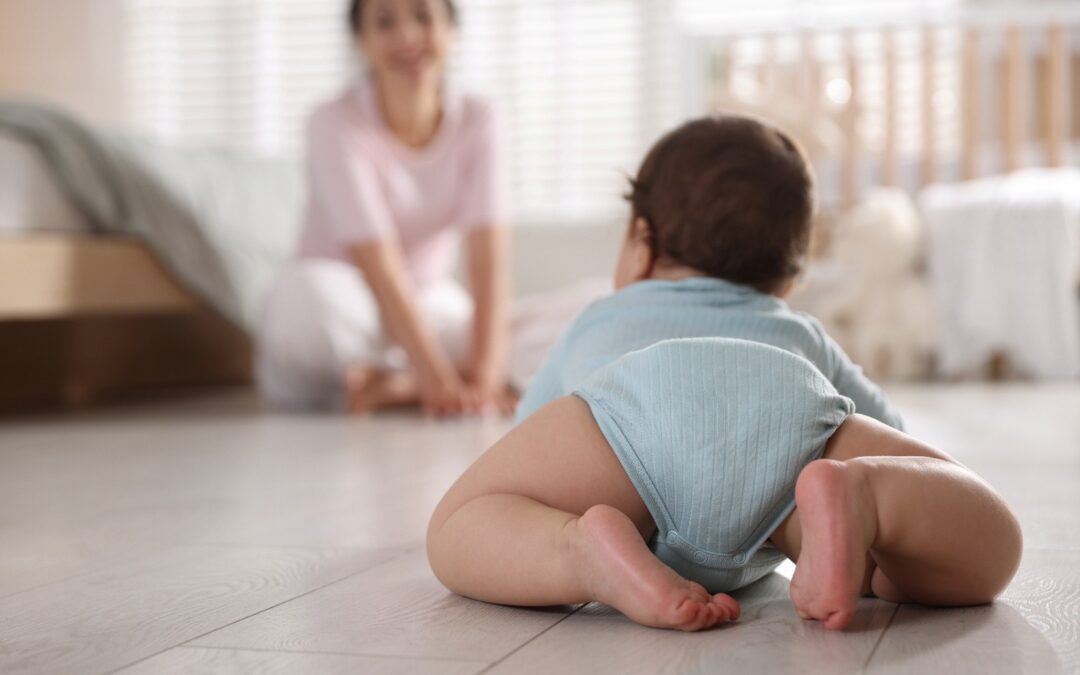
You may expect crawling to mean hands and knees on the floor, but babies do not always follow that picture. Some lift their knees, straighten their legs, and move forward on their hands and feet instead.
This is often called a bear crawl. It can look unusual at first, especially if you are wondering when do babies start crawling? But it is one of several ways babies may experiment with getting around.
What Does Crawling on Hands and Feet Look Like?
In a bear crawl, your baby keeps their hands on the floor while their knees stay lifted. Their legs may be fairly straight, with their bottom raised in the air as they move forward.
Some babies use this style only occasionally. Others discover that it works well and rely on it whenever they want to cross the room.
It can look surprisingly coordinated once they get the hang of it.
There’s a Name for It: The Bear Crawl
The bear crawl gets its name from the way the movement looks.
Unlike a classic crawl, where both knees stay on the floor, a bear crawler moves on their hands and feet. It is one of several crawling styles babies may use as they become more mobile.
Other babies may belly crawl, scoot, roll, or combine more than one approach.
When Do Babies Start Crawling?
Many babies begin crawling somewhere around 7 to 10 months, although the timing can vary.
The first crawl may not look polished, either. A baby may experiment with different positions before finding a way of moving that feels effective.
That means crawling on hands and feet may show up as part of the process rather than after a long period of traditional crawling.
Why Might a Baby Keep Their Knees Off the Floor?
There is not one explanation that applies to every baby.
Babies are constantly experimenting with balance, coordination, and how much force they need to move themselves forward. A hands-and-feet position may simply be the route your baby discovers while working through those challenges.
Once they learn that it gets them where they want to go, they may keep using it for a while.
Does a Bear Crawl Need to Change?
Not necessarily.
Parents sometimes feel tempted to place a baby’s knees back on the floor or encourage a more traditional crawl. But a bear crawl does not automatically need correcting simply because it looks different.
Some babies later switch to hands-and-knees crawling. Others continue mixing movement styles as they become interested in pulling up, standing, or exploring in new ways.
Watch the Whole Movement Pattern
Instead of focusing only on whether your baby’s knees touch the floor, pay attention to how they move overall.
Do they use both sides of the body? Can they reach, turn, and change positions? Are they continuing to discover new ways to move and interact with what is around them?
Looking at the larger picture can be more useful than comparing one crawling style with another.
Give Them Room to Move Their Way
Supervised floor time gives babies space to experiment without turning movement into a lesson.
Let your baby work out how to reach a toy or move toward something interesting. There is usually no need to repeatedly reposition their legs or guide them into a specific crawling pattern.
As mobility grows, remember that babyproofing needs may change too. A bear crawler can move quickly and reach farther than you might expect.
When Is It Worth Asking Your Pediatrician?
Bring questions to your child’s pediatrician if your baby consistently avoids using one side of the body, loses a skill they previously had, seems unusually stiff or floppy, or something about their movement concerns you.
You do not need to decide on your own whether a particular crawling style is significant. Your pediatrician can look at how your baby is developing overall.
A New View of the Room
Once babies figure out how to cross the floor, familiar spaces start to feel much bigger. A toy across the room, a low shelf, or a familiar face may suddenly become something they can reach for themselves.
At Celebree School of Cypress, infant care includes age-appropriate opportunities for movement, gross and fine motor development, and hands-on exploration. Teachers also keep families connected to the everyday changes they notice as babies become more mobile.
Those small discoveries are part of what makes this stage so interesting. Families considering daycare in Cypress, TX, can learn more about how Celebree School of Cypress supports babies through play, movement, and daily routines.