
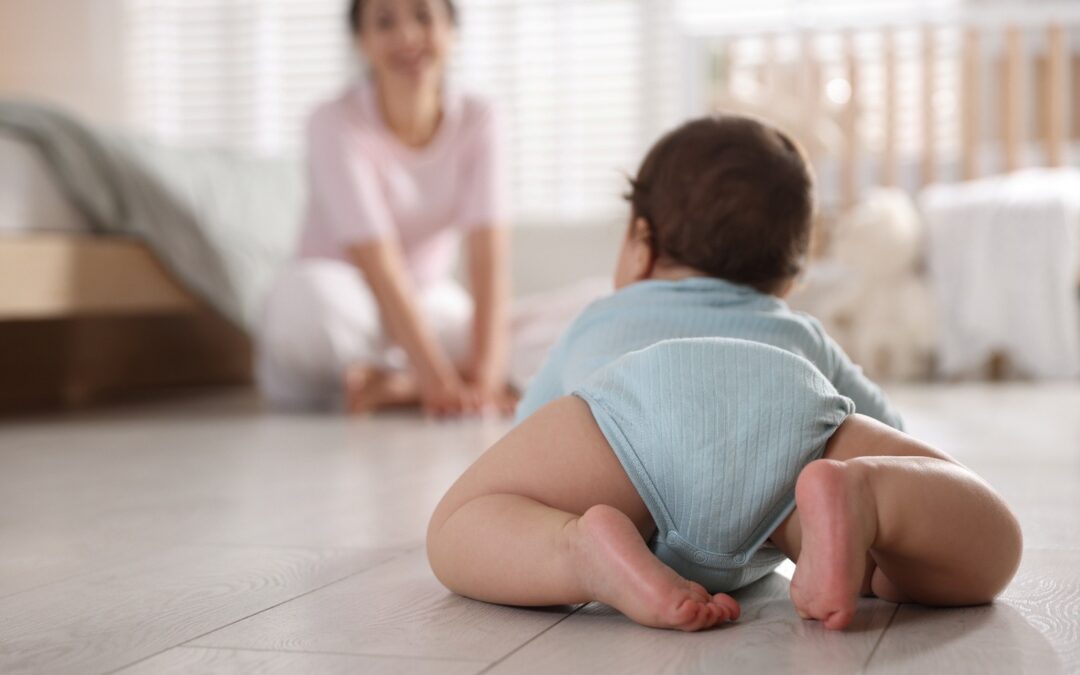
Your baby finally figures out how to crawl. They cross the rug, follow you into another room, and make a beeline for anything you hoped they wouldn’t notice. Once you adjust to this new mobility, another question tends to follow: How long until they’re walking?
There isn’t a set amount of time between the two.
If you’re wondering when do babies start crawling, the American Academy of Pediatrics says traditional crawling is usually mastered between about 7 and 10 months. Many babies take their first steps around their first birthday, although starting earlier or later can also be normal.
What happens in between can look quite different from one baby to another.
Crawling Doesn’t Start a Countdown to Walking
A baby who crawls early won’t necessarily walk early. Likewise, a baby who happily crawls for months isn’t automatically taking too long to move on.
Crawling and walking require different skills. Crawling lets babies travel while keeping their hands and knees, belly, or another part of their body close to the floor. Walking asks them to balance upright and coordinate their body while moving forward on two feet.
That takes practice, and babies don’t all approach it the same way.
Some become interested in standing almost as soon as they can crawl across a room. Others discover that crawling works perfectly well and stick with it for quite a while.
Look for Pulling Up Along the Way
One change you may notice after crawling begins is a new interest in getting off the floor.
The coffee table, couch, or another sturdy surface suddenly becomes something to grab. Your baby may crawl over, place both hands on it, and begin working their way upward.
AAP describes pulling to stand as part of the movement that commonly develops during the later months of a baby’s first year. Current CDC guidance also lists pulling up to stand among the movement milestones most babies achieve by 1 year.
Pulling up can feel like a major step toward walking, but it doesn’t tell you exactly when those first independent steps will arrive.
Your baby still has plenty to figure out once they’re standing.
Then You May See Cruising
After a baby becomes comfortable standing while holding onto something, you may notice them begin moving sideways along the furniture.
That’s commonly called cruising.
At first, your baby might shuffle one foot a few inches and stop. With practice, they may begin traveling along the couch or between nearby pieces of sturdy furniture while keeping at least one hand on support.
CDC lists walking while holding onto furniture as another movement milestone most babies reach by 1 year.
Cruising lets babies experiment with shifting their weight and staying upright while moving. Even so, there isn’t a standard number of cruising days or weeks that must pass before independent walking begins.
Standing Without Holding On Is Another Big Change
A baby who has been pulling up for a while may eventually let go. Sometimes it happens so briefly that you wonder whether you imagined it.
Your baby may stand unsupported for a moment, realize what’s happening, and immediately sit down. Another time, they may remain balanced long enough to reach for a toy or look around.
AAP describes this gradual experimentation with balance as part of the move toward independent steps. These small changes can be easy to overlook when everyone is waiting for the dramatic moment of a first step.
Crawling May Stick Around After Walking Begins
First steps don’t necessarily mark the end of crawling.
A baby may take two or three steps, sit down, and crawl the rest of the way across the room. Walking is new and takes concentration. Crawling may still be faster.
AAP specifically notes that children may continue crawling after they begin walking because they’ll use whichever method is easiest and quickest at the moment.
You may see both methods for a while as your baby’s balance and confidence grow.
You Don’t Need to Hurry the Transition
Once your baby starts pulling up, it can be tempting to turn every opportunity into walking practice. There is no need to rush.
Give your baby safe opportunities to crawl, change positions, pull up on sturdy surfaces, and move as their current abilities allow. You don’t have to hold them upright for long stretches or repeatedly walk them around the room to move things along.
And skip mobile baby walkers. The AAP strongly advises against them because they do not help babies learn to walk and pose significant injury risks.
Ordinary opportunities to move can provide plenty of practice.
What If Walking Doesn’t Seem Close Yet?
It helps to look beyond how much time has passed since crawling began.
CDC’s current milestones include pulling up to stand and walking while holding furniture by 1 year. By 15 months, most children can take a few independent steps. These milestone checklists are intended to help parents follow development and start conversations with their child’s doctor, not diagnose a delay on their own.
If your child loses a skill they previously had, isn’t meeting milestones, or something about their movement concerns you, share what you’re seeing with your pediatrician.
You don’t have to wait for a particular crawling-to-walking deadline before asking a question.
Watching Mobility Grow at Celebree School of Crofton
At Celebree School of Crofton, infant care plans include physical development, gross- and fine-motor activities, and recognizing and documenting milestones. The school also uses daily morning and evening check-ins to help families and teachers stay connected as babies grow and change.
That communication can be especially useful during a period when new movement seems to appear overnight.
A baby who has been crawling confidently may begin pulling up during play. Another may spend more time standing while holding onto a secure surface. Someone else may remain perfectly content traveling on the floor.
Teachers can notice those everyday changes, provide opportunities for age-appropriate movement, and share what they’re observing with families. They aren’t predicting when a baby will walk. They’re helping parents stay connected to the development unfolding throughout the day.
Give Crawling and Walking Room to Overlap
Once crawling begins, walking can feel like the obvious next milestone to watch for. But babies don’t move through these skills on a stopwatch.
There may be plenty of crawling, pulling up, sitting back down, cruising, brief attempts at standing, and more crawling before those first independent steps arrive.
Families looking for daycare in Crofton, MD, can visit Celebree School of Crofton to see how infant teachers support physical development while respecting each baby’s individual pace. Set up a time to visit the school and get to know the infant program.