
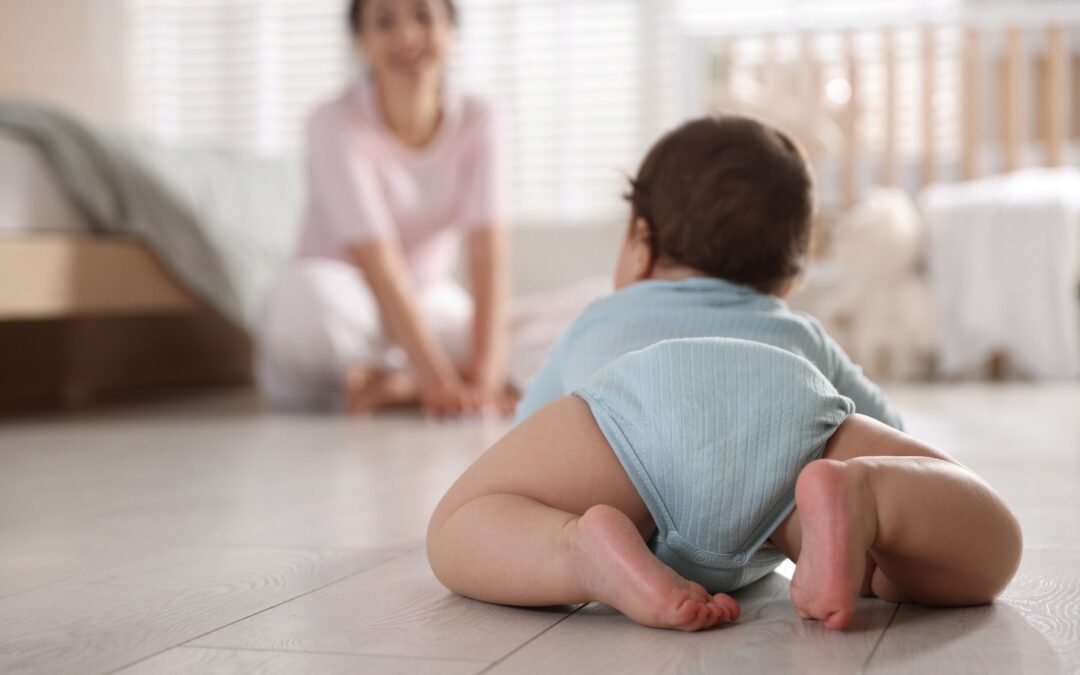
Around 8 or 9 months, it can feel like your baby is changing by the week. They may be sitting more confidently, making new sounds, reaching for everything within sight, and suddenly finding ways to move across the floor.
If you are wondering when do babies start crawling, many babies begin traditional hands-and-knees crawling around 7 to 10 months. Some start sooner or later, while others scoot, roll, or move on their bellies instead.
Crawling tends to get plenty of attention because it is easy to see. During these same months, though, a lot may be happening in other areas of development, too.
Crawling Is Only One Change to Watch
Once mobility begins, you may naturally focus on how far your baby can travel or whether their crawl looks like the one you expected.
Meanwhile, other abilities may be changing right alongside it.
Your baby may become better at moving between positions, more deliberate about reaching for objects, increasingly interested in where you are, or much more vocal during everyday routines.
These developments do not all arrive at once or in the same order. They often overlap.
Sitting and Changing Positions May Get Easier
Around the time crawling commonly appears, many babies are also becoming more capable of getting into and out of sitting positions.
You may see your baby sit and turn toward a toy, lean onto their hands, lower themselves toward the floor, or move from one position to another with less help.
Those transitions can be easy to overlook once crawling steals the spotlight, but they are part of your baby’s growing ability to control where and how they move.
One day, you may realize you no longer have to reposition your baby nearly as often as you did a few weeks earlier.
Their Hands May Be Busier, Too
Gross motor development gets obvious once a baby starts moving across the room. Changes involving the hands can be quieter.
Your baby may begin transferring a toy from one hand to the other, picking up food differently, turning objects around, or repeatedly dropping something just to see what happens.
That last one can become a very popular activity.
These small experiments give babies more ways to interact with the objects they encounter as their world becomes easier to reach.
You May Hear New Sounds
Movement is not the only thing developing during this period.
Babbling may become more varied, and babies may repeat strings of sounds such as “ba-ba-ba” or “ma-ma-ma.” They may also react more noticeably when you talk, imitate sounds, or use their voice to get your attention.
A baby who is busy trying to crawl may also be busy practicing new ways to communicate.
You do not need to compare how quickly one area is progressing with another. Development rarely advances at exactly the same pace across every skill.
Familiar People May Get a Bigger Reaction
Around this age, babies may also become more aware of who is nearby.
You might notice a stronger reaction when you leave the room, hesitation around an unfamiliar person, or a wider range of expressions when something delights or frustrates them.
At the same time, that same baby may crawl away from you to investigate a toy across the room.
Those behaviors can exist together. Growing mobility gives babies more freedom to explore, while familiar caregivers remain an important part of their day.
Crawling May Still Look Different From Baby to Baby
Even during a period when movement is changing quickly, traditional hands-and-knees crawling is not the only possibility.
Some babies scoot while sitting. Others move on their bellies, roll intentionally, or combine several techniques. A few spend relatively little time using a traditional crawl.
Rather than waiting for one specific movement to prove that your baby is progressing, notice the broader changes in what they can do.
Don’t Expect Everything to Happen at Once
Milestone information can be helpful when you want a sense of what may be developing next. It becomes less useful when it starts to feel like a checklist your baby has to complete by a certain date.
One baby may be highly mobile while still working on other skills. Another may be very vocal and socially engaged while taking more time to figure out movement.
Watch the pattern over time.
If something about your baby’s development concerns you, talk with their pediatrician. A loss of a previously learned skill or another change that worries you is also worth bringing up.
Following Development at Celebree School of Columbia-South
At Celebree School of Columbia-South, infant care looks at development across more than one area.
Teachers observe physical abilities, communication, social development, and everyday routines while providing age-appropriate opportunities to move, play, and interact. Families also receive regular updates so changes noticed during the day can become part of the larger picture of how a child is developing.
One day, the big news may be a new way of moving across the floor. Another day, it may be a new sound, a steadier transition into sitting, or a favorite new game.
Those everyday observations help families follow development as it happens rather than focusing on one milestone alone.
Notice the Big Picture, Not Just the Crawl
Crawling is exciting because it makes development very visible. Suddenly, your baby can go somewhere they could not reach before.
Still, there is much more happening during these months than movement alone.
Notice the new sounds, changing expressions, busy hands, stronger position changes, and growing curiosity alongside whatever form mobility takes. Together, those small changes tell a much richer story than a crawling date on the calendar.
If you are looking for day care in Columbia, MD, Celebree School of Columbia-South provides infants with individualized care and age-appropriate opportunities to move, communicate, explore, and grow throughout the day. Schedule a visit to meet our team and learn more about infant care at Celebree.