
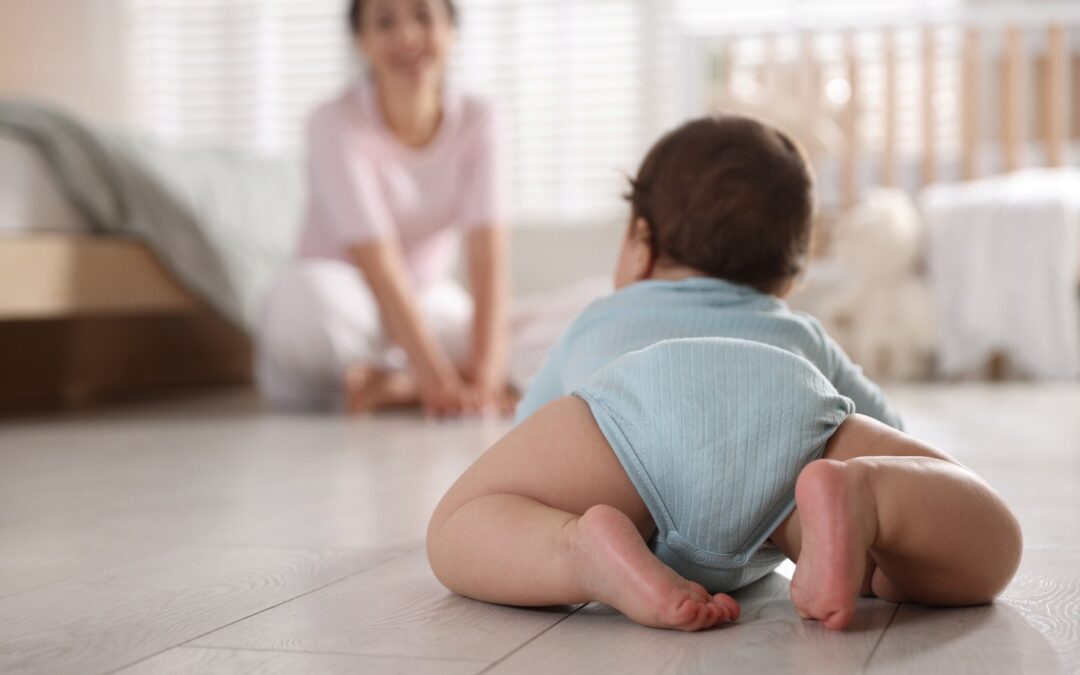
Your baby was sitting on one side of the play mat. A few minutes later, they are noticeably closer to the toy they wanted. You know they moved, but you are not entirely sure how they got there.
Was that crawling?
If you are wondering when do babies start crawling, many babies begin traditional hands-and-knees crawling around 7 to 10 months. The first attempts are not always easy to identify, though. Crawling may begin with a few tentative movements, a belly scoot toward something interesting, or one brief trip that your baby does not repeat again until another day.
There is no official test for a baby’s “first crawl.” What matters more is how independent movement begins to take shape.
Crawling Doesn’t Always Begin With a Big Moment
Some milestones are easy to recognize. Crawling can be a little messier.
Your baby might move forward two steps on hands and knees, lower onto their belly, and finish the journey another way. They may push forward once and then spend the rest of the afternoon sitting happily in the same spot.
A new movement can show up briefly before it becomes something your baby uses regularly.
Instead of looking for one perfect crawling moment, watch for a change in purpose. Is your baby beginning to figure out how to get closer to something they want?
That growing intention is often easier to recognize than a particular crawling technique.
Belly Crawling Still Gets Your Baby Somewhere
Parents sometimes wait for hands-and-knees movement before saying their baby is crawling.
But babies can become mobile in several ways.
A baby who pulls forward on their belly has still figured out how to travel toward a destination. Another might combine a belly crawl with rolling or pivoting.
Some babies eventually move onto their hands and knees. Others continue using another style for quite a while.
So, if your baby has started moving across the floor independently, you do not need to discount the accomplishment because it looks different from the crawl you expected.
One Short Trip May Be Followed by Lots of Practice
The first time your baby moves forward does not necessarily mean they will be crossing the room by bedtime.
You might see a brand-new movement on Tuesday and barely see it again on Wednesday. Then, a few days later, your baby suddenly seems more confident using it.
That can make it surprisingly difficult to decide exactly when crawling “started.”
The early stage is often about experimentation. Babies try movements, return to familiar ones, and gradually discover which strategies work best.
Over time, those short attempts may become longer, smoother, and more purposeful.
Your Baby May Show the Skill Somewhere Else First
Sometimes a teacher tells you that your baby crawled toward a toy during the day before you have seen the same thing happen at home.
That can bring mixed feelings, especially if you were hoping to witness the first moment yourself.
Babies spend their days in different spaces, with different things capturing their attention. A movement that happens during play at day care may not appear at home until later, and the reverse can be true as well.
There is also much more to a new skill than the first time it happens.
You will still see your baby’s crawl become steadier, faster, and more adventurous. Before long, the bigger challenge may be keeping up with them.
Look for Intention More Than Perfect Technique
Early crawling does not have to look coordinated.
Your baby might:
- move only a few inches at first
- travel partly on their belly
- crawl and then switch to rolling
- move backward before figuring out forward motion
- use different styles at different times
Rather than concentrating on whether every arm and leg is in the “right” position, watch what your baby is trying to accomplish.
If they notice something interesting across the floor and increasingly find ways to reach it, mobility is changing.
When Does Crawling Become More Consistent?
There is no standard amount of time between a baby’s first attempt and regular crawling. Some babies quickly figure out how to cover more ground. Others experiment with movement for weeks.
Your baby may also be practicing several abilities at the same time. Sitting, changing positions, reaching, crawling, and even pulling up can overlap rather than arriving in a tidy sequence.
Give your baby safe floor space where they can continue exploring without turning every play session into a crawling practice session.
Consistency tends to come with experience, but it does not need to follow a schedule.
Don’t Let the “First” Become a Test
Milestones can make parents feel as though they should be recording exact dates.
If you cannot decide whether Monday’s belly shuffle or Thursday’s hands-and-knees trip was technically the first crawl, you have not missed anything important.
Watch the bigger change instead.
Your baby may be moving farther than they did a few weeks ago. They may be changing positions more easily or showing much more determination to reach the other side of the room.
Those everyday changes often tell a more useful story than one date on a calendar.
Bring Movement Concerns to Your Pediatrician
There is plenty of variation in how and when babies become mobile, but parents should still speak up when something concerns them.
Talk with your child’s pediatrician if your baby loses a skill they previously had, consistently seems to use one side of the body differently from the other, or you notice another movement pattern that feels unusual.
You do not have to wait for an arbitrary crawling deadline before asking a question.
If something has caught your attention, describe what you are seeing. Your pediatrician can look at that observation within the broader picture of your baby’s development.
Sharing New Milestones at Celebree School of Columbia-North
At Celebree School of Columbia-North, infant teachers pay attention to the small developmental changes that happen throughout the day.
That might mean noticing that your baby traveled toward a toy for the first time, moved farther during floor play, or tried a new way of getting from one place to another.
Teachers can share those observations with families, so parents have another window into what their baby is practicing.
The purpose is not to predict the next milestone or decide which movement officially counts as the first crawl. It is to notice growth, provide age-appropriate opportunities to explore, and keep families connected to what is happening throughout the day.
Let the First Crawl Be a Beginning
The moment your baby first becomes mobile may be obvious, or it may take a few days before you realize crawling has truly begun.
Either way, the first attempt is only the beginning.
Soon you may notice longer trips across the room, quicker changes in direction, and a baby who has become very good at reaching the exact object you hoped they would ignore.
If you are looking for day care in Columbia, MD, Celebree School of Columbia-North offers individualized infant care with room for movement, exploration, and growing independence. We’d be happy to show you around. Reach out to arrange a visit and learn more about our infant program.