
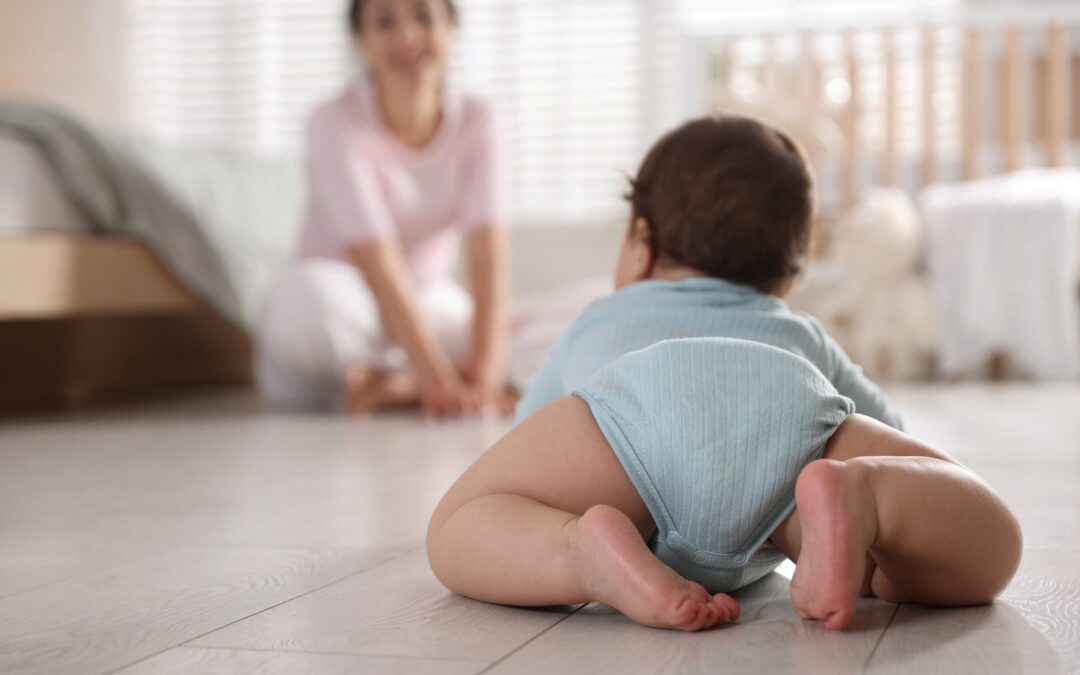
Parents hear plenty of mixed messages about crawling. One source says it is an important developmental stage. Another points out that some babies never use a traditional hands-and-knees crawl.
Both can be true.
If you are wondering when do babies start crawling, many babies begin traditional crawling around 7 to 10 months. Others move earlier or later, and some find different ways to get around altogether.
For babies who do crawl, the experience gives them new opportunities to coordinate movement, explore their surroundings, and decide where they want to go.
Crawling Gives Babies a New Kind of Freedom
Before babies become mobile, much of their movement depends on an adult.
You place them on the play mat. You carry them across the room. You bring interesting objects close enough to reach.
Crawling changes that relationship with their surroundings.
A baby can spot something interesting and begin moving toward it. They can follow you across part of the room, change direction when something else catches their attention, or decide that the toy they ignored five minutes ago is suddenly worth investigating.
That ability to choose where to go opens up many more opportunities to explore.
Moving Across the Floor Takes Coordination
Crawling may eventually look effortless, but there is a lot happening behind the movement.
Babies have to support their bodies, shift weight from one side to another, coordinate their arms and legs, and adjust when they change direction.
Those pieces do not necessarily come together all at once.
Early attempts may include rocking, moving backward, pivoting, belly-crawling, or starting and stopping. With experience, movement may become smoother and more efficient.
Parents do not need to break crawling down into individual skills for their baby. Floor play gives babies opportunities to experiment with those movements naturally.
Crawling Changes How Babies Explore
Once a baby can move across the floor, exploration becomes much more active.
They can approach an object instead of waiting for it to be handed to them. They may move closer, pause, touch it, back away, and then decide whether to return.
The room itself becomes more interesting. A low shelf, the texture of a rug, a toy partly hidden from view, or a familiar person sitting across the room may suddenly become a destination.
That growing mobility gives babies more chances to learn through their own actions and reactions to what they find.
Does Every Baby Need to Crawl?
No. Babies can follow different paths to mobility.
Some use the traditional hands-and-knees crawl. Others belly-crawl, scoot while sitting, roll with purpose, or combine several movement styles.
A few babies spend very little time crawling traditionally before becoming interested in standing and walking. That does not make crawling meaningless. It simply means there is a difference between saying crawling can offer valuable movement experiences and saying every baby must crawl in one specific way.
Parents can pay attention to how mobility is developing without treating a classic crawl as a requirement.
Focus on Opportunities to Move
There is no need to turn crawling into a training program.
Safe floor play gives babies room to reach, roll, pivot, scoot, crawl, and change positions. Interesting objects nearby can give them a reason to move without creating pressure to perform a particular skill.
Give your baby time to experiment.
They may spend one play session trying repeatedly to reach something and another barely moving from the same spot. New physical abilities do not always become consistent immediately.
The goal is to make movement possible, not to dictate how it has to happen.
Watch the Bigger Picture
Because crawling gets so much attention, it can become easy to measure development by one question: “Are they crawling yet?”
Try to look more broadly.
Is your baby finding new ways to change position? Are they reaching farther? Moving toward things that interest them? Gaining more control over where their body goes?
Those observations can tell you more about developing mobility than one specific crawling style.
If something about your baby’s movement worries you, share what you are seeing with their pediatrician. A skill regression is definitely worth making note of and discussing.
Following New Movement at Celebree School of Canton
At Celebree School of Canton, infant teachers provide age-appropriate opportunities for babies to move and explore throughout the day.
One child may be beginning to travel across the floor on hands and knees. Another may be scooting toward a favorite toy, while someone else is experimenting with new ways to change positions.
Teachers observe those changes and share what they notice with families, helping parents stay connected to development as it unfolds.
The focus stays on the individual child rather than expecting every infant to reach the same movement milestone in the same way.
There Is More Than One Way to Become Mobile
Crawling can be an exciting stage because it changes how babies experience the space around them. They can move toward something because they want to, investigate more of their environment, and practice coordinating their bodies along the way.
Some babies will spend months crawling. Others may use another movement style or move fairly quickly toward standing.
Give your baby safe opportunities to explore and pay attention to the new abilities taking shape along the way.
If you are searching for day care in Canton, MD, Celebree School of Canton provides individualized infant care with plenty of opportunities for movement and exploration. Come see our school in person and learn more about how we support babies through these early stages of development.