
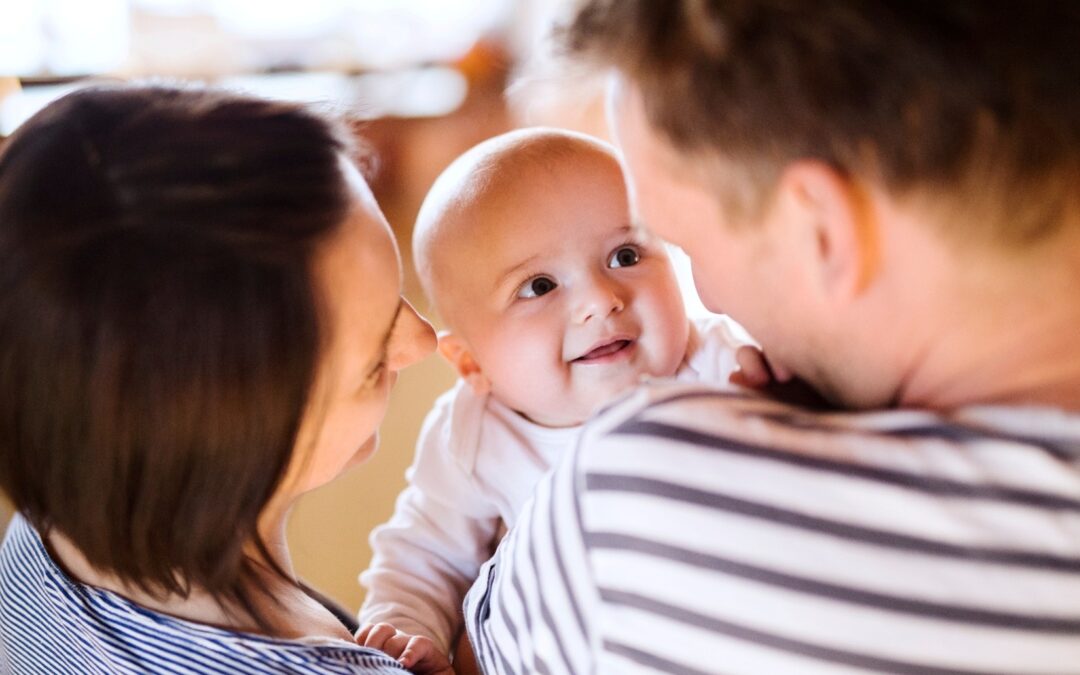
Babies spend a remarkable amount of time watching the people around them. At first, that may mean studying your face or becoming still when they hear your voice. Months later, the same baby may answer your sounds with babbling, join a familiar game, or wave after seeing you do it.
Copying and imitation develop gradually throughout the first year. They grow alongside movement, attention, communication, and social connection. Looking at baby milestones by month helps show how those early responses gradually become more active and purposeful.
Every baby develops differently, so the ages below are general guideposts rather than deadlines.
The First Few Months Begin With Watching and Responding
Newborns are still learning to control their bodies and make sense of a busy new world. During the first month, your baby may briefly focus on a nearby face, react to sounds, and lift or turn their head for short periods during tummy time.
By around 2 months, many babies smile when someone talks or smiles at them, make sounds besides crying, watch people move, and briefly hold their head up while on their tummy.
Around 3 months, social interaction often becomes easier to notice. Your baby may coo more frequently, smile readily, bring their hands toward their mouth, and spend longer periods watching faces or nearby objects.
These early months are important because imitation starts with attention. Before a baby can copy a sound or action, they first have to notice it.
Around 4 to 6 Months, Interaction Becomes More Back-and-Forth
By about 4 months, many babies are much more engaged with the people around them. They may chuckle, make sounds back when you talk, bring their hands to their mouth, swing an arm toward toys, and push up on their forearms during tummy time.
Around 5 months, reaching and grasping often become more deliberate. Babies may roll, laugh more readily, and experiment with a wider range of sounds.
By roughly 6 months, many babies take turns making sounds, laugh, recognize familiar people, reach for objects they want, roll, and begin sitting with support or while leaning on their hands.
The exchange between you and your baby is also changing. A sound from you may prompt a sound from them. A smile may bring another smile. These simple back-and-forth moments are part of learning how interaction works.
When Do Babies Start Imitating?
There is no single age when babies suddenly begin imitating.
Early responses appear within the first few months, while clearer copying of sounds, facial expressions, gestures, and actions becomes easier to recognize as the year progresses.
You do not need to teach imitation as a lesson. Make a sound, pause, and see what your baby does. Smile during face-to-face play. Sing familiar songs. Repetition gives babies plenty of opportunities to notice what you do and experiment with their own response.
Babbling Gives Babies More Sounds to Try
Vocal play becomes especially noticeable during the middle of the first year.
A baby who began with coos may start producing a much wider range of sounds. Over time, those sounds may include repeated combinations such as “bababa” or “mamamama.”
When Do Babies Start Babbling?
Babbling commonly becomes more noticeable during the middle months and grows more varied later in infancy.
By around 7 to 9 months, many babies are using repeated sounds and taking a more active role in vocal exchanges. They may listen when you speak, answer with a string of sounds, pause, and start again.
These are not necessarily words yet. They are opportunities to practice the sounds and rhythm of communication.
Around 7 to 9 Months, Babies Join In More
The second half of the first year often brings a big change in how babies participate.
Around 7 months, sitting may become steadier, objects may move easily from one hand to the other, and babbling often becomes more varied.
By about 8 months, babies may sit more confidently, reach in different directions, and show greater interest in familiar games and routines.
At around 9 months, many babies sit without support, look when their name is called, make repeated sounds, lift their arms to be picked up, and look for something that falls out of sight.
This is also when familiar interactions may become more predictable. If you pause during a favorite song or game, your baby may appear to anticipate what comes next. They are paying attention not only to individual actions, but also to patterns.
Gestures Give Babies Something New to Copy
As hand control and social awareness develop, communication becomes more physical.
A baby may reach toward a person or object, lift both arms to be picked up, or begin experimenting with gestures they see other people use.
When Do Babies Wave or Clap?
Waving and clapping often appear during later infancy, although timing varies.
At first, a baby may simply watch you wave goodbye or clap during a song. Later, they may try the motion themselves, sometimes imperfectly and sometimes only occasionally.
Around 10 to 12 months, gestures often become more purposeful. A baby may wave, imitate a simple action, or use a movement to participate in a familiar social routine.
Clapping is another common later-infancy behavior, but it is not something every baby needs to do by an exact month.
Near the First Birthday, Imitation Becomes Easier to Recognize
During the last few months of the first year, babies often have better control over their hands, bodies, and voices.
Around 10 months, some babies pull to stand, change positions more easily, and begin using gestures more intentionally.
At about 11 months, cruising along furniture may appear. Babies may also imitate familiar actions, use increasingly precise hand movements, and show clearer understanding of words and routines.
By 12 months, many babies:
- Wave goodbye
- Play simple interactive games
- Put objects into containers
- Pull to stand
- Move while holding furniture
- Understand familiar words such as “no”
- Use “mama,” “dada,” or another special name meaningfully
Some babies may also copy a simple action they have seen many times. Others may be more interested in sounds or movement. Independent walking is not required by the first birthday.
Imitation Involves More Than Copying
When your baby repeats a sound or action, several abilities are working together.
They first have to notice what happened. Then they have to remember enough of it to respond and coordinate their own voice, hand, or body to try something similar.
That is one reason imitation often becomes more obvious as the first year progresses. Attention is getting stronger, movements are becoming more controlled, and babies have more ways to participate in social interaction.
Everyday Interaction Gives Babies Plenty to Watch and Try
There is no need to turn play into a test. Babies learn a great deal simply by spending time with responsive adults.
Talk during routines. Sing songs with repeated movements. Read together. Answer babbling. Wave goodbye. Play simple games. Follow your baby’s interest when something catches their attention.
At daycare in Bowie, MD, familiar routines, face-to-face interaction, sensory experiences, movement, and daily play give babies regular opportunities to watch, respond, and participate as their skills develop.
A younger infant may study a caregiver’s face or answer a sound with a coo. An older baby may babble during a song, reach toward something interesting, or join in with a familiar gesture.
Development Does Not Follow an Exact Script
Some babies become very vocal before they show much interest in gestures. Others may eagerly imitate movements while spoken sounds develop more gradually.
What matters most is the broader pattern of development over time.
Talk with your child’s pediatrician if your baby is not meeting expected milestones, loses a skill they previously had, or if something about their hearing, movement, communication, or interaction concerns you.
Throughout the first year, babies move from watching and listening to participating more actively. Those early smiles, sounds, gestures, and attempts to copy what they see are part of how they learn to connect with the people around them.