
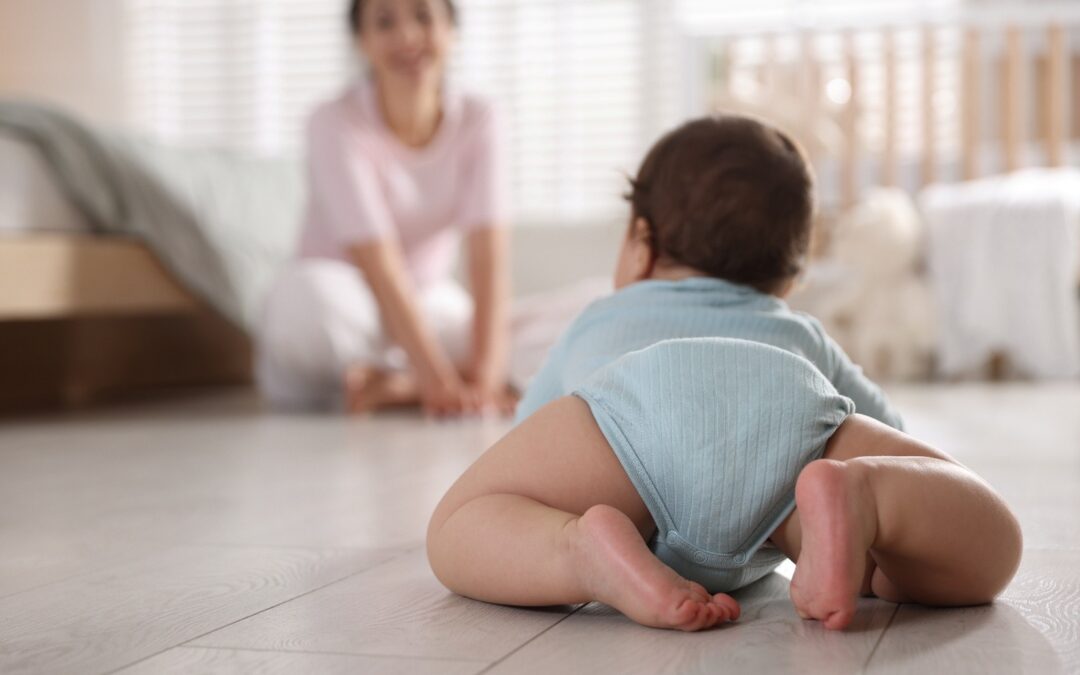
The first few crawls across the floor are exciting. Then you notice your baby’s knees.
Maybe they’re a little pink after an afternoon spent crossing the rug. Or perhaps your baby has discovered the hardwood floor, and suddenly those tiny crawling knee pads you’ve seen online seem a lot more practical.
Before adding another item to the baby gear collection, it helps to know that most babies don’t need special knee protection for ordinary crawling.
If you’re wondering when do babies start crawling, many babies master traditional crawling between about 7 and 10 months. Some belly crawl, scoot, roll, or find another way to get around instead.
Once your baby does start moving, a safe and comfortable place to explore matters more than special crawling equipment.
Do Babies Need Knee Pads for Crawling?
For most babies, probably not. Most babies can crawl comfortably without padded protection over their knees.
That doesn’t mean knee pads are off-limits. Some families may choose them because of a particular floor surface or because their baby seems more comfortable wearing them.
They simply aren’t something every baby needs in order to crawl.
A Little Redness Doesn’t Always Mean Their Knees Hurt
Adults know exactly how uncomfortable it can feel to kneel on a hard floor, so seeing pink knees on a crawling baby can make you wince.
Babies’ knees are different, though. Ordinary crawling does not automatically hurt them simply because the floor feels uncomfortable to an adult.
You can still pay attention to your baby’s skin and behavior.
Temporary redness after crawling is different from persistent irritation, swelling, significant bruising, or a baby who suddenly seems uncomfortable putting weight on a leg. If something looks painful or your baby’s movement changes noticeably, bring it up with the pediatrician.
Focus on the Floor Before the Gear
A newly crawling baby doesn’t need an elaborate setup.
A clean rug, play mat, or other comfortable supervised floor space can give your baby room to move. Check the area for small objects, sharp edges, cords, and anything else that becomes reachable now that your baby can travel.
Then let them explore.
The American Academy of Pediatrics emphasizes floor time as part of babies’ opportunities to practice movement, while CDC guidance encourages putting interesting objects slightly out of reach so babies have a reason to crawl, scoot, or roll toward them.
The important part isn’t what they’re wearing on their knees. It’s having a safe place where they can move.
What About Crawling on Hard Floors?
Hard floors are another reason parents may start looking at knee pads.
If your baby seems perfectly content crawling across the floor, you don’t necessarily need to change anything. A baby may move from a rug to a harder surface without seeming bothered by either one.
If a particular area appears uncomfortable, you can create a softer floor-play space with a rug or play mat. Soft pants can also provide a simple layer between skin and the floor.
There’s no need to turn the entire house into one giant padded crawling zone.
Your baby’s behavior can tell you quite a bit. A baby who happily keeps moving is giving you different information from one who repeatedly stops because something seems uncomfortable.
Knee Pads Shouldn’t Get in the Way
If you do decide to try crawling knee pads, comfort should be the priority.
Anything a baby wears during movement should allow them to bend their legs and move freely. Pads that slide around, feel restrictive, or make your baby more interested in pulling them off than crawling aren’t accomplishing much.
Poorly fitted knee pads can slide or place pressure around the back of the knee. So, knee pads are best viewed as optional gear rather than a developmental tool.
Your baby does not need them to learn the skill.
Crawling Practice Doesn’t Require Special Equipment
When babies are figuring out mobility, simple opportunities are often enough.
Put a favorite toy nearby. Sit a short distance away. Give your baby time on the floor when they are awake and supervised.
They may rock, reach, pivot, scoot backward, or make several attempts before getting where they intended to go.
AAP notes that traditional crawling is usually mastered around 7 to 10 months, but babies don’t all use the same approach. Some scoot or move on their bellies, while others use different crawling styles altogether.
There is no piece of crawling gear that needs to be added before those discoveries can happen.
When a Knee Question Becomes a Movement Question
Sometimes what begins as a question about sore-looking knees turns into a different concern.
Perhaps your baby suddenly stops using a leg they were using normally before. Maybe they seem uncomfortable bearing weight, consistently avoid one side, or lose a movement skill they previously had.
Those observations deserve more attention than whether the floor is hard.
AAP guidance notes that alternative ways of getting around are generally less concerning when babies coordinate both sides of the body and use their arms and legs similarly.
If your baby’s movement changes noticeably or something continues to concern you, share what you’re seeing with the pediatrician rather than trying to solve it with knee pads or other crawling products.
Making Room for Movement at Celebree School of Bowie
At Celebree School of Bowie, infants have opportunities to explore new skills within daily routines that support physical development and individual growth.
The Bowie program recognizes that children develop at their own pace and includes physical development as one of the areas teachers observe and support. Families also receive daily updates about routines and progress, helping parents stay connected to what their child is doing throughout the day.
That might mean hearing that your baby spent more time moving across the play area today, reached something they couldn’t get to last week, or found an entirely new way to travel.
Teachers can notice those changes and share them with families without pushing babies toward a particular crawling style or timetable.
Comfortable Knees Don’t Require a Lot of Gear
Once crawling begins, there’s plenty for parents to think about. Special knee pads don’t automatically need to be one of those things.
Watch how your baby responds to the surfaces around them. Offer a safe, comfortable place to move, and let their behavior guide whether an extra layer of clothing or padding would actually be helpful.
Most importantly, give them room to practice the new skill that suddenly makes the whole room available for exploration.
Families looking for daycare in Bowie, MD can visit Celebree School of Bowie to learn more about infant care and the everyday opportunities babies have to move, explore, and build new skills. We’d be happy to show you around. Contact the school to arrange a visit.