
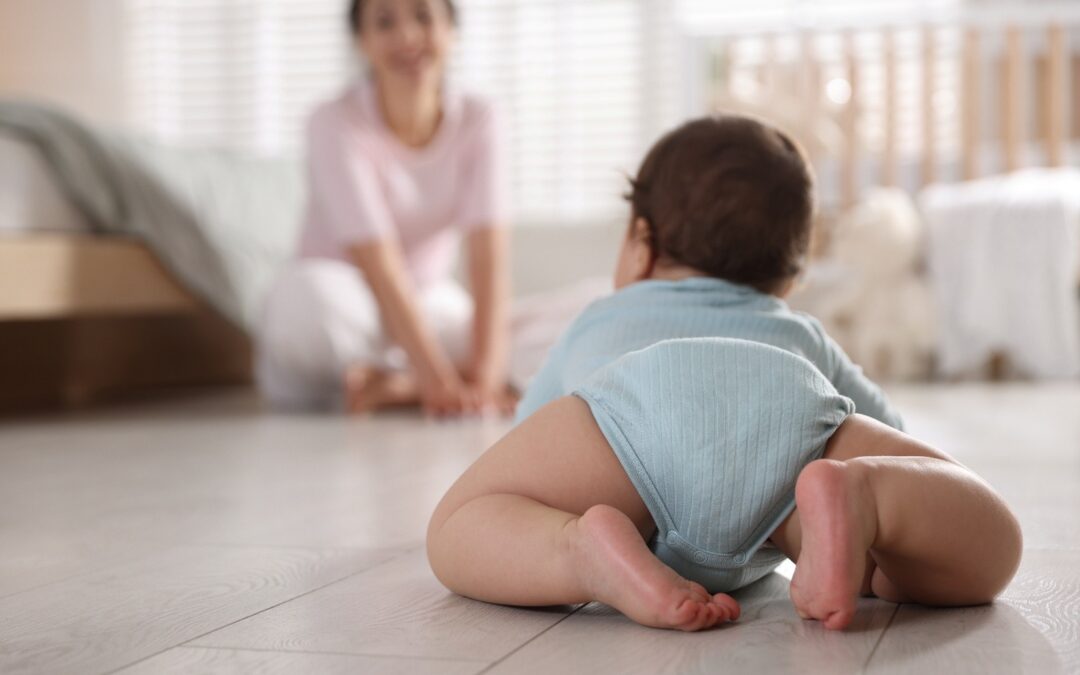
Your baby gets up on hands and knees, starts rocking back and forth, and you wait for the big moment. Then they sit back down or roll away as if crawling was never on the agenda.
If you are wondering when do babies start crawling, many babies begin mastering crawling between about 7 and 10 months. Before forward movement clicks, you may notice your child rocking on hands and knees, shifting their weight, or experimenting with several other ways to get around.
Why Is My Baby Rocking on Hands and Knees?
Rocking gives your baby a chance to practice a position that asks a lot of their growing body. They are supporting their weight through their arms and legs while working on balance and coordination.
The American Academy of Pediatrics notes that babies may spend some time rocking on their hands and knees before crawling. They may even push themselves backward at first before figuring out how to move forward.
From your baby’s perspective, there is a lot to sort out. Moving one arm without losing balance is tricky enough. Coordinating arms and legs while heading toward a toy across the room takes more practice.
Does Rocking Mean Crawling Will Start Soon?
It can be a sign that your baby is experimenting with the movements involved in crawling, but it does not give you a timetable.
Your child might rock for several days or continue doing it for a while. They might move from rocking into a hands-and-knees crawl, start belly crawling, scoot, or discover another way to reach what interests them.
Crawling itself is not currently included on the CDC’s 9-month milestone checklist. At that age, movement milestones include getting into a sitting position and sitting without support.
So, if another baby at the playground is already racing across the floor while yours is still happily rocking in place, comparing the two will not tell you much about what happens next.
What Else Might You Notice Before Crawling?
As your baby becomes more mobile, you may notice changes that seem small until you realize how much more of the room they can suddenly reach.
Your child may lean farther from a sitting position to grab something, roll with a clear destination in mind, pivot while on their stomach, or push up more strongly through their arms. They may also become increasingly determined to reach a toy that is just out of range.
These movements do not need to happen in a particular order. They are simply some of the ways babies practice using their bodies as they become more interested in exploring beyond the spot where you put them.
Give Your Baby Opportunities to Move
You do not need to teach your child a crawling technique.
Supervised floor time gives your baby space to try movements, change positions, and discover what works. You can place a favorite toy a short distance away, sit nearby and talk to them, or simply give them time to explore without directing every move.
The AAP recommends offering interesting objects just beyond a baby’s reach as one way to encourage movement.
Once your child starts covering more ground, take another look at babyproofing too. The cord, outlet, cabinet, or tiny object that seemed safely out of reach may not stay that way for long.
When Should You Talk With Your Pediatrician?
Rocking on hands and knees by itself is not a reason to assume something is wrong.
If you notice that your baby consistently uses one side of their body differently, seems unusually stiff or floppy, loses a skill they previously had, or you have another concern about their movement or development, bring it up with your pediatrician. The CDC also recommends speaking with your child’s healthcare provider when you have developmental concerns.
You know what is typical for your child, so questions are always worth raising rather than trying to interpret one movement on your own.
Making Room for Movement at Daycare
Your baby learns about movement throughout the day, whether they are reaching for a toy at home or trying to get closer to something interesting in the classroom.
At Celebree School of Bear, infant care includes opportunities that support physical development and gross and fine motor skills. Teachers observe your child’s growth during everyday activities and keep you informed about what they are seeing throughout the day.
That may include the first time your baby gets onto hands and knees, a new way of reaching an interesting toy, or simply more confidence moving around the floor. Teachers are there to provide safe, developmentally appropriate opportunities to explore while you and your child’s pediatrician remain the right resources for questions about development.
If you are looking for daycare in Bear, DE, explore Celebree School of Bear to learn more about how we care for infants during a year filled with new skills, discoveries, and plenty of movement.