
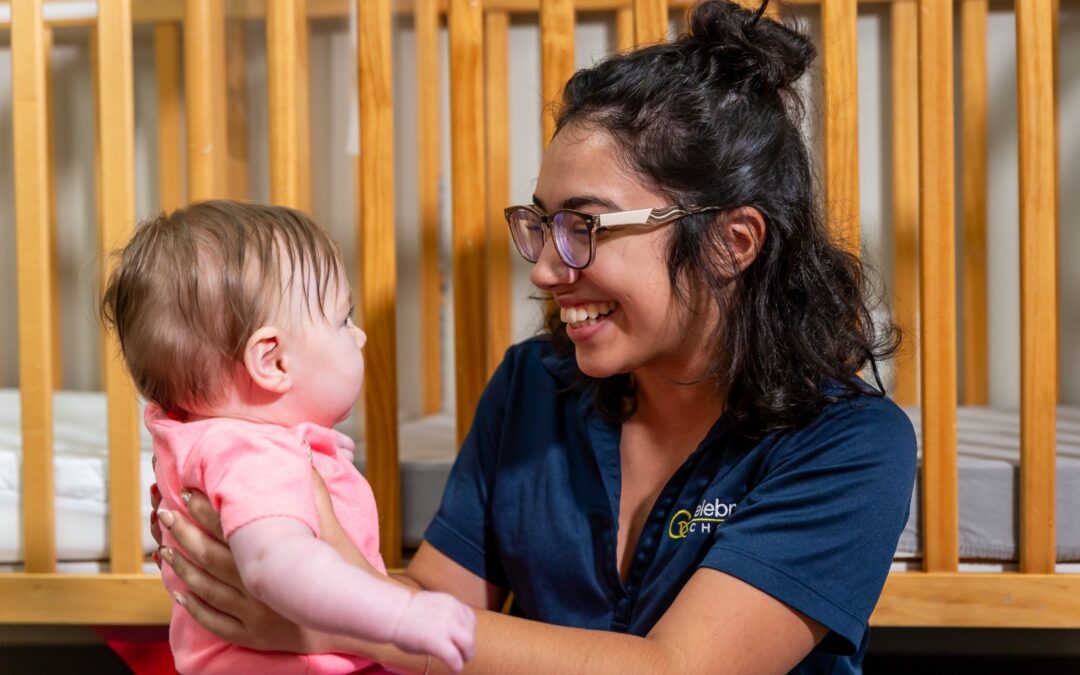
When you hand your baby to someone else in the morning, you are also handing over a lot of information that may be second nature to you.
You know which cry usually means hunger. You know how your baby acts when they are overtired. You may know that this week’s nap routine looks completely different from last week’s.
At Celebree School of Ashburn Farm, infants can begin care at 6 weeks, and each baby is assigned a primary caregiver.
That gives one educator repeated opportunities to become familiar with your child’s routines, preferences, and changing needs while your baby is still part of a larger infant classroom.
What Is a Primary Caregiver in an Infant Classroom?
A primary caregiver is an educator who takes a particularly active role in getting to know your baby. That may include becoming familiar with:
- Feeding habits
- Sleep cues
- Comfort preferences
- Ways your baby communicates
- Current interests
- Changes you are seeing at home
This does not mean your baby will only ever interact with one teacher.
Other educators are still part of the classroom, and your child will experience the broader environment around them. The primary caregiver provides an additional point of familiarity within that setting.
Over time, that person can build a clearer picture of what a typical day looks like for your baby and notice when something begins to shift.
How Does Someone Learn Your Baby’s Routine?
Getting to know a baby involves more than memorizing feeding and nap times.
A caregiver may gradually notice how your baby shows they are getting tired, what tends to help them settle, when they are most interested in interaction, or how they respond when a familiar routine changes.
You help fill in that picture too.
Ashburn Farm uses morning check-ins to learn when your baby last ate, slept, and was changed. You can also share anything different about that morning.
Maybe your baby woke unusually early. Perhaps they ate later than normal or had a restless night.
Those details give the caregiver context instead of asking them to interpret the day without knowing what happened beforehand.
What Does One-on-One Care Look Like During Feeding and Rest?
Some of the most ordinary parts of an infant’s day create natural opportunities for one-on-one interaction. At Ashburn Farm, babies are held during feedings and rocked to sleep.
During a feeding, a caregiver may notice whether your baby seems especially alert, tired, distracted, or interested in interaction.
Settling for rest can offer another glimpse into what currently helps your child feel comfortable.
These moments are not separate from getting to know the baby. They are part of how familiarity develops.
What works today may also change later, which makes repeated interaction especially useful during a stage when routines can shift quickly.
How Does the Rest of the Classroom Fit In?
Having a primary caregiver does not mean your baby spends the day in one-on-one care.
They are still part of an infant classroom filled with voices, movement, books, music, other babies, and opportunities to explore.
Depending on their age and interests, your baby may spend time listening to songs, looking at books, moving on the floor, exploring safe objects, or interacting with different educators.
They may also watch what other babies are doing or become interested in something happening elsewhere in the room.
The primary caregiver becomes one familiar person within that larger experience.
That balance allows your child to be part of a classroom while still having someone who is becoming especially familiar with the details of their day.
How Can a Primary Caregiver Support Early Learning?
Familiarity can also help teachers notice what captures your baby’s attention.
Maybe your child consistently responds to music. Perhaps reaching and grasping have suddenly become a major focus. They may be experimenting with a new sound or showing more interest in books.
Those observations can help shape what teachers offer next.
Ashburn Farm’s infant care plans include areas such as language, physical development, personal and social development, gross and fine motor experiences, and simple sign language.
Celebree’s approach also uses observation and developmental assessment to guide developmentally appropriate experiences.
That means infant learning does not have to follow a preset lesson.
A caregiver who notices your baby repeatedly reaching toward objects may offer more opportunities to grasp and explore. If your child is especially interested in voices and sounds, conversation, songs, and simple signs may become a natural part of awake time.
The caregiver’s familiarity helps connect what your baby is doing now with experiences that make sense for them.
What Happens When Your Baby Changes?
The baby a caregiver gets to know at 6 weeks will not stay the same.
Feedings may shift. Naps may change. Awake periods may grow longer. Movement and communication may become much more active.
Celebree School of Ashburn Farm separates infant classrooms into groups for babies from 6 weeks to 9 months and from 9 to 18 months.
Those age ranges reflect how different the early and later parts of infancy can look.
A younger baby may spend more time feeding, sleeping, being comforted, and observing. Later, your child may be moving around the room, exploring objects, responding more actively to books and music, or communicating through a wider range of sounds and gestures.
A primary caregiver who already knows your child has context for noticing those changes as they happen.
How Do You and the Primary Caregiver Keep Each Other Updated?
The caregiver sees one part of your baby’s life. You see another. Keeping those two perspectives connected can help everyone understand what is changing.
In the morning, you might mention how your baby slept, when they last ate, or something new you noticed overnight.
At the end of the day, Ashburn Farm can share information about meals, diaper changes, naps, play, and other observations.
Celebree also uses Tadpoles to provide daily information, photos, and messages. The technology is useful, but the larger point is the continuity of information.
If your child has started sleeping differently at home and the caregiver is noticing the same change at school, that is helpful context for both sides.
What Should You Ask About the Primary Caregiver Model?
If you are considering infant daycare, it can help to understand how the primary caregiver role works in practice.
You might ask:
- How is a primary caregiver assigned?
- What role does that person play during feeding and naps?
- How do other teachers interact with my baby?
- How are changes in my baby’s routine shared?
- How does the caregiver contribute to the individual care plan?
- What happens when my baby moves into an older infant classroom?
Those answers can give you a clearer picture of how familiarity and teamwork fit together throughout the day.
Learn More About Infant Daycare at Celebree School of Ashburn Farm
If you are considering infant daycare at Celebree School of Ashburn Farm, schedule a visit and ask how the primary caregiver model would work for your baby.
Share what you already know about their feeding, sleep, comfort, communication, and current interests, and learn how that information carries into the classroom as your child grows.