
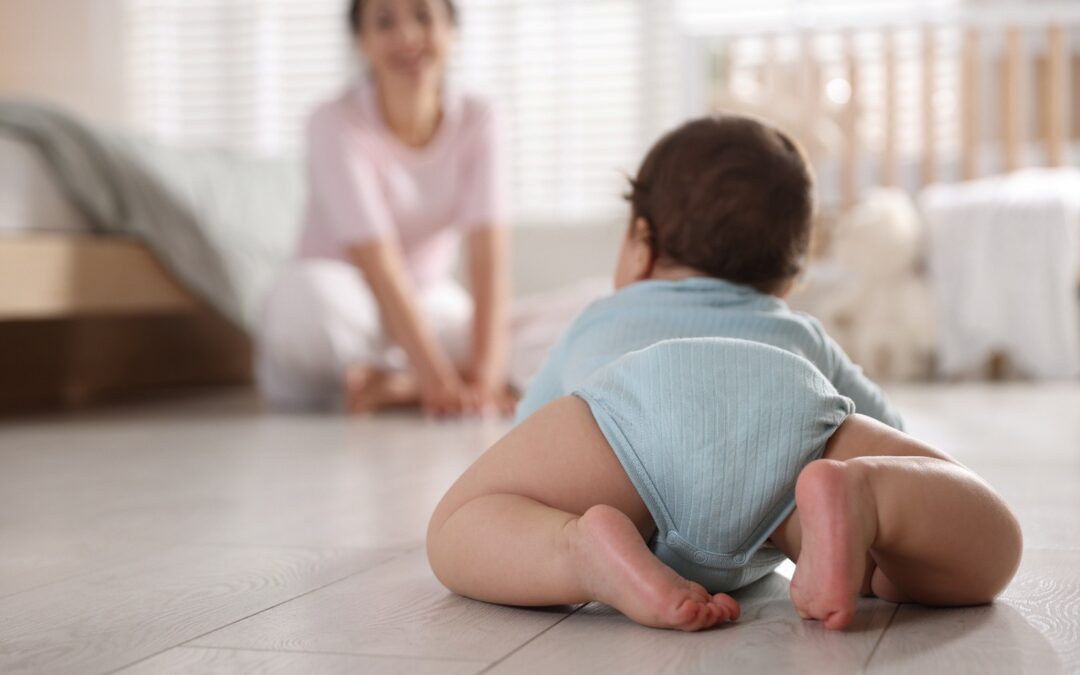
Babies are often described as moving through a neat sequence: sit, crawl, stand, walk.
Real life is usually less orderly.
If you are wondering when do babies start crawling, many begin traditional hands-and-knees crawling around 7 to 10 months. Some start earlier or later. Others may scoot, belly-crawl, roll, or use another way to get across the floor.
And yes, some babies never spend much time crawling on their hands and knees at all.
Does Every Baby Crawl?
Traditional crawling is common, but it is not something every baby does.
Some babies move forward on their bellies. Others scoot while sitting, roll toward what they want, or combine several movement styles. A few may become interested in pulling up and moving while upright without ever becoming dedicated hands-and-knees crawlers.
That can be surprising when so many milestone charts make development look like a fixed sequence. The better question is often not simply, “Is my baby crawling?” but, “How is my baby becoming more mobile?”
With that in mind, you know your baby best. If something seems off, do not hesitate to bring it up with your pediatrician.
What Does It Mean to Skip Crawling?
When people say a baby “skipped crawling,” they usually mean the baby did not spend much time using a traditional hands-and-knees crawl.
It does not necessarily mean the baby went from staying in one place to suddenly walking.
Before walking, a baby who does not crawl traditionally may still be rolling, pivoting, scooting, changing positions, pulling up, or moving along furniture.
All of those movements require growing control and coordination.
Does a Baby Need to Crawl Before Walking?
There is no single route every baby must follow.
Some babies crawl for months before taking their first independent steps. Others become interested in standing and cruising sooner. Crawling, pulling up, cruising, and other movement skills can overlap rather than appearing one at a time.
That is why predicting exactly when walking will happen based on crawling alone can be difficult.
Your baby’s movement may change quickly during this stage, and one skill does not always have to be completely mastered before another begins.
Does Skipping Crawling Cause Problems Later?
Parents sometimes hear that babies must crawl in order to avoid learning or reading difficulties later.
That idea can create unnecessary worry. Current pediatric guidance does not support the claim that skipping traditional crawling causes later reading problems.
It is still useful to pay attention to your baby’s overall physical development. Crawling is one way babies practice movement and explore their surroundings, but it is not the only way they can develop strength, coordination, and greater independence.
Watch How Your Baby Is Moving
Instead of waiting for one particular crawling style, notice how your baby’s abilities are changing.
Can they reach and shift their weight more easily? Are they moving between positions? Have they figured out a way to get closer to something they want? Are they becoming more controlled and confident in how they use their body?
Those observations can give you a fuller picture than a single milestone.
If something about your baby’s movement concerns you, talk with their pediatrician. A loss of a skill they previously had or a persistent difference in how they use the two sides of their body is also worth discussing.
Give Your Baby Space to Explore
Babies need opportunities to experiment with movement in their own way.
Supervised time on a safe floor gives your baby room to roll, reach, pivot, scoot, crawl, or try another way of getting around. A favorite toy or familiar face nearby may give them something interesting to move toward.
There is no need to repeatedly place your baby into a crawling position or pressure them to follow a particular sequence.
Stay nearby, keep the space safe, and let movement develop through everyday exploration.
Supporting Individual Development at Celebree School of Wylie
At Celebree School of Wylie, infant teachers pay attention to where each child is developmentally and provide age-appropriate opportunities for movement and exploration throughout the day.
One baby may be working on sitting more steadily. Another may be scooting toward toys. Someone else may be experimenting with pulling up.
Teachers can observe those changes and share what they notice with families without expecting every baby to follow the same timetable or movement pattern.
Follow Your Baby’s Progress
Crawling is an exciting change, but traditional hands-and-knees crawling is not the only path toward mobility.
Notice how your baby is gaining control, finding new ways to move, and becoming more interested in exploring the space around them. If something worries you, your pediatrician can help you look at development more broadly.
If you are looking for daycare in Wylie, TX, Celebree School of Wylie provides infants with safe opportunities to move, explore, and develop at their own pace. Schedule a visit to meet our team and learn more about infant care at Celebree.