
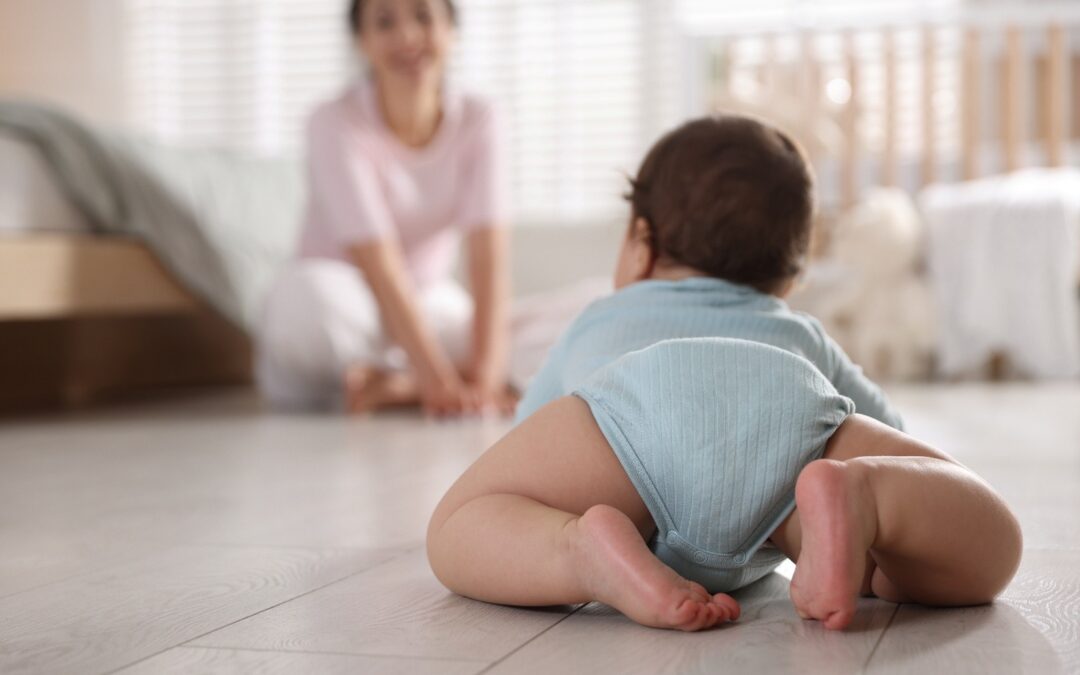
Eight months can be an especially interesting stage for movement. One day your baby may stay happily in one spot, and the next they are turning toward a toy, scooting across the floor, or trying to push forward.
When do babies start crawling? Many begin somewhere around 7 to 10 months, which puts 8 months right in the middle of that common range. Still, there is no single way crawling has to look at this age.
Is 8 Months a Common Age to Start Crawling?
Yes. For many babies, 8 months falls within the period when crawling begins to take shape.
Some babies may already be moving confidently across the room. Others are still experimenting with balance, shifting their weight, or figuring out how to move forward.
A baby who is not crawling yet at 8 months may still be developing plenty of other movement skills.
Crawling May Still Look a Little Unpolished
Those first attempts do not always look smooth.
Your baby may move a few inches and stop. They might push backward instead of forward, drop onto their belly, or change direction halfway toward a toy.
You may also notice short bursts of movement rather than long stretches of crawling. Early mobility often involves plenty of experimenting before your baby finds a pattern that works.
Your Baby May Be Working on Something Else
Not every 8-month-old is focused on crawling. Your baby may be more interested in:
- Rocking on hands and knees
- Pivoting toward something nearby
- Scooting
- Rolling to another part of the floor
- Sitting and reaching in different directions
- Moving between positions
These changes can all be part of becoming more comfortable and capable with movement.
What If Crawling Hasn’t Started Yet?
At 8 months, there is still room for variation.
One baby may crawl early in the month while another is still figuring things out several weeks later. Some babies also use a different movement style before traditional hands-and-knees crawling appears.
Try not to turn 8 months into a deadline. Instead, notice whether your baby is gaining new ways to reach, turn, shift, or explore.
Let Curiosity Lead the Way
You do not need to create a formal crawling routine.
Supervised floor time and a few interesting objects nearby can be enough to encourage movement naturally. Your baby may reach, roll, scoot, or work their way toward something that catches their attention.
The goal is not to make crawling happen sooner. It is to give your baby space to experiment.
When Is a Movement Question Worth Asking?
If something about your baby’s movement concerns you, bring it up with your pediatrician.
That is especially important if your baby loses a skill they previously had, consistently favors one side of the body, or seems unusually stiff or floppy.
A pediatrician can look at what you are noticing as part of your child’s overall development rather than focusing on crawling alone.
More of the Room Comes Into Reach
At 8 months, even a small change in movement can make familiar surroundings feel brand new. A toy that was once out of reach may suddenly become a destination. A baby who has been sitting in one spot may begin turning, scooting, or crawling toward something interesting.
At Celebree School of Virginia Beach, age-appropriate play and sensory experiences give infants opportunities to follow that growing curiosity throughout the day. Teachers also keep families connected to the changes they notice as babies become more active and mobile.
You can learn more about infant care and day care in Virginia Beach, VA, through Celebree School of Virginia Beach.