
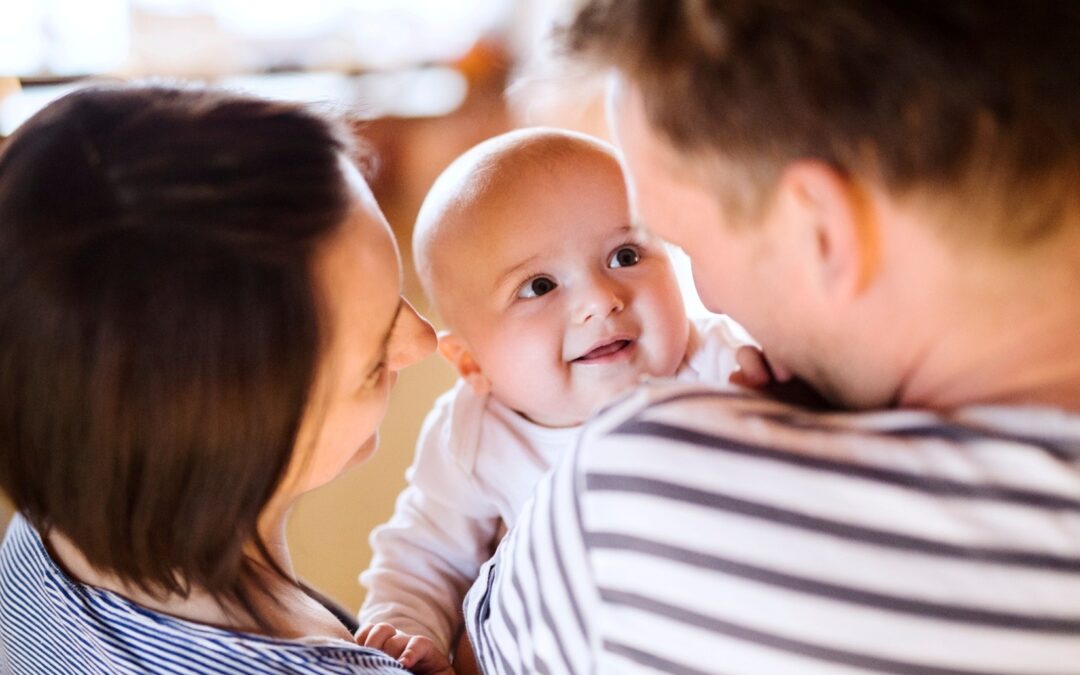
Long before babies can crawl across a room or say their first word, they are already busy taking in the world around them. A newborn may study a nearby face or react to a familiar voice. A few months later, that same baby may reach for an interesting toy, turn toward a sound, or use both hands and mouth to investigate something new.
These everyday moments are part of your baby’s development. As movement, attention, and coordination grow during the first year, so do the ways babies explore through sight, sound, touch, and movement.
Every baby develops differently, so these baby milestones are best viewed as general guideposts rather than a schedule every child should follow exactly.
In the First Months, Babies Are Learning What to Notice
During the earliest weeks, much of a baby’s world is close by.
Around 1 month, babies may briefly focus on nearby faces, react to sounds, and turn toward familiar voices. Movement is still largely reflexive, and physical contact plays a big role in how babies experience their surroundings.
By about 2 months, many babies look closely at faces, watch people move, notice a toy for a short time, and respond more clearly to voices. They may also begin holding their head up briefly during tummy time.
Around 3 months, babies often spend more time studying their own hands, bringing them toward the mouth, cooing, and beginning to swipe toward nearby objects.
At this stage, simply watching, listening, and moving are important forms of exploration.
Faces, Voices, and Movement Become More Interesting
By around 4 months, babies often become much more active during their awake time.
Many begin turning toward voices, looking at their hands with interest, swinging toward toys, and bringing their hands or objects toward the mouth. Tummy time may also look different as babies gain more strength through the shoulders and upper body.
Around 5 months, visual attention and reaching often become more deliberate. Instead of simply watching a toy, your baby may stretch toward it and try to grab it.
When Do Babies Start Tracking and Reaching for Things?
Visual attention develops before precise reaching.
A younger baby may watch an object move from one side to the other. As coordination improves, swiping becomes more purposeful. By around 6 months, many babies reach for toys they want.
That progression shows how several abilities begin working together: noticing something, judging where it is, moving toward it, and making contact.
Babies Explore With Their Hands and Mouths
If it seems like every safe toy eventually ends up in your baby’s mouth, that is a familiar part of infancy.
Around 5 to 6 months, babies often explore objects by touching, holding, turning, shaking, and mouthing them. A toy’s texture, shape, temperature, weight, and sound all offer new information.
By around 6 months, many babies also laugh, recognize familiar people, take turns making sounds, reach for objects, and roll.
A rattle, soft book, textured toy, or safe object made for infant play may provide plenty to investigate without requiring anything elaborate.
Sitting Changes the View
Sitting does more than change a baby’s posture. It changes what they can see and reach.
Around 7 months, many babies are becoming steadier while sitting and may use both hands more during play. They can look around from a different position, reach toward nearby objects, and spend longer examining what they find.
By about 8 months, some babies sit with greater control and turn their bodies toward interesting sounds, toys, or people. They may pass an object between their hands, bang it against another surface, or repeatedly turn it over.
These actions combine movement with curiosity.
Mobility Makes the World Bigger
During the second half of the first year, some babies begin moving beyond what is immediately within reach.
Around 8 to 9 months, babies may experiment with crawling, scooting, creeping, rolling, or another way of getting around. There is plenty of variation in how and when mobility develops.
By around 9 months, many babies sit without support, move objects between their hands, search for something that falls out of sight, respond when their name is called, and lift their arms to be picked up.
Mobility adds another layer to sensory exploration because babies can begin choosing what to approach. An interesting toy across the floor, a familiar person nearby, or a new texture may suddenly be something they can move toward themselves.
Near the First Birthday, Exploration Becomes More Purposeful
During 10 and 11 months, babies often become more precise in how they move and handle objects.
They may pull themselves up for a better view, cruise along furniture, imitate a familiar movement, or use their fingers with greater control.
By around 12 months, many babies:
- Wave goodbye
- Play simple interactive games
- Pull to stand
- Move while holding onto furniture
- Pick up small objects with the thumb and pointer finger
- Understand familiar words such as “no”
- Use “mama,” “dada,” or another special name meaningfully
Some babies are walking independently by this point, while others continue crawling or cruising. Independent walking is not required at 12 months.
What often stands out near the first birthday is how intentional exploration has become. Babies may move toward something they want, pick it up carefully, study it, and then look back toward you as if to share the experience.
Sensory Play Does Not Need to Be Complicated
You do not need a long list of special activities to give a baby interesting things to notice. Sensory experiences are already part of ordinary life:
- Listening to a familiar voice or song
- Feeling different safe textures
- Looking at books and pictures
- Reaching for toys during floor play
- Watching movement around the room
- Handling objects made for infant exploration
- Moving between different positions during play
The goal is not to overwhelm babies with stimulation. A few safe, age-appropriate experiences and time to investigate them are often enough.
Exploration Is Part of Everyday Infant Care
Babies learn a great deal through ordinary routines and interactions with familiar caregivers.
At daycare in Smyrna, GA, nurturing interactions, familiar routines, sensory experiences, and time to explore give babies opportunities to notice, reach, move, and interact with their surroundings throughout the day.
For a younger baby, that may mean watching a caregiver’s face or listening to a song. A few months later, it may look like reaching toward a textured toy, sitting to explore an object, or moving toward something interesting across the floor.
Babies Take In the World in Different Ways
One baby may seem fascinated by sounds and voices. Another may want to touch everything within reach. A third may spend a great deal of time quietly watching before becoming more physically adventurous.
Those differences do not make one style of exploration better than another.
Look at your baby’s development across movement, communication, social interaction, and play over time. If your baby is not meeting expected milestones, loses a skill they previously used, or you have concerns about vision, hearing, movement, communication, or development, talk with your child’s pediatrician.
During the first year, exploration grows along with your baby. What begins as a glance, a sound, or a small movement gradually becomes a much more active way of discovering the world.