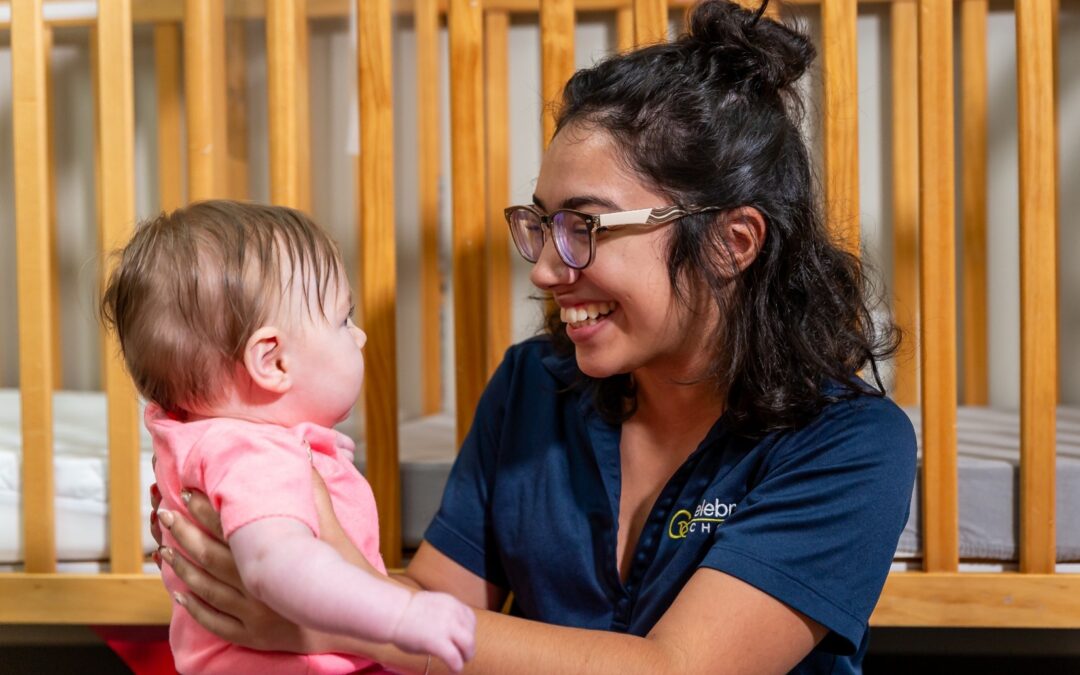
Babies do not always follow the plan for the day.
Your baby might arrive hungry earlier than expected after a different morning at home. On another day, they may need more sleep, extra comfort, or a little time before they are ready to interact with the room.
At Celebree School at San Pablo, infant care begins at 6 weeks. Teachers work with families to understand each child’s routines and continue paying attention as those needs shift throughout infancy.
That ability to notice and adjust is an important part of responsive infant care.
Getting to Know Your Baby
Families already know a great deal about how their baby eats, sleeps, settles, and communicates.
Sharing those details gives teachers helpful context from the beginning. Celebree School at San Pablo develops individual care plans with families and assigns each infant a primary caregiver.
Over time, caregivers can become familiar with things like how your baby tends to show tiredness, what helps them settle, and whether feeding or sleep has started to look different.
That familiarity makes it easier to recognize when your child needs something outside their usual pattern.
Feeding and Sleep Do Not Always Follow the Clock
Feeding and rest take up a significant part of an infant’s day, especially in the earliest months.
At Celebree School at San Pablo, babies are held during feedings and rocked to sleep. Morning check-ins also help teachers understand when your child last ate, slept, and was changed.
The routine provides a useful reference point, but the day still needs room for normal variation.
If your baby seems hungry sooner than usual, that information matters. The same is true when a child appears ready for rest earlier after a difficult night.
Infant care works best when the schedule helps inform the day without becoming the only thing teachers pay attention to.
Some Days Need a Different Pace
Even familiar routines have off days.
Your baby might want a quieter morning instead of active floor time. A nap could run longer than expected, or settling might take more time.
Those differences do not automatically signal a problem. Babies can simply need different things from one day to the next.
Teachers can keep your child’s usual patterns in mind while adjusting the pace when the day calls for it.
Early Learning Can Follow Their Interests
The same approach applies to learning.
Celebree School at San Pablo includes personal and social development, language, physical development, gross and fine motor experiences, developmental observation, and simple sign language within infant care.
Teachers can use what they observe to decide which experiences are worth building on.
A strong interest in voices might lead to more conversation or songs. Increased interest in movement can create opportunities to spend more time exploring on the floor.
Infant curriculum does not require every child to complete the same activity. What captures your baby’s attention can help guide what comes next.
Familiarity Still Matters
Adjusting to individual needs does not mean every day feels completely different. Familiar caregivers and recognizable care routines remain part of the infant experience.
A primary caregiver who knows how your baby usually eats, rests, settles, and engages with the room has useful context when something starts to shift.
Sleep patterns can move. Feeding needs evolve. A child who once spent more time watching may become increasingly interested in movement or interaction.
Having familiar adults nearby can help teachers notice those changes as they happen.
The Day Changes Across Infancy
Celebree School at San Pablo has separate infant classrooms for babies from 6 weeks to 9 months and from 9 to 18 months.
The balance of the day can look very different across that period.
Earlier in infancy, feeding, sleep, comfort, and close interaction often occupy more time. Longer awake periods later on can open up more opportunities for movement, books, sounds, gestures, objects, and exploration.
Children move through these changes at their own pace. The classroom groupings reflect broad differences across infancy while still allowing care to stay individualized.
Keeping Home and School Connected
What happens before drop-off can influence the day ahead. A shorter night of sleep, an earlier feeding, or a recent change in naps can all be useful for teachers to know.
Celebree School at San Pablo also shares end-of-day information about meals, diaper changes, naps, and play so families have a clearer picture of what happened while they were apart.
Those conversations become especially helpful when a new pattern starts to emerge. Parents and teachers can compare what they are each noticing and keep the baby’s care current.
What Parents Can Expect From Responsive Infant Care
Responsive care does not mean abandoning routines or changing plans constantly. It means teachers know the familiar patterns while still paying attention to the child in front of them.
Parents should be able to have useful conversations about how their baby eats, sleeps, settles, interacts, and spends time awake, along with anything that seems to be changing.
That becomes increasingly important throughout infancy, when the routine that works today may look different several months from now.
Learn More About Infant Daycare at Celebree School at San Pablo
If you are considering infant daycare at Celebree School at San Pablo, schedule a visit and talk with the team about your baby’s current feeding, sleep, comfort, and awake-time routines.
You can also ask how teachers adjust when those needs shift and how observations from the classroom are shared with families.