
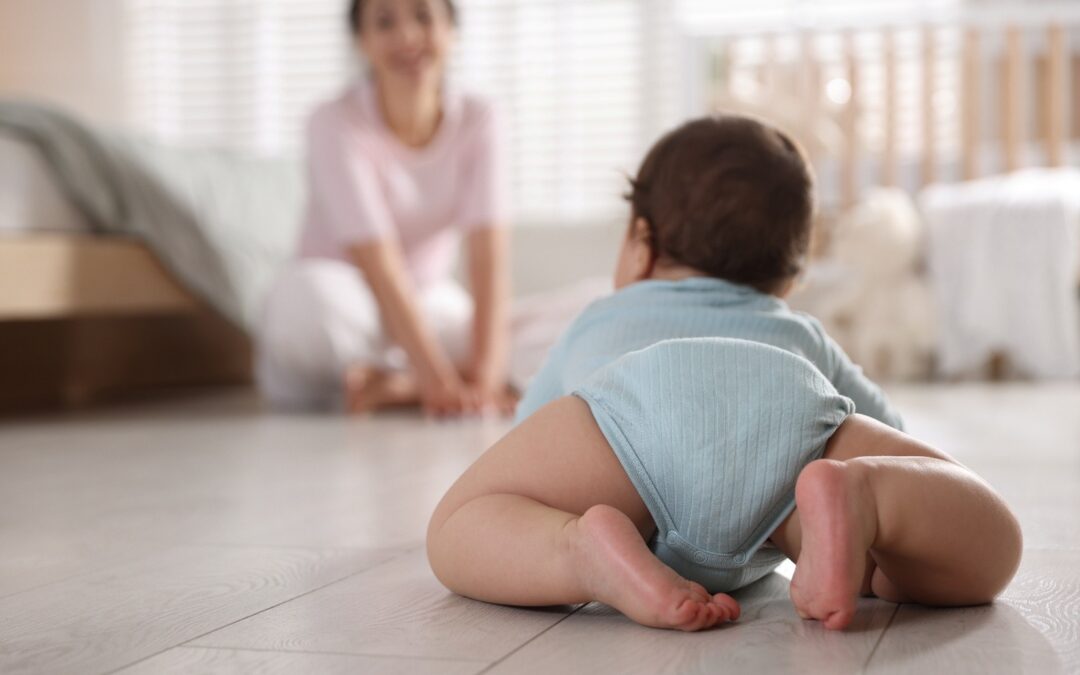
At 8 months, your baby may seem much busier on the floor than they did a few weeks ago. They sit up to play, twist toward something interesting, roll to a new spot, or somehow end up facing the opposite direction.
But they still aren’t crawling.
If you’re wondering when do babies start crawling, many babies master traditional crawling between about 7 and 10 months. At 8 months, some babies are already on the move while others are still working out how to get from one place to another.
Instead of looking only for a hands-and-knees crawl, it can help to notice all the other ways your baby’s movement is changing.
At 8 Months, Look at What Your Baby Can Do Now
A month can make a noticeable difference at this age.
Your baby may be sitting more steadily and reaching farther without toppling over. They might turn their body to follow a toy, roll with more purpose, or use their hands differently to support themselves.
AAP describes babies around this stage as becoming increasingly mobile, with sitting, reaching, rolling, and experimenting with different forms of movement all part of the picture.
Those changes can be easy to overlook if you are waiting for one specific milestone. Try comparing your baby with themselves a few weeks ago rather than asking only whether crawling has started.
Your Baby May Already Be Getting Around
Traditional crawling is not the only way an 8-month-old can become more mobile.
Maybe your baby rolls repeatedly until they reach the object they want. Perhaps they pivot around while sitting, move on their belly, or have begun scooting a short distance.
Some babies spend time experimenting with several methods before one becomes their favorite.
AAP notes that babies may crawl, scoot, move on their stomachs, or use other approaches to mobility. A few never use the classic hands-and-knees crawl at all.
So, if your baby is finding new ways to explore the floor, that progress matters even when you have not yet seen a traditional crawl.
Sitting Can Tell You Quite a Bit
At this age, sitting is another useful movement to notice.
A baby who can sit steadily has a different view of the room and more freedom to reach in several directions. You may see them lean toward a toy, catch themselves with a hand, straighten back up, and immediately reach for something else.
They may also begin figuring out how to get from sitting toward the floor.
These transitions can look ordinary, but they require your baby to control their body in increasingly complex ways. AAP advises parents to let their pediatrician know if a baby is not sitting independently by 9 months.
For an 8-month-old, watching sitting and position changes can give you more useful context than treating crawling as the only movement that counts.
Progress Doesn’t Always Move Forward
Sometimes physical progress looks surprisingly inefficient.
Your baby may lean toward a toy and end up lying on their stomach. They may push with their arms and move backward instead of forward. They might turn halfway around before giving up on the object they originally wanted.
Those attempts may look like they went nowhere, but your baby is still learning what happens when they shift their weight, push against the floor, or move from one position into another.
It can take repeated attempts before those movements start helping a baby travel efficiently. That is one reason the lead-up to crawling can be harder to recognize than the finished skill.
Give Them Something Interesting to Move Toward
You do not need to turn floor time into a crawling lesson.
Place a favorite toy nearby. Sit where your baby can see you. Give them room to reach, roll, turn, or try another way of moving closer.
CDC encourages parents to place toys slightly out of reach and let babies crawl, scoot, or roll toward them.
The distance does not need to be challenging. A toy that is just beyond an easy reach can be enough to invite movement without creating frustration.
Some days your baby may make a determined effort. On others, they may decide whatever is already within reach is perfectly interesting.
Don’t Let 8 Months Become a Deadline
Once parents hear that crawling commonly begins around this age, it is easy for 8 months to start feeling like a checkpoint.
It isn’t.
Some healthy 8-month-olds crawl quickly. Others are still experimenting with rolling, sitting, belly movement, or another strategy.
Rather than counting the weeks until your baby crawls, notice whether their movement is changing.
Are they becoming steadier? Reaching farther? Moving into new positions? Showing more interest in getting to something on the other side of the mat?
Those everyday changes give you a fuller view of development.
When Should You Ask Your Pediatrician?
Not crawling at 8 months by itself does not automatically indicate a problem. Still, you do not need to dismiss a concern simply because crawling has a broad age range.
Talk with your pediatrician if your baby loses a skill they previously had, consistently seems to use one side differently from the other, appears unusually stiff or floppy, or shows very little movement overall.
As 9 months approaches, sitting independently is another ability worth discussing if it has not developed.
CDC encourages families to speak with their child’s doctor whenever a child is not meeting milestones, loses skills, or the parent has concerns. Crawling itself is not included on the CDC’s current 9-month milestone checklist.
You can describe what you have been seeing without trying to determine the cause yourself.
Watching Progress at Celebree School of Owings Mills
At Celebree School of Owings Mills, infant teachers see many versions of movement developing throughout the day.
One 8-month-old may already be crawling across the play space. Another may be rolling toward toys, while someone else is becoming noticeably steadier while sitting and reaching.
The infant program includes individualized care plans and age-appropriate opportunities for physical development, including tummy time, reaching, grasping, and movement. Teachers also recognize and document milestones as they emerge.
Sharing those observations with families can help parents notice changes that might be easy to miss from one day to the next.
The goal is not to make every baby crawl on the same timeline. It is to provide safe opportunities to move and stay connected with families as new abilities develop.
Notice the Progress Before the Crawl
An 8-month-old can be making plenty of physical progress before taking that first trip across the room.
Maybe today it is a longer reach. Next week, it could be a smoother transition from sitting to the floor. Crawling may follow soon, or your baby may continue experimenting for a while.
Give them safe space to explore, watch how movement changes, and bring any concerns to your pediatrician rather than relying on a single crawling age.
Families looking for daycare in Owings Mills, MD can visit Celebree School of Owings Mills to learn more about individualized infant care and the everyday opportunities babies have to move, explore, and grow. Reach out to arrange a tour and see the infant program in person.