
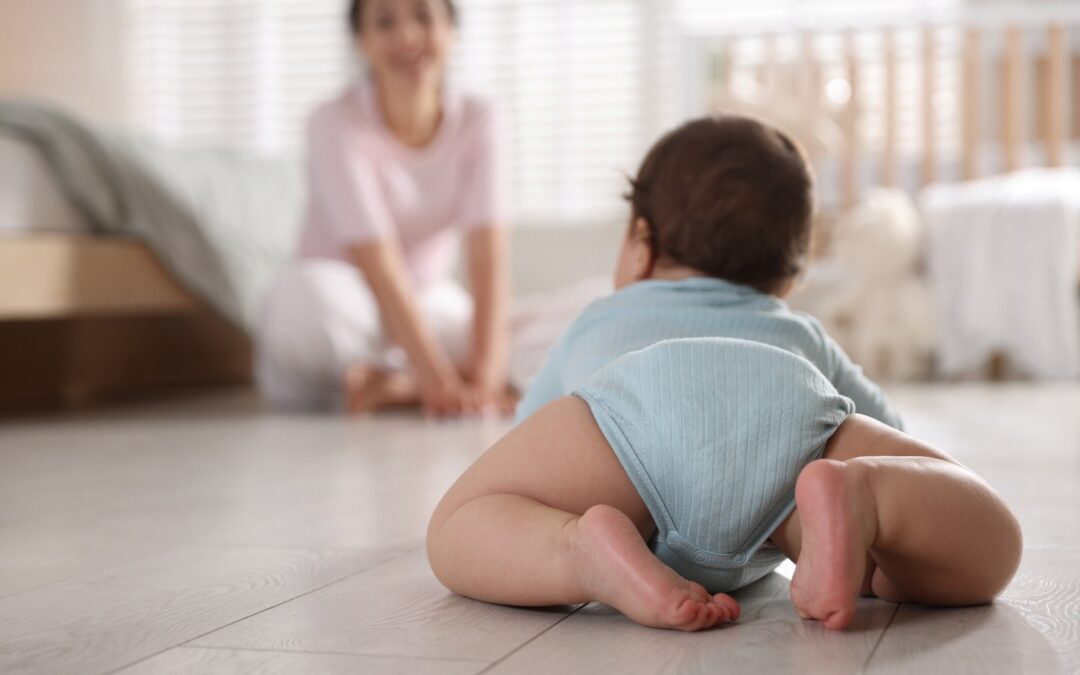
A play blanket can feel like plenty of space when your baby is staying mostly in one spot. Then one day, they figure out how to get beyond it.
If you are wondering when do babies start crawling, many babies begin traditional hands-and-knees crawling around 7 to 10 months. Some start earlier or later, while others scoot, roll, or move on their bellies instead.
However your baby becomes mobile, their surroundings suddenly matter in a new way. They need safe places where they can turn, reach, change direction, and see what happens when they try to get somewhere on their own.
A Newly Mobile Baby Uses the Room Differently
Before crawling begins, you may choose most of what comes within your baby’s reach.
Mobility changes that.
A toy on the other side of the mat can become a destination. Your baby may turn toward a familiar voice, move closer to an object, pause to investigate something along the way, then head in a completely different direction.
That means the floor is no longer just where your baby sits or plays. It becomes part of how they explore.
Giving babies enough room to move lets them practice using their bodies in ways that are difficult when they are confined to a seat, swing, or other small space for long periods.
Babies Don’t Need a Complicated Crawling Setup
There is no special course or elaborate equipment required for crawling practice. A safe section of floor, a few age-appropriate toys, and an adult nearby can provide plenty of opportunity.
You might place an interesting object a short distance away and see whether your baby decides to move toward it. They may crawl. They may roll. They may turn around and become fascinated with something you hadn’t planned on at all.
The point is to give your baby room to make some of those decisions themselves.
Leave Space for Trial and Error
Early movement can look messy.
Your baby may start in one direction and end up somewhere else. They might move backward when they were clearly trying to go forward. They may reach, pause, sit back down, or try the same movement several times.
That experimentation is part of learning how their body works.
Adults do not need to constantly reposition a baby or guide every attempt. Sometimes giving your baby a little space to work through the movement is more useful than stepping in immediately.
Stay close enough to keep the area safe, but allow time for your baby to try, pause, and try again.
What Should Be Within Reach?
A crawling space does not need to be filled with toys. In fact, too much clutter can make it harder for a baby to move freely.
Choose a few safe objects that your baby can reach for, turn toward, or explore. You can change them out periodically to keep the space interesting without overwhelming the floor.
Once mobility increases, also pay attention to what has unintentionally become reachable. A baby may suddenly discover a cord, low shelf, shoe, bag, or other everyday object that never mattered when they stayed in one place.
The goal is a space that offers something to explore while still leaving plenty of open room for movement.
Does a Crawling Baby Need Special Equipment?
Most babies do not need devices intended to “teach” crawling or speed up mobility.
Everyday floor play gives them opportunities to practice reaching, shifting weight, changing positions, and moving in whatever way they are currently able.
Mobile baby walkers are also not a substitute for floor movement. They can give babies access to places and objects they otherwise could not reach and are not needed to help children learn to walk.
Simple is often enough: open floor space, safe objects, supervision, and time.
Supervision Changes Once Crawling Begins
A baby who can cross the room requires a different kind of attention than one who stays where you put them.
You may find yourself thinking less about what is immediately beside your baby and more about where they could be a minute from now.
As your baby’s speed and confidence grow, keep updating the space. Something that was safely out of reach last week may no longer be.
That does not mean hovering over every movement. It means staying aware of how quickly your baby’s abilities are changing.
Movement May Not Look the Way You Expected
Traditional crawling is only one way babies become mobile.
Your baby may scoot, belly-crawl, roll with a purpose, or combine several movements before settling into a method that works well for them.
Some babies also switch between styles depending on the surface or what they are trying to reach.
Give them enough room for the movement they are actually using rather than waiting for one specific crawling pattern.
If something about your baby’s movement concerns you, talk with their pediatrician. A loss of a previously learned skill or a persistent difference in how the two sides of the body are used is also worth bringing up.
Room to Explore at Celebree School of North Dallas
At Celebree School of North Dallas, infant teachers provide babies with age-appropriate opportunities to move and explore in a safe classroom environment.
As babies become more mobile, teachers can adjust to what each child is ready to do. One baby may need space to roll and pivot. Another may be scooting across the floor. Someone else may have recently discovered how quickly crawling can get them from one activity to another.
Teachers observe those changes, provide appropriate opportunities for movement, and keep families informed as new abilities develop.
The goal is not to rush crawling or the skill that comes next. It is to give babies room to use the abilities they are developing now.
Give New Mobility Somewhere to Go
Once your baby starts moving, even an ordinary room becomes much more interesting.
Offer safe floor space, keep a few inviting objects nearby, and give your baby time to experiment without directing every movement. Their path across the room may not be straight or predictable, but figuring it out is part of the experience.
If you are looking for daycare in Dallas, TX, Celebree School of North Dallas provides infants with space to move, explore, and develop at their own pace. Schedule a visit to meet our team and learn more about infant care at Celebree.
