
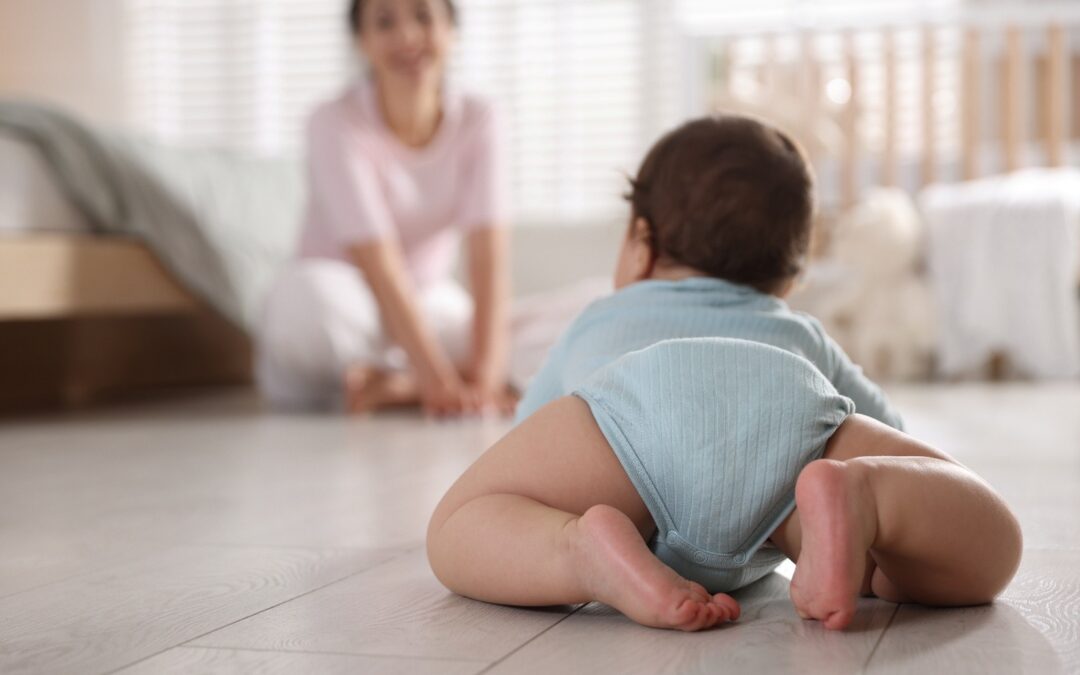
Your baby sees a toy across the floor and clearly wants to get there. They push, twist, turn sideways, and somehow end up farther away than when they started.
Early mobility can look surprisingly uncoordinated.
If you are wondering when do babies start crawling, many babies begin traditional hands-and-knees crawling around 7 to 10 months. Others start earlier or later, and some use scooting, belly movement, rolling, or another way to get around.
Before movement becomes efficient, there can be plenty of trial and error.
Early Attempts May Barely Look Like Crawling
Parents often picture crawling as a clear moment: one day a baby is stationary, and the next they are moving across the room on hands and knees.
The lead-up is usually less tidy.
Your baby might pivot on their belly, push backward, briefly lift onto their hands and knees, return to sitting, or spend several days repeating a movement that does not seem to take them anywhere.
They may also appear close to crawling one week and then spend the next several days more interested in sitting or reaching.
Those changing attempts are part of figuring out movement. They do not need to follow a specific sequence.
Your Baby May Experiment With Several Strategies
Babies do not necessarily settle on one method right away.
A baby who belly-crawls today may begin using hands and knees later. Another may scoot while sitting, roll deliberately toward an object, or combine several techniques depending on where they are trying to go.
Even after crawling begins, the movement can change as babies become stronger and more coordinated. Rather than looking for one perfect pattern, notice how your baby is solving the problem of getting from one place to another.
Going Backward Is Still an Attempt to Move
There is a particular kind of frustration that comes with watching your baby work very hard to reach something in front of them, only to slide backward instead.
Early movement does not always go in the intended direction.
Your baby is learning what happens when they push against the floor, shift their weight, or move an arm or leg. It can take time for those individual actions to come together into forward motion.
Backward movement, turning in circles, or repeatedly changing positions may simply be part of that experimentation. You do not need to reposition your baby every time the attempt goes off course. Give them a safe space and a little time to work through it.
Look for Changes Across Days, Not Minutes
It is easy to watch one floor session and wonder whether anything is happening. Progress may become clearer when you look back over a week or two.
You might notice that your baby is:
- Getting into a position more easily
- Reaching farther without losing balance
- Turning toward objects more deliberately
- Shifting weight with greater control
- Finding more than one way to change position
- Covering a little more ground during play
None of these is a required step toward crawling. They are simply examples of the kinds of changes parents may notice as physical control develops.
The bigger picture matters more than whether today’s attempt looked smoother than yesterday’s.
Give Your Baby Opportunities Without Turning It Into Practice
Babies need opportunities to move, but that does not mean crawling requires drills.
Supervised floor time provides room to reach, turn, roll, scoot, or crawl. A favorite toy placed nearby may give your baby something interesting to move toward, but there is no need to repeatedly position their arms and legs or guide them through a crawling pattern.
Sometimes the best approach is simply to make room and see what your baby tries.
Keep the area safe, stay nearby, and allow enough time for exploration without stepping in after every awkward movement.
An Awkward Attempt Is Different From Losing a Skill
Early movement can be inconsistent. A baby may do something once and then not repeat it for several days. That is different from losing an ability they had previously been using consistently.
If your baby loses a skill they had already developed, you notice a persistent difference in how they use the two sides of their body, or something else about their movement concerns you, talk with their pediatrician.
You do not need to diagnose what you are seeing yourself. Share the specific changes or behaviors you have noticed so your child’s doctor can consider them within the larger developmental picture.
Watching Development at Celebree School of Melford
At Celebree School of Melford, infant teachers pay attention to the small changes that happen before a major milestone becomes obvious.
One day, a teacher may notice that your baby is turning toward toys more easily. Another day, they may spend more time moving between sitting and the floor or trying a new way to travel across the play space.
Those observations can be shared with families without predicting when crawling will happen.
Infant care is individualized around each child’s current stage of development, giving teachers opportunities to respond to what a baby is actually doing rather than expecting every child of the same age to practice the same skill.
That ongoing communication can be especially helpful during a stage when movement seems to change quickly.
Give the Messy Part Some Room
The path toward crawling does not always look organized from the outside.
Your baby may go backward before going forward, change strategies, repeat the same awkward movement dozens of times, or surprise you by finding a way to move that you never expected.
Keep watching what changes over time and give them safe opportunities to experiment. Eventually, those scattered attempts may begin to look much more deliberate.
If you are looking for daycare in Bowie, MD, Celebree School of Melford provides individualized infant care with opportunities for safe movement, exploration, and development throughout the day. Schedule a visit to meet our team and learn more about infant care at Celebree.