
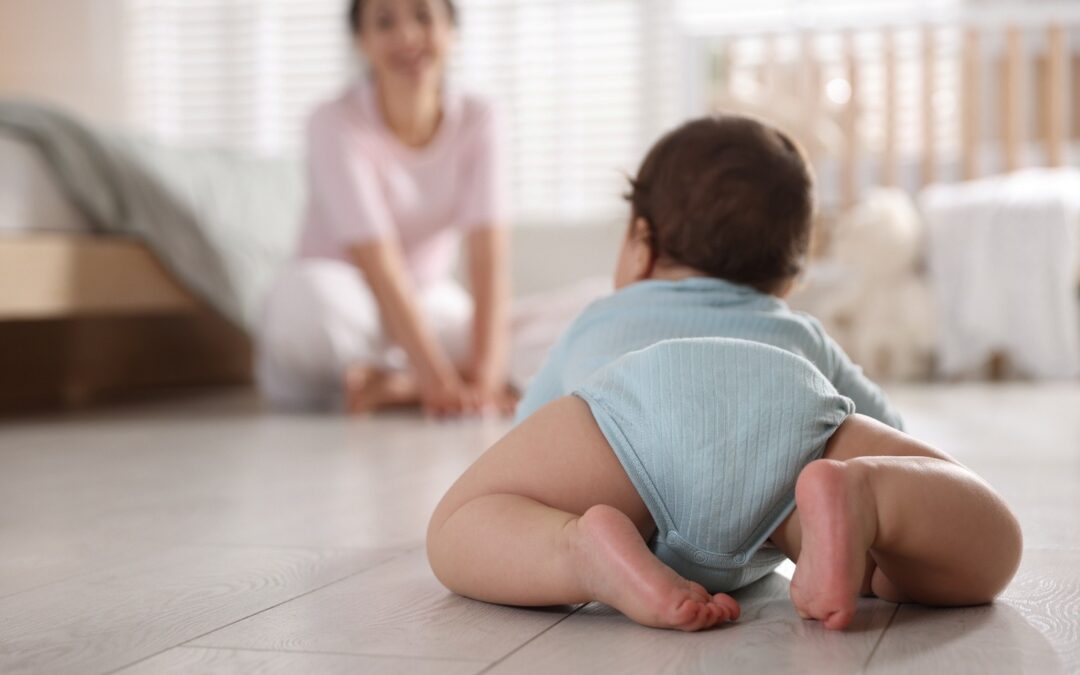
Before a baby starts crawling, there can be a stretch of time when it seems like something new is about to happen. You may notice more reaching, rocking, turning, or determination to get to a toy that used to feel too far away.
These changes can be exciting to watch, especially when you are wondering, when do babies start crawling? Many babies begin crawling around 7 to 10 months, but the movements leading up to it do not follow a set schedule. Think of them as signs your baby is experimenting with mobility, not a countdown to the first crawl.
What Can Happen Before a Baby Starts Crawling?
Crawling requires several things to come together, including balance, coordination, strength, and the motivation to move toward something interesting.
Before forward crawling appears, your baby may spend plenty of time testing what their body can do. One baby might rock on hands and knees. Another may pivot across the floor or stretch farther and farther from a seated position.
These small experiments can look very different from child to child.
Rocking on Hands and Knees Can Be One Clue
Getting onto hands and knees often gets parents’ attention. Your baby may hold the position briefly, rock forward and backward, then drop back onto their belly.
It can look like crawling is about to happen at any moment, but that is not always the case. Some babies practice this movement for quite a while before traveling forward. Others find another way to move instead.
Either way, your baby is learning more about balance and how shifting their weight changes what they can do.
Reaching Starts to Involve the Whole Body
Watch what happens when a favorite toy is slightly farther away than usual.
Your baby may lean to one side, twist, put a hand down for support, or stretch until their entire body is involved in the effort. What begins as reaching can turn into pivoting, scooting, or another attempt to close the distance.
There is no need to keep moving the toy farther away to make the activity harder. A little curiosity can provide plenty of motivation on its own.
Sometimes the First Move Is Backward
One of the more surprising stages can happen when your baby tries to move toward something and ends up going the opposite direction.
Babies may push backward while they are still figuring out how to coordinate their arms and legs for forward movement. Your baby might even become frustrated when the toy they want seems to be getting farther away.
Backward movement does not mean anything has gone wrong. It may simply be part of the experimenting that happens before your baby finds a more effective route.
Does Getting on All Fours Mean Crawling Is Next?
Maybe, but there is no reliable way to predict exactly when it will happen.
A baby can look ready to crawl for days or weeks before taking off. Another may give very few obvious hints and then suddenly find a way across the floor.
Rather than watching the calendar, notice how your baby’s movement is changing. Are they trying new positions? Reaching in new ways? Finding different ways to get closer to what interests them? Those changes can tell you more than trying to predict a specific crawling date.
Your Baby May Choose a Different Way to Get There
Classic hands-and-knees crawling is only one possibility.
Some babies move on their bellies, scoot, roll, or combine several methods as they explore. A baby may also use one style for a while and change it later.
Giving them room to experiment lets them work through movement without repeatedly repositioning them into the crawl you expected to see.
Give Curiosity Somewhere to Go
Supporting movement can be simple.
Supervised floor time gives your baby room to turn, reach, shift positions, and explore. Place a few safe objects within an interesting distance and see what your baby decides to do.
The goal is not to teach crawling or make it arrive sooner. It is to give your baby opportunities to move when curiosity takes over.
Notice Progress Without Watching the Calendar
It is natural to compare what you are seeing with milestone timelines, but one movement does not tell the whole story.
Bring questions to your child’s pediatrician if your baby loses a skill they previously had, consistently favors one side of the body, seems unusually stiff or floppy, or you have another concern about development. You do not need to wait for a certain age before asking.
Small Discoveries Add Up at Daycare
The first crawl may be memorable, but many of the changes leading up to it are much quieter. A baby may reach a little farther, find a new way into position, or spend part of the day determined to get closer to something interesting.
Those everyday discoveries are part of infant care at Celebree School of Matthews, where age-appropriate play and exploration give babies opportunities to move and investigate their surroundings. Regular communication also helps families stay connected to what their child is experiencing throughout the day.
Learn more about the infant program and day care in Matthews, NC, at Celebree School of Matthews.