
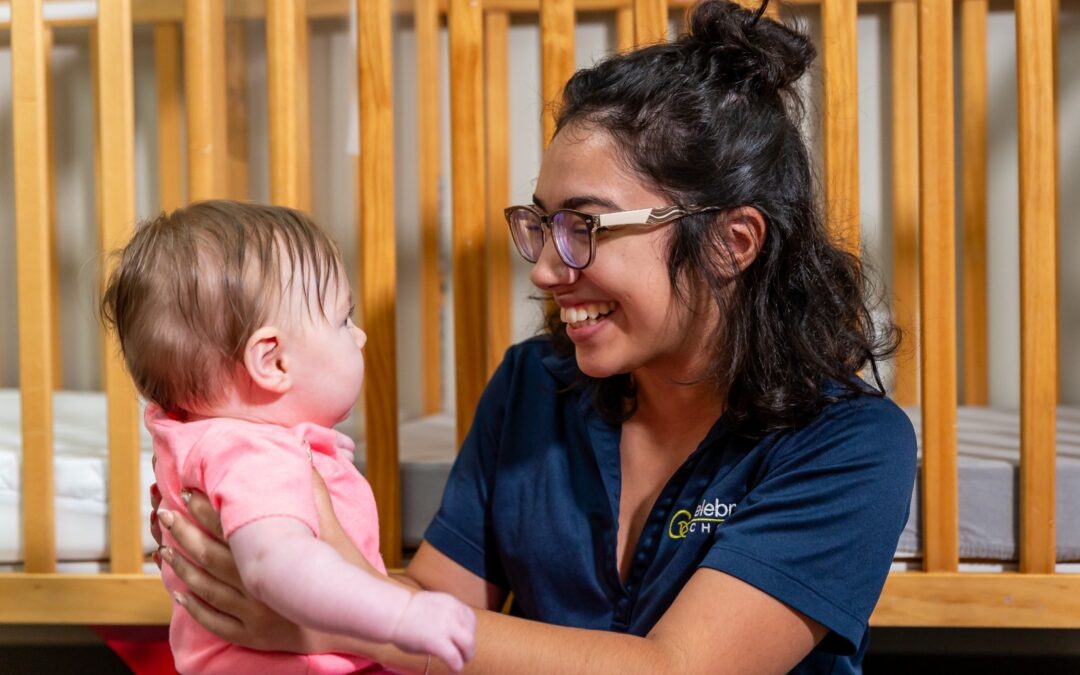
Babies communicate long before they have words.
Hunger, tiredness, discomfort, and interest can all show up through small cues. Parents gradually learn what those cues look like for their own child, and teachers can begin learning them too.
At Celebree School of Marietta at Shallowford, infant care begins at 6 weeks, and each baby is assigned a primary caregiver. Spending regular time together gives that caregiver opportunities to understand the routines, preferences, and signals that are specific to the child.
Getting to Know a Baby Takes Time
Families bring valuable information from home when infant care begins.
You already know when your baby tends to eat, what tiredness often looks like, how they usually settle, and which kinds of interaction seem to capture their attention.
Celebree School of Marietta at Shallowford develops individual care plans with families so teachers have that context from the start.
Experience in the classroom adds another layer. As caregivers spend time with the same child, they can become more familiar with how those routines actually show up throughout the day.
Familiarity Helps With Feeding, Sleep, and Comfort
Feeding, sleep, and comfort take up a significant part of an infant’s day.
At Celebree School of Marietta at Shallowford, babies are held during feedings and rocked to sleep. Morning check-ins also give teachers information about when a child last ate, slept, and was changed.
Knowing the child’s usual patterns can make that information more useful.
If sleep comes earlier than expected or feeding looks different from the day before, teachers have something familiar to compare it with. They can respond to what is happening now while keeping the child’s typical routine in mind.
A Schedule Only Tells Part of the Story
Knowing approximately when a baby usually eats or sleeps can help organize the day. But times alone do not explain everything.
A baby may be ready for a nap sooner after a difficult night or stay awake longer as their routine begins to shift. Feeding patterns can change too.
Regular time with the same child gives teachers more context for recognizing when something is simply different that day and when a new pattern may be developing.
Familiar Caregivers Can Notice New Interests
Knowing a child well is useful beyond feeding and sleep. During awake periods, teachers can notice what repeatedly captures a baby’s attention.
Celebree School of Marietta at Shallowford includes personal and social development, language, physical development, gross and fine motor experiences, developmental observation, and simple sign language within infant care plans.
An infant who has become especially interested in reaching might spend more time exploring safe objects. Greater interest in voices could lead naturally to more conversation, songs, or simple back-and-forth sounds.
Observation helps teachers choose experiences that make sense for the child at that point in time.
The Role Changes Along With the Baby
Celebree School of Marietta at Shallowford has separate infant classrooms for babies from 6 weeks to 9 months and from 9 to 18 months.
Across those months, the balance of the day shifts considerably.
Feeding, sleep, comfort, and close interaction often occupy more time early on. As awake periods lengthen, movement, communication, and exploration begin taking up a larger share of the day.
A caregiver who has spent time getting to know the child can see those shifts unfold gradually and adjust the day accordingly.
Parents Get More Context at Pickup
At the end of the day, parents usually want the practical details: when their baby ate, how long they slept, and how the day went overall.
Celebree School of Marietta at Shallowford provides evening check-ins that document meals, diaper changes, naps, and play.
A familiar caregiver may also be able to add useful context.
Perhaps your baby needed more rest than usual, showed particular interest in a song, or spent more time focused on movement. Those details can help parents understand more than the basic timeline of the day.
Familiar People Can Help the Day Feel Consistent
Consistency does not require every day to unfold the same way.
Sleep can vary. Feeding needs can shift. Some mornings are quieter, while others bring more interest in movement or interaction.
Familiar adults and routines give the day some continuity even when those details change. Teachers know what is typical for the child, which makes it easier to recognize when something new begins showing up.
What Can Parents Ask About During a Tour?
When visiting an infant classroom, ask how caregivers get to know each baby over time.
You might ask how families share feeding and sleep information, how teachers learn a child’s comfort preferences, or how they communicate changes they notice during the day.
Those questions can give you a clearer sense of how individualized care works beyond the schedule itself.
Learn More About Infant Daycare at Celebree School of Marietta at Shallowford
If you are considering infant daycare at Celebree School of Marietta at Shallowford, visit the school and talk with the team about how primary caregivers learn each baby’s routines, preferences, and changing needs.
You can also ask how feeding, sleep, communication, and early learning come together throughout the infant day.