
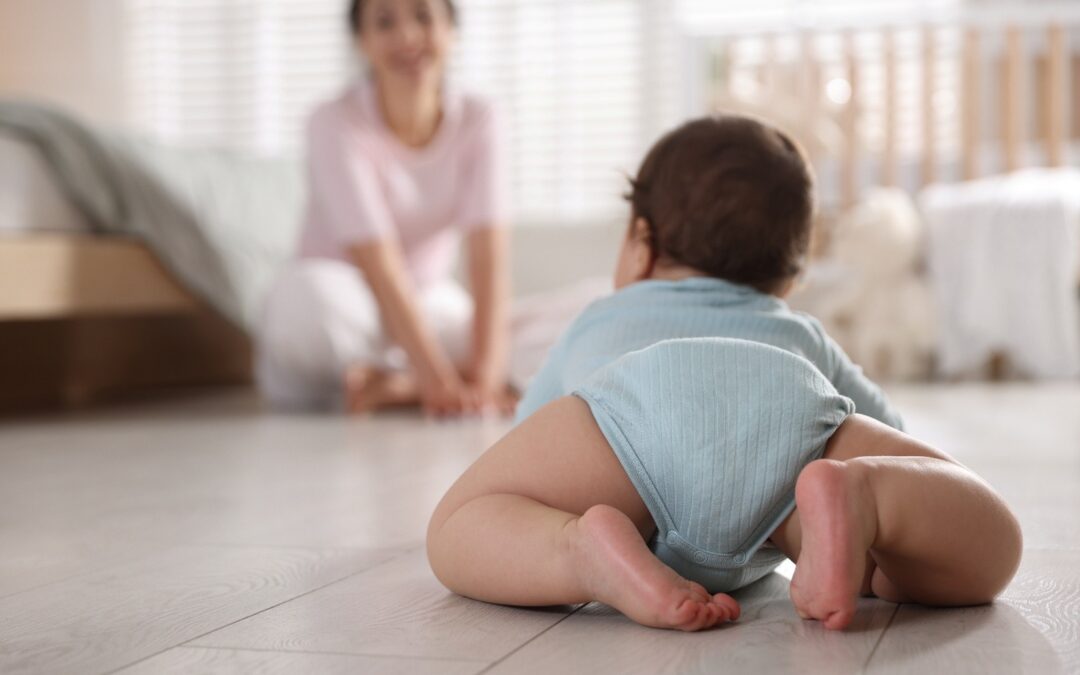
Your baby may be perfectly happy watching a toy from across the floor one week and determined to reach it the next. As that curiosity grows, you may start thinking about crawling and whether there is anything you should be doing to help.
So, when do babies start crawling? The American Academy of Pediatrics notes that crawling is often mastered between about 7 and 10 months, although babies can follow very different paths toward becoming mobile. Some crawl on hands and knees, while others scoot, belly crawl, or find another way to move.
Can You Help Your Baby Learn to Crawl?
You can give your baby opportunities to practice movement, but you do not need to teach crawling step by step.
Much of the work happens naturally as babies reach, roll, push up, shift their weight, and try to move toward something interesting. Giving them time and space to experiment lets those skills develop without turning movement into a lesson.
That also takes some pressure off you. Your job is not to get your baby crawling by a certain date. It is to give them safe chances to move.
Give Your Baby Plenty of Time on the Floor
Supervised floor play gives your baby room to use their whole body.
They might stretch toward a toy, turn to follow your voice, push themselves up, or discover that moving an arm or leg in a new way changes their position. Even attempts that do not look anything like crawling can give your baby useful practice coordinating movement.
You do not need elaborate equipment. A comfortable, safe space with enough room to turn and reach can offer plenty to explore.
Put Something Interesting Just Out of Reach
Sometimes a little motivation helps. Try a favorite toy, a soft ball, or even yourself. Sit nearby and let your baby decide how to close the distance.
Keep the challenge reasonable. The goal is to spark curiosity, not frustrate your child by putting something far beyond reach.
Let Your Baby Choose How to Get There
You may be waiting for a hands-and-knees crawl and get something completely different.
Your baby might roll toward the toy. They may pull forward on their stomach, scoot across the floor, push backward, or make several attempts without going anywhere at all.
Those experiments are part of figuring out movement. You do not need to reposition your baby’s arms and legs every time their technique looks different from what you expected.
Crawling itself is also not currently included on the CDC’s 9-month milestone checklist. The CDC instead includes movement skills such as sitting without support and getting into a sitting position, another reminder that babies do not all need to demonstrate one particular form of mobility at the same age.
Skip the Pressure to Make Crawling Happen Faster
It can be tempting to compare your baby with another child who is already racing across the room. Try not to turn that comparison into a training schedule.
More floor time, opportunities to reach, and interesting things to explore can encourage movement. What you cannot control is exactly when all those pieces come together into crawling.
Once your baby does start covering more ground, the more useful task may be updating your babyproofing. A child who becomes mobile can suddenly reach cords, low shelves, small objects, stairs, and other things that were irrelevant only a few days earlier.
When Should You Ask Your Pediatrician About Movement?
Questions about your baby’s development are always appropriate to bring to their pediatrician.
The AAP recommends speaking with your child’s doctor if you are concerned about the way your baby moves. Persistent differences in how each side of the body is used, unusual stiffness or floppiness, or losing a skill your baby previously had are also reasons to seek professional guidance.
You do not need to decide whether something is significant before asking. Your pediatrician can consider what you are seeing alongside your baby’s overall development.
Making Room for Movement at Daycare
Babies get opportunities to explore movement throughout an ordinary day, not only during planned activities.
At Celebree School of Leander at Crystal Falls, infant care includes hands-on experiences, sensory exploration, responsive care, and opportunities for children to grow at their own pace. Families also receive regular updates and daily communication from teachers.
For a baby becoming more interested in movement, that might mean time to reach, shift position, explore something nearby, or discover an entirely new way to get across the floor. Teachers can share what they notice while giving your child safe, age-appropriate opportunities to explore.
If you are looking for daycare in Leander, TX, Celebree School of Leander at Crystal Falls offers an environment where babies can stay curious, move at their own pace, and learn through everyday experiences.