
When you hear that babies “play” at daycare, you may picture toys, games, or planned activities. For a young infant, it is usually much simpler.
At Celebree School of Glen Mills, infant care begins at 6 weeks. Awake periods can include watching a caregiver, moving on the floor, listening to language or music, handling something safe, or taking in what is happening nearby.
Babies do not need to be crawling or talking for those parts of the day to matter.
Play Often Starts With Attention
Young babies spend a lot of time noticing what is around them.
A caregiver’s face may hold their attention. They might turn toward a voice, listen while a book is read, or watch movement across the room.
There may not be much obvious activity happening. For an infant, however, watching and responding are ways of engaging with the people and environment around them.
Movement Has a Place Before Crawling
Babies begin exploring with their bodies long before they can travel across the room on their own. Floor time gives them space to kick, reach, grasp, stretch, turn, and experiment with movement.
Celebree School of Glen Mills includes fine and gross motor development within infant care.
These opportunities do not have to revolve around reaching the next milestone. The movement itself gives babies another way to interact with their surroundings.
Sensory Exploration Can Be Very Simple
Celebree School of Glen Mills includes sensory and interactive play as part of its infant program. For babies, that does not require an elaborate sensory activity.
They are already encountering different sounds, textures, movements, and visual details throughout the classroom. A safe object to touch, music to hear, or something interesting to watch can provide plenty to investigate.
Ordinary moments often offer more than enough for a young infant to focus on.
A Caregiver Can Be Part of the Play
Some of the most engaging moments in an infant room involve another person.
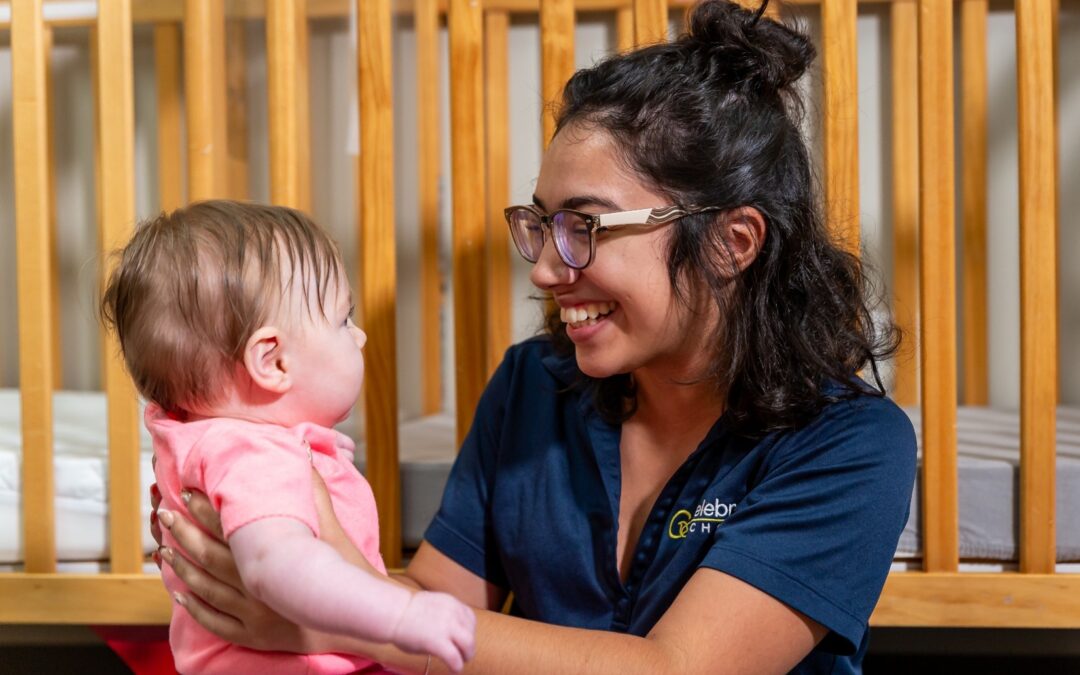
A caregiver might talk face-to-face with a baby, respond to a sound or expression, share a book, sing, or use simple signs.
Celebree School of Glen Mills incorporates early language exposure through music, reading, and simple sign language.
Those exchanges allow babies to respond in their own ways, whether through attention, movement, sounds, expressions, or gestures.
Not Every Awake Moment Needs an Activity
Sometimes a baby is content to watch the room, study an object, listen, or sit quietly with a caregiver. There is no need to fill every alert period with something new.
A realistic infant day includes active moments as well as slower stretches when a child simply takes in what is happening.
Teachers Pay Attention to What Draws Interest
Infants often make their preferences visible before they have words to express them.
A particular sound might repeatedly draw attention. A baby might spend extra time with an object or become especially engaged during a familiar song or interaction.
Teachers can use those observations when deciding what to revisit during future awake periods. Celebree School of Glen Mills uses individualized care plans that support language, physical, social-emotional, motor, and sensory development.
Play Changes Across the Infant Program
Celebree School of Glen Mills has infant classrooms for babies from 6 weeks to 9 months and from 9 to 18 months. Earlier on, much of awake time may involve close interaction, listening, touch, watching, and early body movement.
Later, babies typically have additional ways to handle objects, move through their surroundings, communicate, and participate.
The types of play available to them naturally expand without requiring every child to progress on the same timeline.
Feeding and Sleep Help Determine When Play Happens
Infant play does not happen according to one classroom-wide timetable.
Celebree School of Glen Mills uses individualized plans around feeding, sleep, and play. Morning check-ins also let teachers know when babies last ate, slept, and were changed.
Some parts of the day will center on rest or feeding. At other points, a rested and alert child may be ready to move, interact, or explore.
That rhythm will look a little different for each infant.
What Should Parents Expect From Infant Play?
For a young baby, play may look like movement, interaction, books, music, sensory experiences, safe objects, or quiet observation.
It does not need to be elaborate or constant. As babies gain new ways to move, communicate, and participate, the possibilities grow with them.
Explore Infant Daycare at Celebree School of Glen Mills
If you are exploring infant daycare at Celebree School of Glen Mills, visit the infant classroom and ask what play looks like for babies at different stages.
You can also ask how teachers balance awake time with feeding, sleep, and other everyday care needs.