
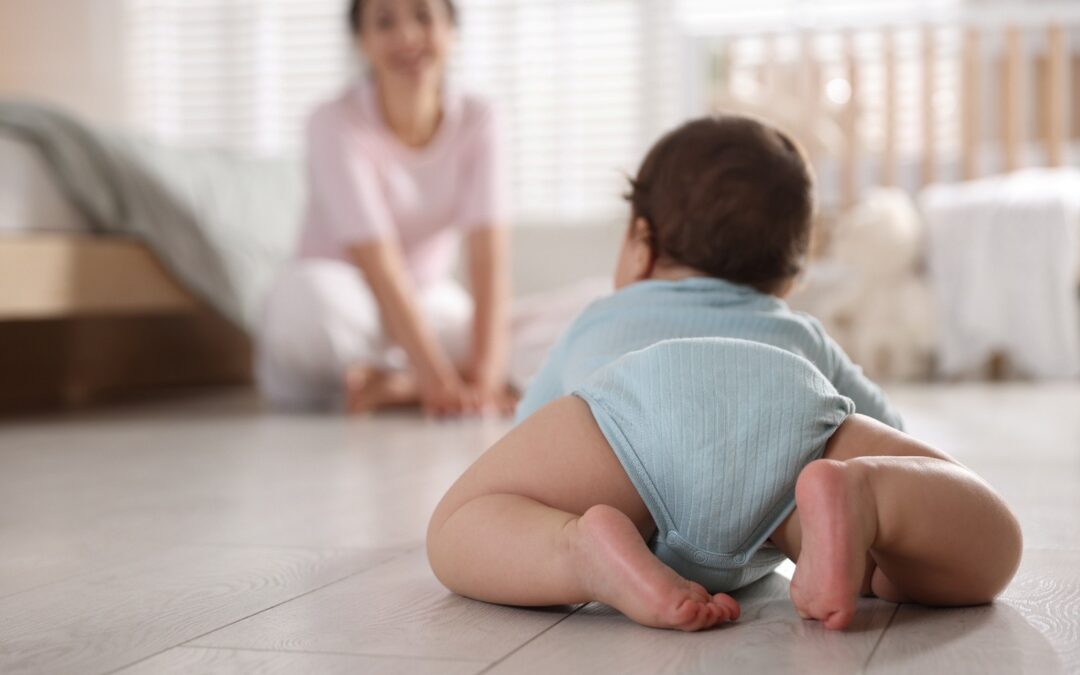
Your baby has figured out crawling, but their technique is probably not what you pictured. One knee stays on the floor while the other leg sticks out to the side, with the foot helping push them forward.
They are certainly getting where they want to go. Still, that one-leg-up crawl can catch your attention.
If you’re wondering when do babies start crawling, traditional crawling is commonly mastered between about 7 and 10 months. Babies can also experiment with different ways of moving during this period. A one-knee, one-foot pattern is often called a hitch crawl or three-point crawl.
What Does a Hitch Crawl Look Like?
With a traditional hands-and-knees crawl, both knees usually make contact with the floor. A hitch crawl looks different.
Your baby may keep one knee underneath the body while planting the opposite foot on the floor. That leg can act almost like a kickstand, helping propel the body forward.
Once babies discover an effective way to travel, they may become surprisingly fast at it. The fact that the crawl looks unusual does not change the obvious part: your baby has found a way to move independently.
It is still worth paying attention to how that movement develops.
Your Baby May Experiment With More Than One Crawl
A new crawler’s technique doesn’t always stay the same.
You may see your baby crawl on both knees for a few feet, lift one leg for the next stretch, drop to the belly when tired, and then sit down to investigate something.
That gives you different information from seeing the exact same one-sided pattern every time your baby moves.
AAP notes that babies can use alternatives to classic crawling and says the use of both sides of the body provides useful context when looking at those movement differences.
So instead of focusing on a single trip across the rug, watch what your baby does over time.
Pay Attention to Both Sides of the Body
If one leg is up during crawling, look beyond the crawl itself.
Does your baby kick with both legs during play? Reach readily with either hand? Turn toward both sides? Change which leg they use when moving?
You don’t need to turn playtime into an evaluation. These are simply observations that can help you understand whether the one-legged crawl is one of several movements your baby uses or a consistent pattern.
AAP’s guidance says alternative ways of getting around are less concerning when a baby coordinates both sides of the body and uses each arm and leg similarly.
Don’t Try to Diagnose a Crawl From Its Appearance
A one-leg-up crawl can lead parents straight to an internet search for an explanation. Try not to jump from an unusual-looking movement to a specific medical condition.
How a baby crawls, by itself, cannot tell you why they are using that pattern. An individual child’s movement has to be considered alongside their other physical skills, development, and health history.
You also don’t need to correct your baby’s leg every time they start moving.
Give them safe opportunities for floor play and notice what happens naturally. If the pattern continues to concern you, your pediatrician is better equipped to decide whether it needs a closer look.
When Should You Mention It to the Pediatrician?
A baby trying several crawling techniques is different from a baby who consistently seems to use one side of the body differently.
It is worth bringing your observations to your pediatrician if your baby repeatedly drags or avoids using one side, one arm or leg seems much less involved, movement appears unusually stiff or floppy, or a skill your baby previously had disappears.
You can also ask simply because something doesn’t look right to you.
AAP specifically recommends talking with the pediatrician when a baby’s movement does not seem to be developing normally. Its developmental guidance also flags dragging one side while crawling as something parents should discuss with their child’s doctor.
There is no need to arrive with an explanation. Saying, “They almost always crawl with the right knee down and left foot up,” gives the pediatrician something concrete to consider.
Keep Floor Time About Moving, Not Fixing
Once you’ve noticed an unusual crawl, it can be hard not to watch every trip across the room. Your baby still needs ordinary time to explore.
Put something interesting nearby and let them decide how to reach it. Give them room to change positions, crawl toward you, stop to play, and move again when something else catches their attention.
You don’t need to run crawling drills or repeatedly rearrange their body into a textbook hands-and-knees position.
If your pediatrician believes a particular movement needs attention, they can guide you on the appropriate next step. Until then, floor play can remain what it was meant to be: a chance for your baby to move and explore.
Sharing Movement Changes at Celebree School of Germantown
Babies spend a lot of time practicing new movements, which means teachers may notice changes that parents haven’t seen yet.
At Celebree School of Germantown, individualized infant care plans include physical development, gross- and fine-motor activities, and recognizing and documenting milestones. Infants also have a primary caregiver, and daily check-ins help parents and teachers share information between home and school.
A teacher might notice that your baby sometimes crawls on both knees but lifts one leg when moving quickly. Or perhaps the same crawling pattern appears repeatedly throughout the day.
Sharing those observations doesn’t require the teacher to interpret what they mean medically. It simply gives families another view of how their baby is moving.
The Germantown day care program also includes tummy time and other developmentally appropriate opportunities for infants to move and explore.
Watch the Pattern, Not Just One Crawl
A one-legged crawl is certainly noticeable, especially when you expected the classic hands-and-knees version. But one unusual trip across the room doesn’t tell you everything about how your baby moves.
Notice whether your baby’s technique changes, how they use both sides of their body during other activities, and whether new movement skills continue to emerge. If the same asymmetry persists or something about it worries you, share what you’re seeing with your pediatrician.
Families exploring daycare in Germantown, MD, can see how Celebree School of Germantown supports infants through individualized care, movement, and daily communication with families. Reach out to the school to plan a visit and spend some time getting to know the infant program.