
When you hear the word “curriculum,” you may picture planned lessons or activities with a clear beginning and end. For a baby, learning usually looks much more ordinary.
Your baby reaches for the same toy several times. A teacher talks with them during a diaper change. A song catches their attention. Floor time turns into another attempt to roll, crawl, or move toward something interesting.
These moments may seem simple, but they give babies opportunities to communicate, explore, move, and connect with the people around them.
At Celebree School of Forest Hill-Rock Spring, infant daycare brings care and early learning together throughout the day.
At our Rock Spring Road school in Forest Hill, your baby’s everyday experiences can become opportunities to practice emerging skills and discover more about their surroundings.
What Does Learning Look Like for an Infant?
Infant learning does not need to resemble a lesson.
Your baby is already gathering information through movement, sound, touch, repetition, and interaction with other people.
Depending on where they are developmentally, learning may include:
- Listening and responding to voices
- Looking at faces
- Reaching and grasping
- Moving on the floor
- Exploring sounds and textures
- Repeating an action
- Responding with sounds or gestures
- Watching what happens when they interact with an object
There may not be a finished project to bring home at the end of the day.
For an infant, watching, listening, moving, trying something again, or responding to another person can all be meaningful parts of learning.
Everyday Care Gives Teachers Time to Connect With Your Baby
Some of the most frequent one-on-one moments in infant daycare happen during ordinary care routines.
Feeding, diaper changes, comforting, and preparing for rest are necessary parts of the day, but they are also opportunities for teachers to interact closely with your baby.
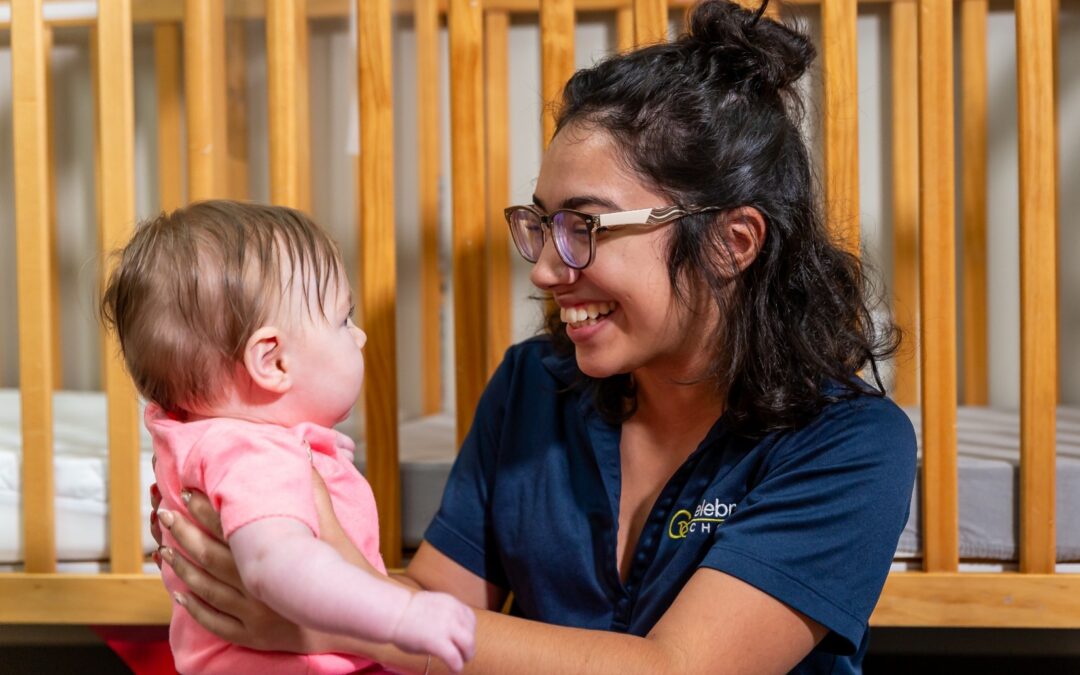
During a diaper change, a teacher might describe what is happening, respond when your baby makes a sound, or notice something that consistently captures their attention.
While feeding or comforting your child, teachers also have time to become more familiar with the cues your baby uses to communicate.
Those repeated interactions help teachers get to know your child as an individual rather than treating everyday care as something separate from the rest of the infant experience.
Floor Time Turns Curiosity Into Exploration
Babies learn a great deal simply by having opportunities to move.
Depending on your baby’s current stage, they may reach toward an object, roll into a new position, sit and explore, crawl toward something interesting, pull up, or manipulate materials with their hands.
There is no need for every baby to be working on the same movement at the same age.
Teachers can observe what your child is beginning to attempt and provide appropriate opportunities to keep practicing.
If your baby repeatedly reaches for an object, for example, that interest tells the teacher something. If they are suddenly determined to move across the room, their environment can offer new opportunities to explore.
The activity grows from what your baby is already showing they want to do.
Why Are Books, Songs, and Conversation Part of Infant Curriculum?
Your baby begins experiencing language long before they can carry on a conversation.
That makes everyday interactions an important part of infant learning.
Teachers may read books aloud, sing familiar songs, name objects, talk through routines, or respond when your baby babbles or gestures.
Sometimes the interaction is very simple.
Your baby makes a sound. A teacher responds. Your baby makes another sound.
That small exchange introduces the rhythm of back-and-forth communication without turning language into a formal lesson.
Books and music can also become familiar parts of the day while giving babies new sounds, words, expressions, and experiences to take in.
How Do Teachers Decide What Comes Next?
Infant curriculum should not assume that every baby of the same age is ready for the same experience.
At Celebree, teachers use observation and developmental assessment to help understand what children are already doing and where learning can build from there.
If your baby becomes increasingly interested in moving toward objects, teachers can provide appropriate opportunities for movement and exploration.
If your child is experimenting with new sounds and gestures, teachers can respond with more conversation and interaction.
If they keep investigating how an object works, they can have time to repeat the experience and continue exploring.
Assessment is woven into everyday activities rather than handled through formal testing.
The goal is to notice what your baby is showing and use those observations to help guide what comes next.
How Does Learning Fit Around Feeding and Naps?
Your baby does not need to be awake at one particular time to participate in the day’s “lesson.”
Infant learning can happen throughout the day.
Your child’s routine may include feeding, rest, diapering, floor movement, books, music, exploration, and one-on-one interaction. Another baby in the classroom may experience those things in a different order.
That flexibility matters because infant schedules can vary considerably.
If your baby is asleep while another child is exploring an activity, they have not missed class. There will be other opportunities to move, listen, interact, and explore when they are awake and ready.
The curriculum fits around the realities of infant care rather than asking every baby to follow one group schedule.
What Ages Does Infant Daycare Serve?
Celebree generally considers infant care part of the first year of life, although exact age groupings can vary based on state licensing requirements and the individual school.
Reach out to Celebree School of Forest Hill-Rock Spring to ask about our current infant enrollment ages and how classroom transitions are handled.
Your baby’s experience will also change considerably within the infant stage.
A younger infant may spend more time feeding, sleeping, observing, and practicing early movement. As your baby becomes more alert and mobile, they may spend longer periods exploring objects, moving through the classroom, communicating, and interacting with teachers.
Learning continues throughout those changes. It simply begins to look different.
How Will You Know What Your Baby Is Learning?
Infant learning can be subtle, especially when you are not there to see it firsthand.
Celebree uses Tadpoles to help you stay connected through daily information, photos, and messages.
Along with practical details such as feeding and naps, those updates can give you a window into what interested your baby during the day.
Maybe your child spent time exploring a new material. Perhaps they practiced an emerging movement, responded enthusiastically to a song, or showed a new interest that teachers noticed.
You can also share what you are seeing at home.
When you and your child’s teachers exchange those observations, it becomes easier to see how everyday experiences are supporting development across the whole day.
See Infant Learning at Our Forest Hill-Rock Spring School
Infant curriculum does not have to compete with feeding, diapering, naps, or other care routines.
For babies, those everyday moments are part of the experience.
Care, movement, conversation, play, observation, and relationships can all give your child opportunities to learn in ways that make sense for their current stage.
If you are exploring infant daycare at Celebree School of Forest Hill-Rock Spring, schedule a tour of our Rock Spring Road school in Forest Hill to see how care and early learning come together throughout the infant day.