
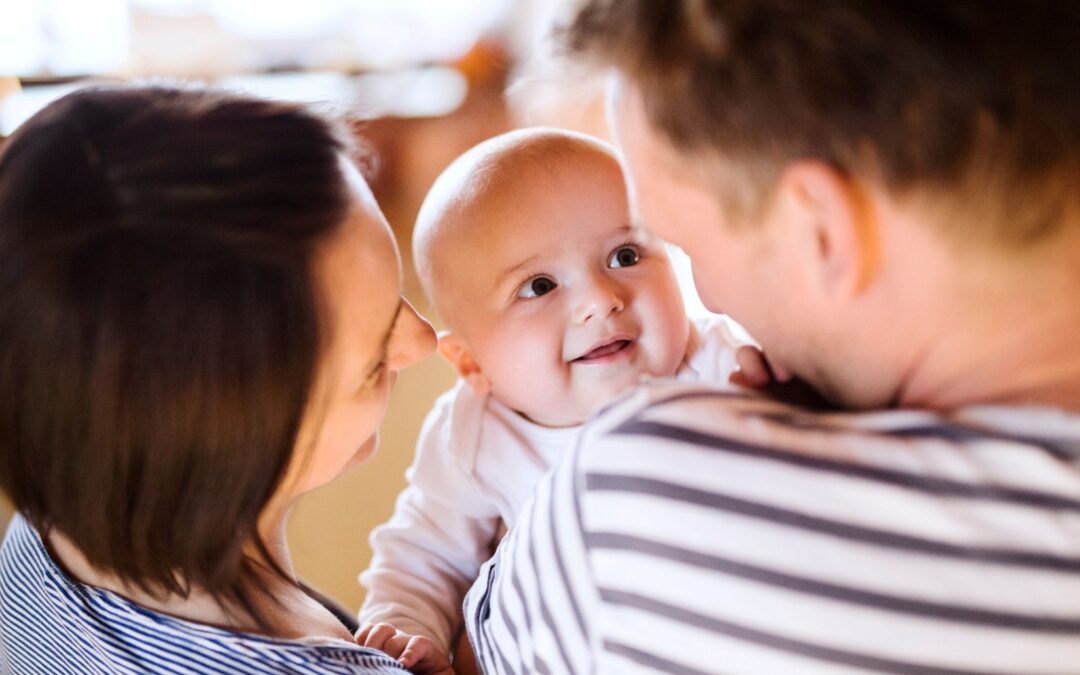
You call your baby’s name from across the room, and this time, they turn to look at you.
Was it their name that caught their attention, or simply the sound of your voice?
Early on, it can be hard to tell. Babies spend months listening to voices and learning the patterns of familiar interactions before they begin responding more consistently to their own name. Like many baby milestones, name recognition develops gradually.
When Do Babies Start Responding to Their Name?
By around 9 months, many babies look when their name is called.
Some may begin showing a recognizable response earlier, but there is no need to expect a consistent reaction months before that point.
At first, a response may be as simple as pausing, turning their head, or looking toward the person speaking. Over time, it usually becomes easier to tell that your baby is responding specifically to their name.
Familiar Voices Come First
Long before babies recognize their own name, they are learning what familiar voices sound like.
By around 4 months, many babies turn their head toward the sound of a caregiver’s voice. They may also make sounds back during interaction.
You might notice your baby becoming especially attentive when someone they know starts talking.
Those early listening experiences are part of the larger communication process that eventually helps babies connect familiar sounds with meaning.
Familiar People Become Easier to Recognize
By about 6 months, many babies recognize familiar people.
That may show up as a smile, laugh, excited movement, or simply more focused attention.
A baby hears their name most often during these familiar interactions. Someone may say it while picking them up, feeding them, changing them, or trying to get their attention.
With repetition, the sound becomes part of everyday communication.
What Does Responding to Their Name Look Like?
A response does not need to be dramatic.
Your baby may stop what they are doing for a moment, turn their head, look toward you, smile, or make a sound.
Sometimes the reaction is obvious. Other times, it may be subtle. By around 9 months, the clearest developmental marker is simply looking when their name is called.
Why Doesn’t My Baby Respond Every Time?
Even a baby who recognizes their name may not turn every single time they hear it. They may be deeply focused on a toy, watching something nearby, tired, or distracted by another sound.
That is why one missed response does not tell you much by itself. It is more useful to notice whether responding to their name is becoming part of the way they interact over time.
Name Response Is Part of a Bigger Communication Picture
By around 9 months, many babies are also making repeated sounds such as “mamamama” or “bababababa.”
They may lift their arms when they want to be picked up, react when a caregiver leaves, or smile during a familiar game.
These skills all show that communication is becoming more active.
Responding to a name is one part of that larger shift, not a milestone that develops in isolation.
What Comes Next?
Near the first birthday, babies often have even more ways to communicate.
By around 12 months, many wave goodbye, join simple games, understand a familiar word such as “no,” and use “mama,” “dada,” or another special name meaningfully.
A baby who once responded mostly through movement and sound is gradually finding clearer ways to show what they understand and what they want.
Baby Milestones From Birth to 12 Months
Here is a general look at how communication and social attention may change during the first year:
- 1 month: Reacts to nearby sounds and familiar voices
- 2 months: Looks at faces and makes sounds besides crying
- 3 months: Social responses and interest in voices may become more noticeable
- 4 months: Many make sounds back and turn toward a caregiver’s voice
- 5 months: Vocal play and familiar interactions may become easier to recognize
- 6 months: Many recognize familiar people, laugh, and take turns making sounds
- 7 months: Familiar voices may get stronger responses
- 8 months: Babies may become more attentive during familiar interactions
- 9 months: Many look when their name is called and make repeated babbling sounds
- 10 months: Gestures and vocal responses may become more deliberate
- 11 months: Familiar words and routines may bring clearer reactions
- 12 months: Many wave, join simple games, and use “mama,” “dada,” or another special name meaningfully
The months between official developmental checkpoints describe common patterns rather than milestones every baby needs to reach at that exact age.
Other Skills Are Changing Too
Communication is only one part of the first year.
By around 6 months, many babies reach for toys, roll from tummy to back, and begin supporting themselves while sitting.
By about 9 months, many sit without support and move objects from one hand to the other. Near the first birthday, pulling to stand and moving while holding furniture may appear.
A baby may make quick progress in one area while another develops more gradually.
Everyday Communication on Rock Spring Road
Babies hear their names and familiar voices during ordinary routines throughout the day.
At daycare on Rock Spring Road in Forest Hill, MD, babies hear familiar voices as caregivers talk, respond, and interact with them during everyday routines.
For a younger infant, that may mean turning toward a voice. Months later, the response may be a look, smile, sound, or movement when their own name is called.
When Should You Ask About Name Response?
Try not to judge development based on one moment.
Look at the broader pattern: Is your baby reacting to sounds? Becoming more social? Making sounds of their own? Showing growing interest in familiar people and voices?
Talk with your child’s pediatrician if your baby is not meeting expected milestones, loses a skill they previously used, or if you have concerns about hearing, communication, or development.
Responding to a name may seem like one small moment, but it is part of a much larger first-year shift from simply hearing the world to beginning to understand and respond to it.