
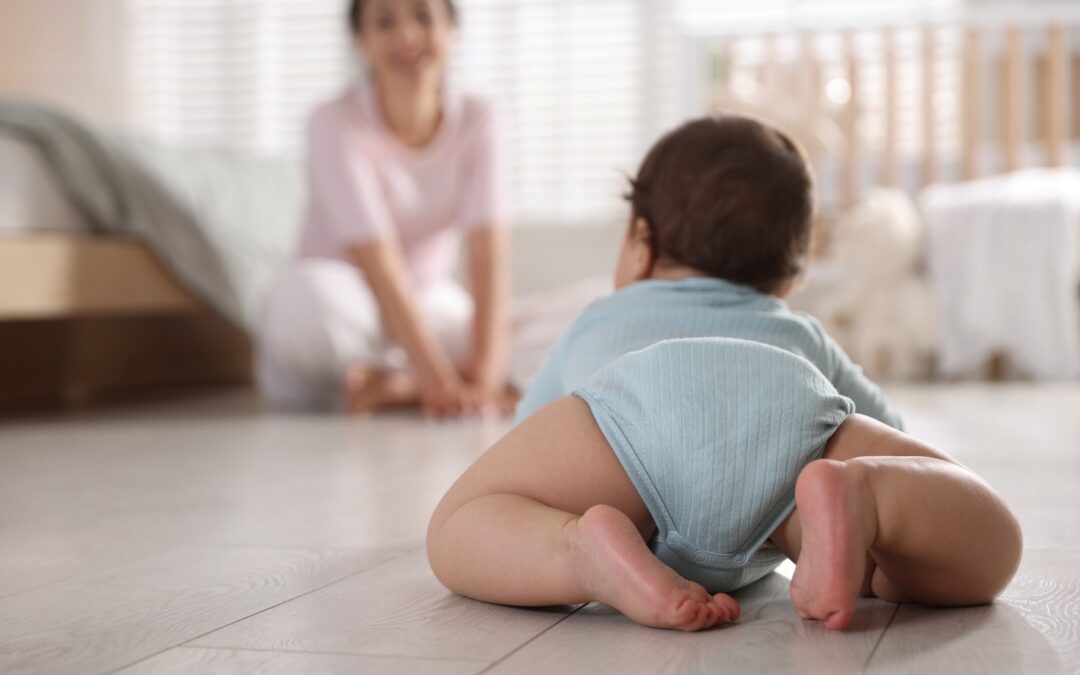
You set a toy a few feet away, and suddenly your baby is determined to get there. The surprise may be how they do it. Instead of getting up on hands and knees, your child might pull forward with their arms while keeping their belly on the floor.
This is often called an army crawl or commando crawl, and it is one of several ways babies may begin getting around. If you have been wondering, “when do babies start crawling?” a common range is around 7 to 10 months. There is plenty of variation, though, both in timing and in what crawling actually looks like.
What Does an Army Crawl Look Like?
An army-crawling baby stays low to the floor, usually with their stomach touching the ground. They may pull with both arms, push with their legs, or develop their own combination that gets the job done.
Once your baby realizes this new skill can take them somewhere interesting, you may see a lot more of it.
An army crawl may eventually lead to hands-and-knees crawling, but it does not have to. The American Academy of Pediatrics describes several ways babies move, including belly crawling, bottom scooting, traditional crawling, and other variations. Some children never use the classic hands-and-knees crawl at all.
When Do Babies Start Crawling on Hands and Knees?
There is no set point when an army crawl needs to turn into traditional crawling.
Your baby may spend some time moving on their belly before starting to push up onto hands and knees. You might also see rocking back and forth as they work on balance and coordination. Sometimes babies even move backward before they figure out forward.
Others take a different route. Your child may scoot, roll to reach something, pull up on furniture, or combine several movement styles.
That variety is one reason crawling itself is not currently included on the CDC’s 9-month milestone checklist. At 9 months, the CDC instead lists movement skills such as sitting without support and getting into a sitting position.
Let Your Baby Practice Moving in Their Own Way
You do not need special crawling equipment to encourage movement.
Supervised time on the floor gives your baby room to reach, shift their weight, roll, scoot, and experiment. Try putting a favorite toy a little beyond easy reach and see how your child decides to get there.
You can join them on the floor, too. Your face, voice, or a familiar toy can be plenty of motivation.
Try not to turn it into a crawling lesson. Babies learn a great deal by testing movements for themselves. Your role is mostly to give your child safe opportunities to move and something interesting to explore.
A Mobile Baby Changes the Room
Crawling also changes what your baby can reach.
It can happen quickly. Something that was safely across the room last week may suddenly be within reach today.
This is a good time to look around your home from your baby’s level. Pay particular attention to cords, outlets, stairs, unstable furniture, choking hazards, and anything tempting enough to make a new crawler change direction.
As your child becomes more mobile, supervision and babyproofing need to keep pace.
What If Your Baby Uses One Side Differently?
An army crawl can look uneven at times, particularly while your baby is still figuring out how to coordinate their body. One unusual-looking movement by itself does not tell you that something is wrong.
If you consistently notice that your child uses one side much more than the other, seems unusually stiff or floppy, loses a skill they previously had, or you simply have a concern about how they are moving, talk with your pediatrician. They can look at your child’s development as a whole rather than judging one crawling style in isolation.
Growing and Exploring at Day Care
Your baby’s urge to reach something new does not disappear when you drop them off for the day. Movement is part of how infants explore the people, objects, and spaces around them.
At Celebree School of Forest Hill-Rock Spring, our infant teachers provide developmentally appropriate opportunities for babies to move and explore during the day. Teachers also observe the changes they see during everyday play and communicate with families about their child’s experiences.
That might mean noticing a baby who has discovered how to scoot toward a favorite toy or one who suddenly seems very interested in getting up onto hands and knees. Those observations are part of caring for your child and staying connected with you, not diagnosing their development.
If you are exploring day care in Forest Hill, MD, we invite you to learn more about Celebree School of Forest Hill-Rock Spring and the care we provide during this busy stage of your baby’s first year.