
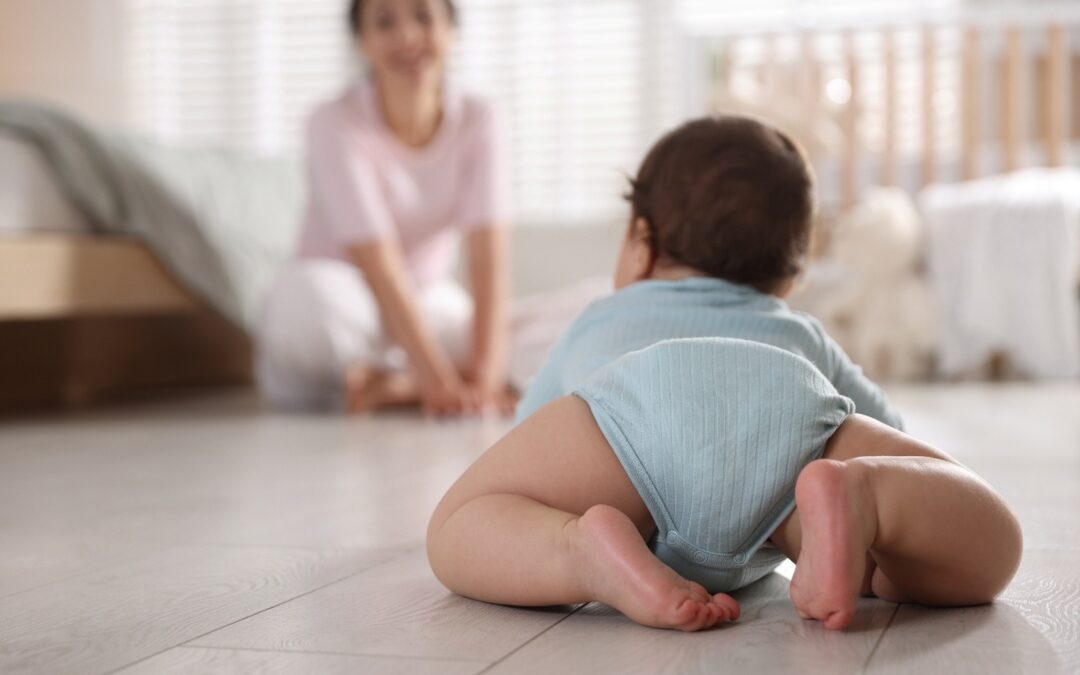
One day, your baby seems perfectly content staying where you put them. Then suddenly they are leaning toward toys, twisting around to see what is behind them, or pushing up as if they have somewhere important to be.
Those little changes can make you wonder whether crawling is around the corner. So, when do babies start crawling?
Many babies begin crawling around 7 to 10 months, but there is a wide range in both timing and technique. Some crawl on hands and knees, while others scoot, belly crawl, roll, or find another way to get where they want to go.
What Might You Notice Before Crawling Begins?
There is no single set of steps every baby completes before crawling. You may, however, start seeing your child experiment with movement in new ways.
Your baby might reach farther for a toy, push up more strongly during floor time, pivot while on their tummy, or shift their weight from one side to the other. Sitting may also become steadier, giving them more freedom to lean, turn, and reach.
Sometimes the biggest clue is simply motivation. A toy that used to be interesting from across the room suddenly becomes something your baby is determined to reach.
These movements are not a countdown to crawling. They are examples of your child learning what their body can do.
Does Getting on Hands and Knees Mean Crawling Is Close?
It can be part of the process, but it does not tell you exactly when your baby will start moving forward.
Some babies get onto hands and knees and rock back and forth for a while. Others push backward before figuring out forward movement. Your child might also abandon that position altogether and start belly crawling or scooting instead.
The American Academy of Pediatrics notes that babies use several crawling styles and that some children never use the traditional hands-and-knees crawl.
That is why it helps to watch your baby’s overall movement rather than waiting for one particular pose to appear.
Your Baby May Find Their Own Way to Get Around
Crawling can look very different from the version you pictured.
One baby may glide across the floor on hands and knees. Another may pull forward with their belly down. Some babies scoot while sitting, and others rely on rolling or another combination of movements for a while.
Crawling itself is also not currently listed as a 9-month milestone on the CDC developmental checklist. At that age, the CDC includes movement skills such as getting into a sitting position and sitting without support.
That does not make crawling unimportant. It simply means babies do not all need to demonstrate the same form of movement at the same age.
How Can You Support Your Baby Without Rushing Them?
You do not need to teach your baby a crawling technique.
Instead, give your child safe opportunities to move. Supervised time on the floor lets them practice reaching, rolling, pushing, turning, and changing positions at their own pace.
Try placing an interesting toy a short distance away. You can sit nearby and talk to your baby while they decide how to reach it. If your baby decides the fastest route is something you have never seen before, that is part of the experiment.
And once those experiments start covering real distance, take another look at your babyproofing. Mobility has a habit of arriving just as your baby discovers every cord, cabinet, and low shelf you had stopped noticing.
When Should You Talk With Your Pediatrician?
A baby’s crawling style or timing should be considered alongside their overall development, not judged in isolation.
If your child consistently uses one side of their body differently, seems unusually stiff or floppy, loses a skill they previously had, or you have another concern about how they are moving, bring it up with your pediatrician. You do not have to wait for a certain birthday or milestone before asking a question.
Watching New Skills Emerge at Daycare
A lot can change during your baby’s first year, and new skills do not always appear when you happen to be watching.
At Celebree School of Fate, infant care includes opportunities for physical development, gross and fine motor experiences, and safe exploration throughout the day. Teachers observe your child’s everyday experiences and communicate with you about what they are seeing.
Sometimes that means sharing a major first. Other times, it may be something smaller: your baby reached farther than usual, pushed up with more confidence, or suddenly became very interested in getting to a toy across the floor. Those everyday observations can help you stay connected to your child’s changing interests and abilities while their pediatrician remains your resource for questions about development.
If you are looking for daycare in Fate, TX, Celebree School of Fate provides responsive infant care with plenty of opportunities for your baby to move, explore, and discover what comes next.
