
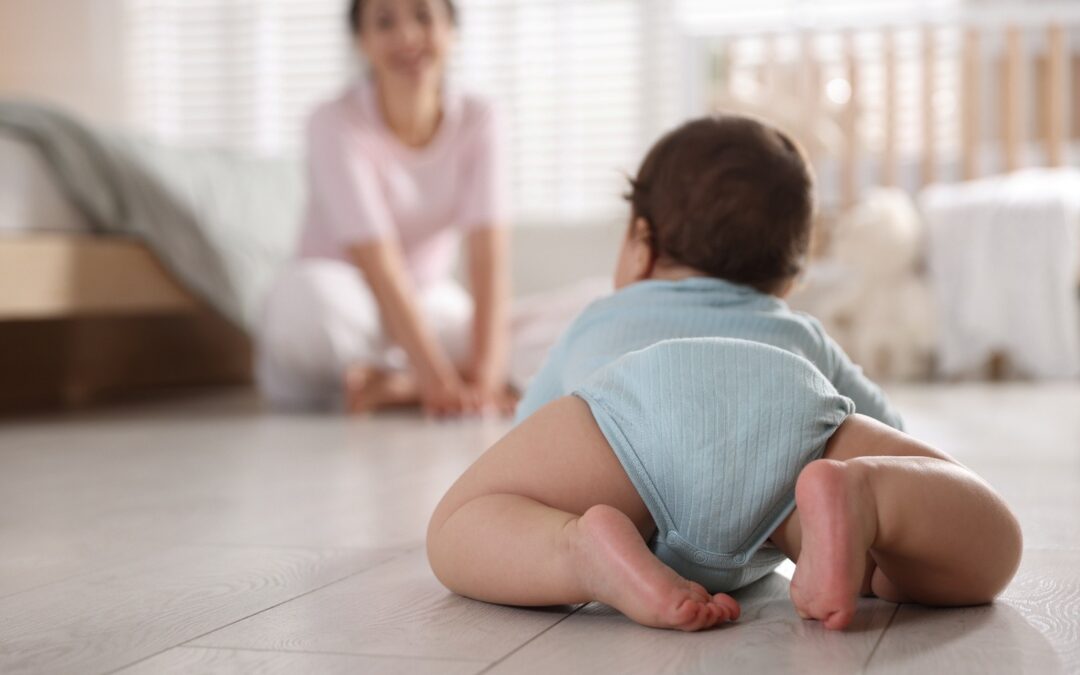
You may be waiting for your baby to crawl when they suddenly grab the couch, your hands, or the edge of a low table and start trying to pull themselves up.
So what happened to crawling?
If you are wondering when do babies start crawling, many babies begin traditional hands-and-knees crawling around 7 to 10 months. Pulling to stand often develops during this same broader period of increasing mobility, which means the two skills can overlap more than parents expect.
Your baby does not have to complete one movement before becoming interested in another.
Does Crawling Usually Come Before Standing?
For many babies, crawling appears before pulling to stand. But development does not always unfold in a tidy sequence.
A baby may spend time scooting or belly-crawling while also becoming interested in getting upright. Another may pull to stand before traditional crawling is well established.
During these months, babies are learning several things about movement at once: how to change positions, support their weight, reach farther, move toward something interesting, and eventually get upright.
That overlap can make it difficult to point to one skill and say, “This must come next.”
Several Movement Skills Can Develop at the Same Time
Once babies become more active, you may notice new abilities arriving close together.
Your baby might sit more steadily, move from sitting toward the floor, push up onto hands and knees, or reach for furniture they can use for support.
Some of those attempts may be brief or inconsistent at first.
A baby who crawls across the room one day might spend much of the next day practicing how to get onto their knees beside the couch. They are not abandoning crawling. They simply have another movement to investigate.
What If My Baby Wants to Stand More Than Crawl?
Some babies become fascinated with being upright.
Once they discover they can grab something and pull, they may want to repeat the experience again and again. That can leave parents wondering whether they should encourage more crawling instead.
There is usually no need to turn either skill into a drill.
Continue giving your baby safe opportunities for floor movement while also allowing them to explore supported standing when they initiate it. One experience does not have to replace the other.
Your baby may crawl toward the couch, pull up, sit back down, and crawl away again. That combination is a good example of how movement skills can work together.
Crawling May Still Look Different
A baby who is already pulling up may not suddenly develop a textbook hands-and-knees crawl.
They may continue scooting, moving on their belly, or using a combination of movements to reach whatever they want. Some babies also spend less time crawling traditionally than parents expect.
Rather than focusing only on whether the movement “counts” as crawling, watch how your baby is becoming more capable of getting where they want to go and changing positions on their own.
Getting Up Can Be Easier Than Getting Back Down
One of the more memorable parts of this stage is the baby who proudly pulls to standing and then realizes they have no idea how to get back to the floor.
You may see them hold on tightly, fuss, or look at you for help.
As babies practice, they gradually learn how to bend their knees, lower themselves, and return to sitting or the floor. That skill may take some time to catch up with the excitement of standing.
Stay close while your baby is experimenting with upright movement and give them opportunities to work on getting down safely.
Make Pulling-Up Opportunities Safe
Once your baby starts looking for things to grab, take another look at the environment.
Choose sturdy, stable surfaces that will not tip or slide if your baby uses them for support. Keep potentially unsafe objects out of reach and stay nearby while your baby experiments.
At the same time, preserve open floor space where they can roll, scoot, crawl, or change positions freely.
The goal is not to create a special standing station. It is to make everyday movement safer as your baby’s abilities expand.
Look at the Bigger Pattern of Movement
It can be easy to become focused on one question: “Why isn’t my baby crawling yet?”
Try widening the view.
Are they getting into new positions? Supporting more of their own weight? Reaching farther? Moving toward objects? Becoming more comfortable changing from sitting to the floor or from the floor to standing?
Those changes can tell you more than one milestone alone.
If something about your baby’s movement concerns you, talk with their pediatrician. A loss of a previously learned skill or a persistent difference in how they use the two sides of their body is also worth bringing up.
Supporting Movement at Celebree School of Elkridge
At Celebree School of Elkridge, infant teachers observe physical development throughout the day and provide age-appropriate opportunities for babies to move and explore.
One baby may be working on getting across the floor. Another may repeatedly reach upward to pull into a supported stand. Someone else may move between both.
Teachers can notice those changes, adjust the environment to what each child is ready to try, and share observations with families without treating development as a fixed sequence.
That ongoing communication helps parents stay connected to the small changes that can happen between the bigger milestone moments.
Let the Skills Overlap
A baby does not need to finish crawling before becoming interested in standing.
During this stage, movement can develop in several directions at once. Give your baby safe opportunities to explore the floor, support themselves, change positions, and try whatever new movement has captured their attention.
If you are exploring daycare in Elkridge, MD, Celebree School of Elkridge provides individualized infant care with room for movement, exploration, and growing independence. Reach out to arrange a tour and see how our infant classrooms support babies through these changing stages.