
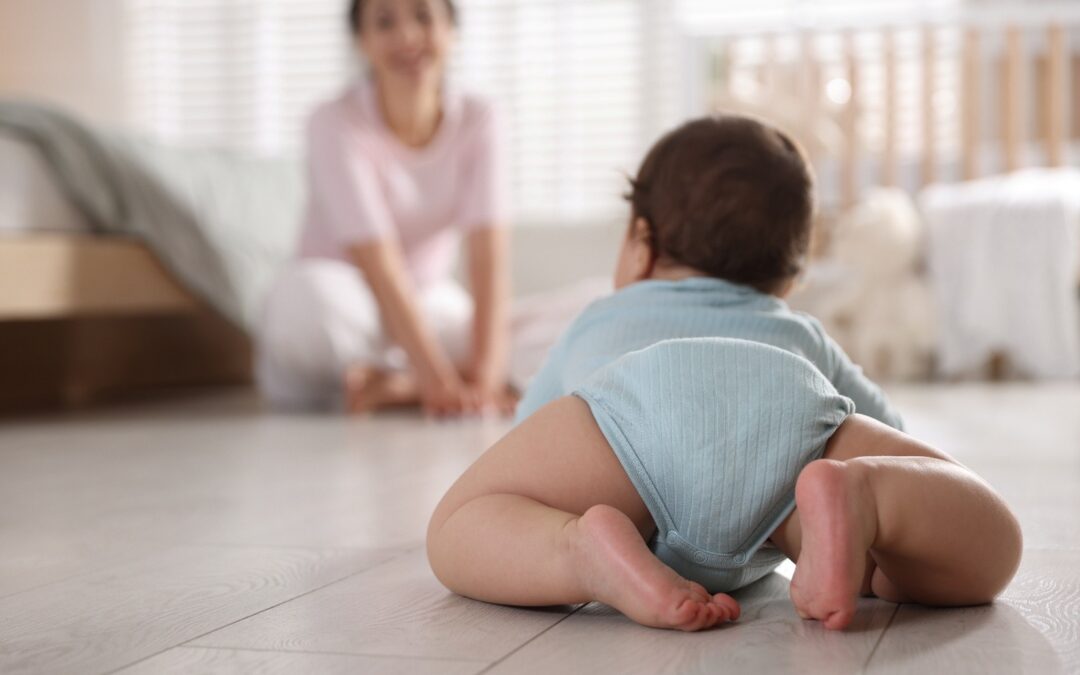
Your baby gets onto their hands and knees, rocks back and forth with impressive determination, and then…stays right where they are.
If you are wondering when do babies start crawling, many babies begin traditional hands-and-knees crawling around 7 to 10 months. Before forward movement clicks, some spend time getting into position, rocking, shifting their weight, or even moving backward.
That rocking can look like crawling is moments away, but infant movement does not come with a countdown.
Why Is My Baby Rocking on Hands and Knees?
Getting onto all fours requires your baby to support their body in a different way than sitting or lying on the floor.
Once there, rocking gives them a chance to experiment with shifting their weight forward and backward. They may stay in the position for a few seconds at first, then begin returning to it more often.
You might also see your baby reach with one hand, drop back onto their belly, sit down again, or repeat the same movement several times.
There is no need for every baby to go through a long rocking phase. Some do it frequently, while others move toward crawling in a different way.
Does Rocking Mean Crawling Is About to Start?
It may be part of the lead-up to crawling, but it does not tell you exactly when forward movement will happen. A baby might rock for days or weeks before figuring out how to move ahead. Another may barely rock at all.
Sometimes parents see a baby getting onto hands and knees and assume crawling will happen by the end of the week. Then the baby decides to spend more time sitting, rolling, or practicing something completely different.
That can be perfectly normal. Babies often work on several physical abilities at the same time.
Why Is My Baby Going Backward Instead?
Moving backward can be one of the more amusing parts of this stage. Your baby sees the toy in front of them, pushes with obvious effort, and somehow ends up farther away from it.
Early crawling attempts do not always send babies in the direction they intended. They may push backward before they figure out how to coordinate forward movement.
You might also notice sideways movement, turning in circles, or repeated attempts that cover very little distance. These early experiments can look awkward because your baby is still learning how different movements affect where they end up.
Your Baby May Choose Another Way to Move
Rocking on hands and knees does not guarantee that traditional crawling will become your baby’s main method of getting around.
Some babies move forward on their bellies. Others scoot, roll, or combine several movement styles. Your baby may even rock on all fours for a while and then decide that another method works better.
Rather than trying to convert every attempt into a classic crawl, pay attention to how your baby is becoming more mobile overall.
Give Them Space to Figure It Out
One of the most useful things you can offer during this stage is room to move.
A safe floor area gives your baby space to get onto hands and knees, rock, reach, change positions, and try again. A favorite toy or familiar person a short distance away may give them something interesting to move toward.
You do not need to repeatedly place your baby into a crawling position or guide their arms and legs through the motion. Let them experiment while you stay nearby and keep the space safe.
Sometimes the most interesting part is seeing what your baby tries when nobody is directing the next move.
What If Rocking Doesn’t Turn Into Crawling?
Not every baby who rocks on hands and knees will follow that movement with traditional crawling. Some babies use another form of mobility, and the timing of crawling can vary considerably.
Look at the broader changes in how your baby moves. Are they gaining better control? Changing positions more easily? Reaching farther or finding ways to get closer to something that interests them?
If something about your baby’s movement concerns you, talk with their pediatrician. A loss of a skill they previously had or a persistent difference in how they use the two sides of their body is also worth discussing.
Watching Emerging Movement at Celebree School of Dulles-North
At Celebree School of Dulles-North, infant teachers observe physical development throughout the day and provide age-appropriate opportunities for babies to move and explore.
A teacher may notice that your baby spent more time getting onto hands and knees, began rocking more often, or tried a new way to move across the floor.
Those observations can be shared with families without trying to predict exactly when crawling will begin. The focus stays on what each child is currently practicing and giving them safe opportunities to keep developing.
Let the Movement Take Shape
Rocking on hands and knees can be an exciting hint that your baby is experimenting with a new kind of movement. It may lead to crawling soon, or your baby may take another route.
Give them room to try, resist the urge to rush the process, and enjoy watching those early attempts become more coordinated over time.
If you are looking for daycare in Ashburn, VA, Celebree School of Dulles-North provides infants with opportunities for safe movement, exploration, and individualized development throughout the day. Schedule a visit to meet our team and learn more about infant care at Celebree.