
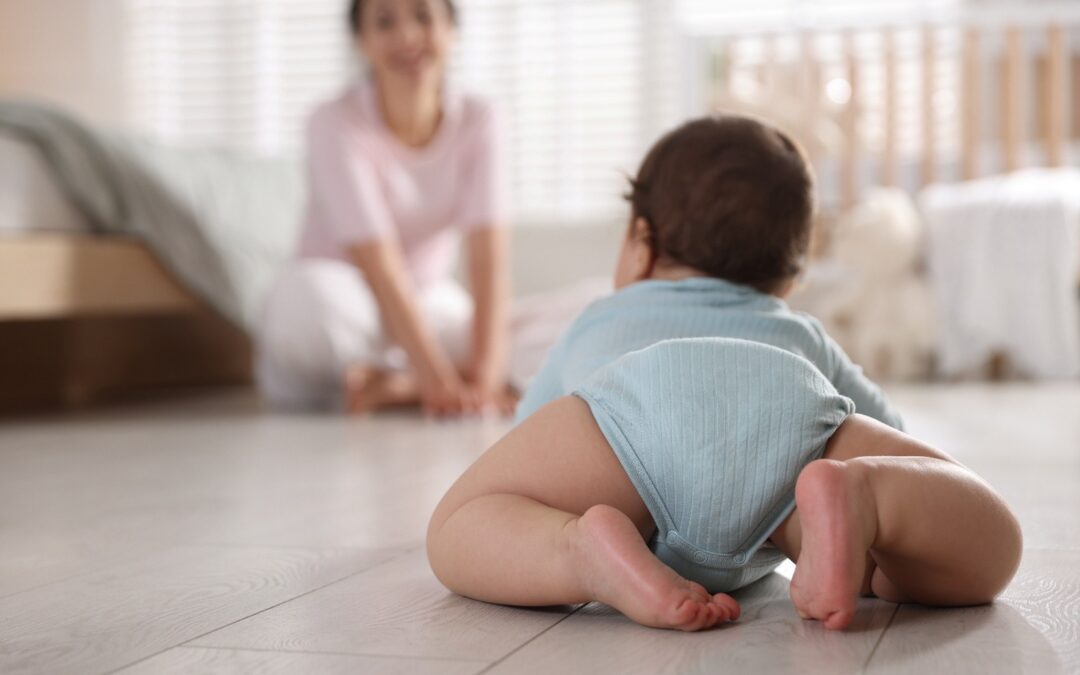
Crawling does not always look perfectly even. Your baby may move across the floor with one knee down and the other leg bent, lifted, or pushed out to the side.
That can look unusual, especially if you were expecting the classic hands-and-knees crawl. But babies can experiment with different movement patterns as they figure out balance, coordination, and how to get where they want to go.
What Does Crawling With One Leg Up Look Like?
Some babies crawl while keeping one leg in a different position from the other. You may notice one knee staying on the floor while the opposite foot pushes against the ground, or one leg doing more of the work.
The movement can still be surprisingly effective. Your baby may cover plenty of ground even though their crawl does not look symmetrical.
When Do Babies Start Crawling?
Many babies begin crawling somewhere around 7 to 10 months, but both the timing and the technique can vary.
One baby may move forward on hands and knees. Another may belly crawl, scoot, move backward, or use a one-leg crawling pattern.
So, when you are thinking about when do babies start crawling, it helps to remember that there is no single way those first trips across the floor have to look.
Why Might Crawling Look Uneven?
Babies are still learning how to shift their weight, coordinate their arms and legs, and stay balanced while moving.
A child may discover that one particular position feels easier or gets them across the floor more quickly. Once a movement works, they may repeat it.
There is usually no way for a parent to determine exactly why an individual baby has chosen a particular crawling style simply by watching it. That is why it is more helpful to notice the broader movement pattern than to try to diagnose the crawl yourself.
Should You Try to Correct the Crawl?
You generally do not need to keep repositioning your baby’s legs or force them into a traditional hands-and-knees crawl.
Instead, give your baby supervised time on the floor and plenty of room to explore. Toys placed in different directions can encourage reaching, turning, changing positions, and experimenting with movement naturally.
Let your baby work through those movements without making crawling feel like an exercise they have to perform correctly.
Watch How Both Sides of the Body Are Used
If crawling looks uneven, pay attention to how your baby moves at other times too. You might notice whether they:
- Reach with both hands
- Turn in both directions
- Change positions on their own
- Use both legs during play
- Sit and shift their weight comfortably
- Continue gaining new movement skills
Looking at the full picture can be more useful than focusing on one crawling position alone.
When Should You Ask Your Pediatrician?
A one-leg crawling style does not automatically mean something is wrong. Still, persistent one-sided movement is worth mentioning if it concerns you.
Talk with your child’s pediatrician if your baby consistently avoids using one side of the body, seems unusually stiff or floppy, loses a skill they previously had, or you notice another movement pattern that worries you.
Your pediatrician can consider what you are seeing alongside your child’s overall development.
Different Ways to Move at Day Care
Once babies become mobile, they often spend a lot of time experimenting with what their bodies can do.
At Celebree School of Cross Creek Ranch, infants have opportunities for age-appropriate physical development, gross and fine motor experiences, and everyday exploration. Teachers can also share the new movements and changes they notice with families.
For one baby, that may mean a classic crawl across the floor. For another, it may be a one-leg crawl that gets them exactly where they want to go.
If you are looking for day care in Fulshear, TX, Celebree School of Cross Creek Ranch provides responsive infant care where babies have room to move, explore, and discover new abilities at their own pace.