
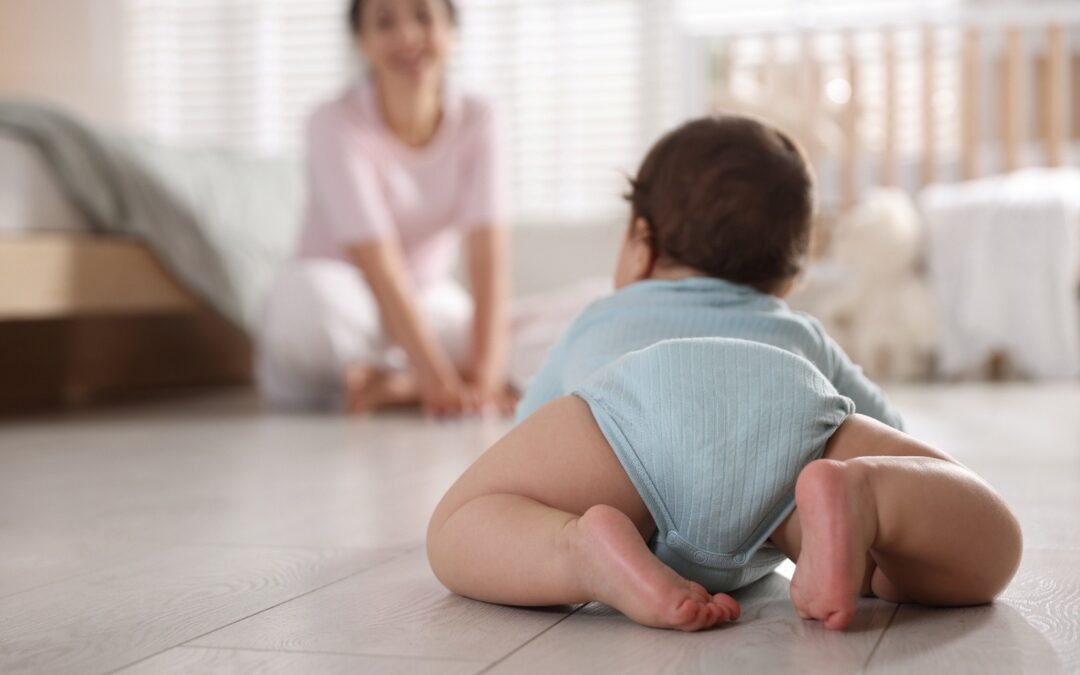
Once a baby figures out how to crawl, the movement can look surprisingly natural. Getting there, though, involves a lot of practice.
If you are wondering when do babies start crawling, many babies begin traditional hands-and-knees crawling around 7 to 10 months. Others start earlier or later, and some rely more on scooting, belly-crawling, rolling, or another way of getting around.
During this period, your baby is working on much more than simply moving from one side of the room to the other.
Crawling Takes More Coordination Than It Looks
Think about everything your baby has to manage while crawling.
They are supporting their body, shifting weight from one side to the other, coordinating their arms and legs, deciding where to go, and adjusting when something gets in the way.
Even stopping to reach for a toy requires your baby to balance while changing how their weight is distributed.
None of this appears all at once. Babies spend months gaining greater control of their bodies through everyday movement and exploration.
The Practice Starts Before Forward Movement
Long before your baby crosses the floor, you may notice them testing what their body can do.
Reaching for an object requires balance and control. Pushing up during floor play works different muscles than lying flat. Sitting gives babies another position from which to turn, reach, and shift their weight. Pivoting or changing positions helps them learn how movement affects where they end up.
These experiences do not need to follow one exact order.
One baby may spend a long time sitting and reaching before becoming mobile. Another may become determined to move across the floor while still refining other skills.
Movement Opens Up More Opportunities to Explore
Mobility changes your baby’s relationship with the room around them.
Instead of waiting for someone to bring an interesting object closer, they may be able to move toward it. They can follow a caregiver with their eyes and then try to follow with their body. A toy that once seemed too far away may suddenly become reachable.
This growing independence gives babies more opportunities to make choices about where they want to go and what they want to investigate.
Of course, it also means parents quickly discover just how interesting cords, cabinets, shoes, and other ordinary household objects can become.
Does Crawling Have to Be on Hands and Knees?
No single crawling style works for every baby.
Traditional crawling involves moving on hands and knees, but babies may also belly-crawl, scoot while sitting, roll to reach something, or use other movement patterns.
Some spend relatively little time crawling traditionally before becoming more interested in pulling up and moving while upright.
That variety matters because physical development is bigger than one recognizable crawling position.
What If Your Baby Skips Traditional Crawling?
It is understandable to wonder whether your baby is missing something if they do not crawl the way you expected.
Rather than focusing only on hands-and-knees crawling, watch the broader changes in how your baby moves. Are they gaining better control of their body? Changing positions? Reaching, shifting weight, or finding ways to move toward things?
Those observations provide useful context.
If something about your baby’s movement concerns you, talk with their pediatrician. A loss of a previously learned skill or a persistent difference in how your baby uses the two sides of their body is also worth discussing with your child’s doctor.
Give Movement Room to Develop
Babies need opportunities to use their bodies.
Supervised time on a safe floor gives your baby room to reach, roll, sit, pivot, crawl, or experiment with another form of movement. Toys, familiar faces, and interesting objects can give them something to investigate without turning movement into a lesson.
You do not have to place your baby into a particular crawling position or repeatedly direct them through a sequence. Give them space, stay nearby, and notice what they begin figuring out for themselves.
Watching Physical Development at Celebree School of Bethesda
At Celebree School of Bethesda, infant teachers observe where each child is developmentally and provide age-appropriate opportunities for movement and exploration throughout the day.
That may include time for babies to reach, change positions, move across the floor, or practice other emerging physical skills in a safe environment.
Teachers can also share observations with families as new abilities appear. One day it may be steadier sitting. Another day it could be a new way of moving toward a favorite toy.
The goal is not to hurry a baby toward crawling. It is to understand what each child is currently able to do and give them room to keep developing.
There Is a Lot Happening Behind Every New Move
Crawling may be one of the most visible changes during your baby’s first year, but it is only part of a much broader period of physical development.
Notice the small changes along the way: greater control, easier position changes, stronger reaching, and new ways of exploring. Those everyday moments can tell you a great deal about how your baby’s movement is developing.
If you are looking for daycare in Bethesda, MD, Celebree School of Bethesda provides an infant environment where babies have safe opportunities to move, explore, and grow at their own pace. Schedule a visit to meet our team and learn more about infant care at Celebree.