
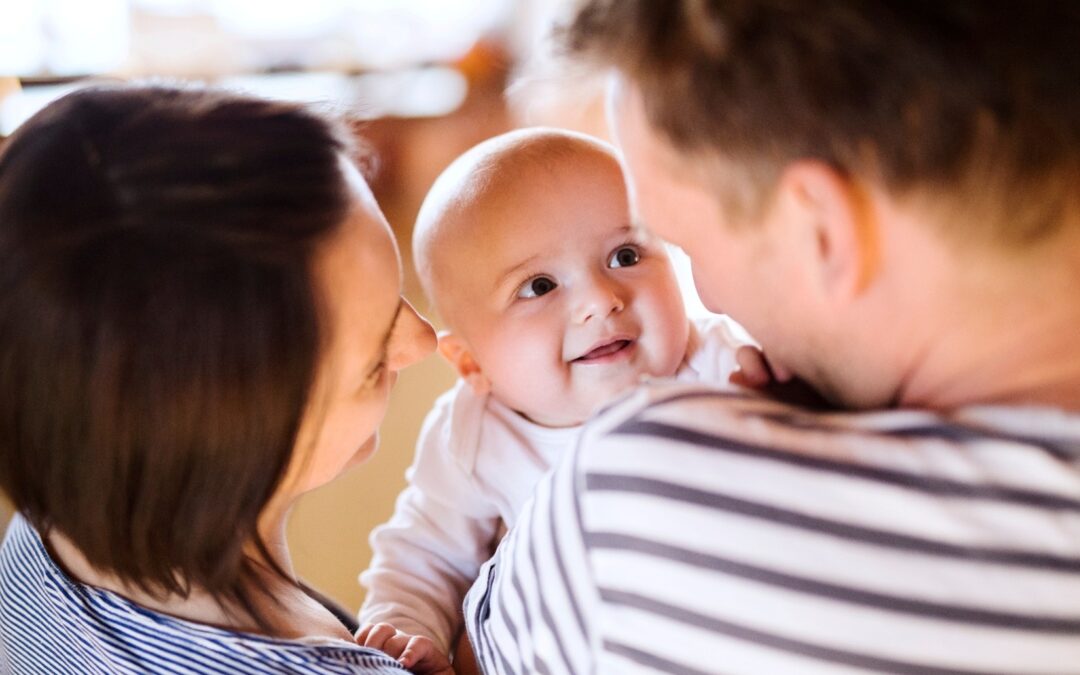
A baby’s first laugh can feel like a big change. Smiles are already exciting, but hearing a real giggle gives you a new sense that your baby is enjoying the interaction right along with you.
Laughter develops gradually during the first several months. It begins with watching faces and responding to familiar voices, then grows into smiles, chuckles, and more obvious social play. Like other baby milestones, the exact timing varies from one child to another.
When Do Babies Start Laughing?
Many babies begin chuckling around 4 months. By about 6 months, laughter is a common developmental milestone.
The difference may be subtle at first. A 4-month-old might give you a quick chuckle when you make a playful sound or expression. A couple of months later, that response may become a much fuller laugh.
Some babies are naturally more expressive than others, so laughter does not arrive on one exact date.
Smiles Come Before the First Laughs
The social changes that eventually lead to laughter begin much earlier.
Around 1 month, babies spend brief periods studying nearby faces and reacting to voices.
By about 2 months, many begin smiling when someone talks or smiles at them. They may also seem especially interested when a familiar caregiver comes close.
Around 3 months, those interactions may last longer. Your baby may watch your face closely, make sounds during quiet time together, or respond when you speak.
These early moments set the stage for more playful back-and-forth interaction.
Around 4 Months, Chuckles May Begin
By about 4 months, many babies become noticeably more interactive.
They may smile to get your attention, make sounds back when you talk, and chuckle when someone tries to make them laugh.
What gets a response can be surprisingly simple. A silly sound, exaggerated facial expression, or familiar game may be enough.
Around 5 months, those reactions may become easier to recognize. Your baby might anticipate a playful interaction and respond before you even finish it.
By 6 Months, Laughter May Be Easier to Hear
Around 6 months, many babies laugh and recognize familiar people.
They may also begin taking turns making sounds with you. You talk, your baby vocalizes, and you answer again.
Laughter often becomes part of that exchange. Instead of simply reacting to something happening nearby, babies are becoming more active participants in social interaction.
What Makes Babies Laugh?
There is no universal formula.
One baby may find a funny voice hilarious. Another might laugh when you gently bounce them, repeat a familiar sound, or play a simple game.
Repeated interactions can become especially entertaining because babies begin to recognize what is coming next.
Your baby’s sense of humor will also be entirely their own. Something that produces a huge laugh one day may barely get a smile the next.
Social Play Keeps Changing After 6 Months
During 7 and 8 months, babies often become more expressive with familiar people. They may use sounds, facial expressions, or movement to keep an interaction going.
By around 9 months, many babies look when their name is called and make repeated sounds such as “mamamama” or “babababa.”
They may also show stronger reactions when a familiar caregiver leaves or returns.
Simple games can become more interesting at this stage because babies are paying closer attention to people and familiar patterns.
Near the First Birthday, Babies Join In More
During 10 and 11 months, babies may begin participating more actively in repeated games and social routines.
A familiar phrase or gesture might prompt a smile before the activity even begins. Babies may imitate an action or use sounds and movement to signal that they want the game to continue.
By around 12 months, many wave goodbye and take part in simple interactive games such as pat-a-cake.
That is quite a change from the newborn who could only watch and listen.
Baby Milestones From Birth to 12 Months
Here is a quick look at how social interaction and other development may progress during the first year:
- 1 month: Watches nearby faces and reacts to voices
- 2 months: Smiles during interaction and makes sounds besides crying
- 3 months: May stay engaged with faces and voices for longer periods
- 4 months: Smiles for attention, makes sounds back, and may chuckle
- 5 months: Social responses and vocal play may become more varied
- 6 months: Laughs, recognizes familiar people, and takes turns making sounds
- 7 months: May become more expressive during familiar interactions
- 8 months: Repeated games and familiar voices may get stronger reactions
- 9 months: Looks when their name is called and makes repeated sounds
- 10 months: May use gestures, movement, and sounds more deliberately
- 11 months: Familiar social routines may become easier to anticipate
- 12 months: Waves goodbye and participates in simple interactive games
The months between official developmental checkpoints describe common patterns rather than requirements every baby must meet at that exact age.
Familiar Interaction at Daycare
Babies have many opportunities to practice social interaction during ordinary parts of the day. A caregiver may talk during a diaper change, respond to a baby’s sounds, or share a playful moment during floor time.
At daycare in Bear, DE, babies spend time with familiar caregivers who respond to their sounds, smiles, and growing interest in social play.
For a younger infant, that interaction may be as simple as eye contact or a quiet coo. Later, it may turn into shared laughter or a game your baby recognizes right away.
Babies Do Not All Laugh on the Same Schedule
One baby may smile often before laughing much. Another may start chuckling quickly and become very expressive during play.
Both can be developing normally.
Milestones are most useful as general guideposts. Talk with your child’s pediatrician if your baby is not meeting expected milestones, loses a skill they previously used, or if you have concerns about hearing, communication, interaction, or development.
From the first social smile to a full belly laugh, babies gain more ways to share the moment with you throughout the first year.